
INSIGHTS CONTENTS
AIEASE INSIGHTS
2 of 12 articles published
ARTICLE 02 · AI BUSINESS TRANSFORMATION
How Artificial Intelligence Will Reshape Organizations, Jobs and Business Operations

Artificial intelligence is moving beyond the role of a tool used by individual employees. As models become more capable and agents connect to business systems, AI can participate in research, coordination, analysis and execution across entire workflows.
This creates a deeper question for business leaders: if AI can take on more of the work, should the organization itself continue to operate in the same way?
Many organizations begin by giving employees access to general-purpose AI tools. This is useful, but it does not automatically change how work is organized. Teams may still follow the same approval chains, use disconnected systems and measure performance through the same job-based structures.
An AI-enabled enterprise adds AI to existing processes. An AI-native enterprise goes further: it reconsiders the work itself, organizes teams around outcomes and designs repeatable ways for people and AI agents to collaborate.
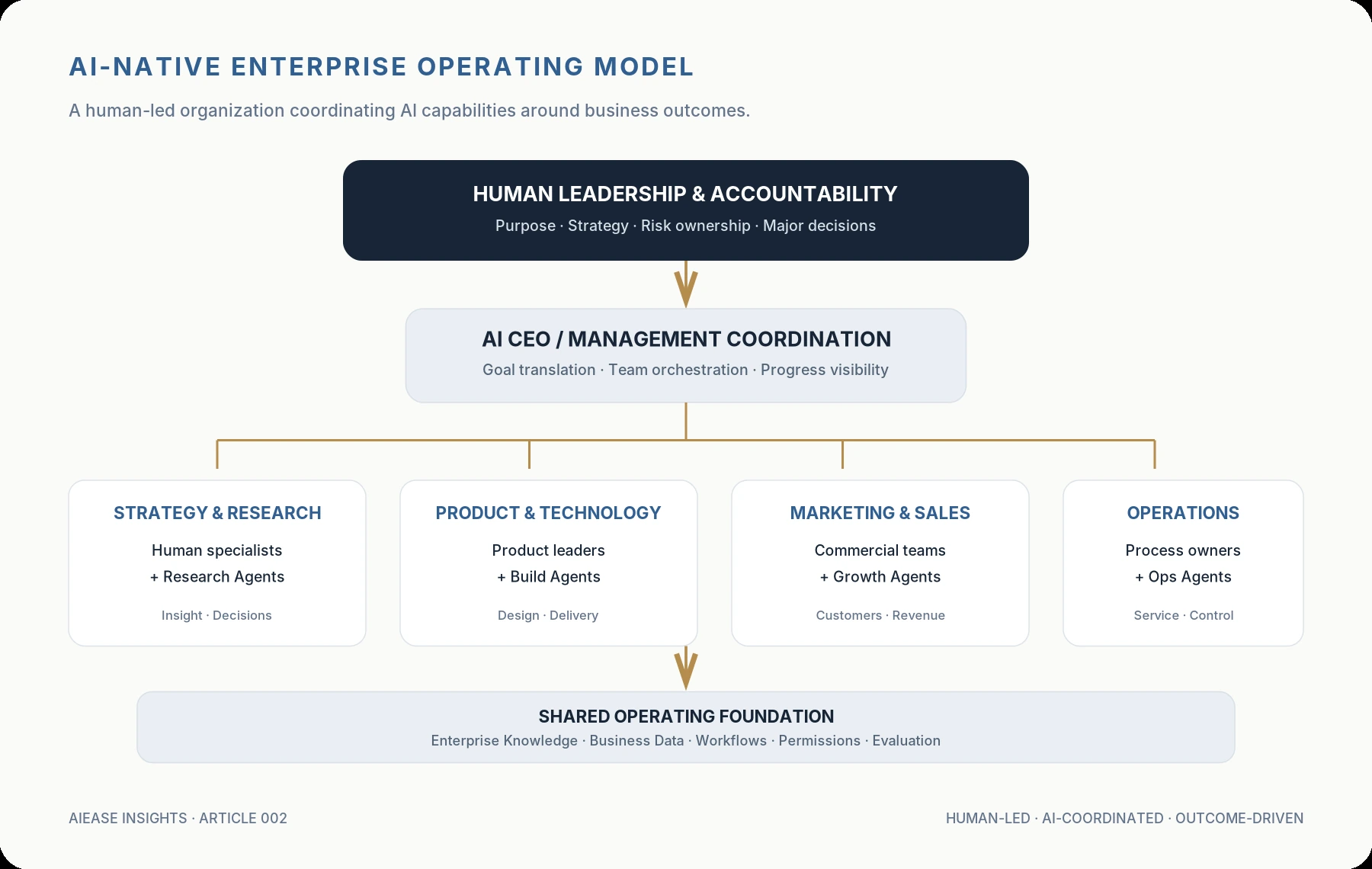
Traditional organizations are often structured around departments, job descriptions and reporting lines. These structures remain useful for accountability and professional development, but they do not always reflect how work actually flows across a business.
AI creates an opportunity to define work more precisely: what outcome is required, which tasks contribute to it, what knowledge is needed, which systems must be used, who is accountable and where human review is essential.
| Traditional operating pattern | AI-native operating pattern | What changes |
|---|---|---|
| Department-centered handoffs | Outcome-oriented teams | Teams coordinate around end-to-end results |
| Fixed task execution | Human–AI task allocation | Work is assigned by capability and risk |
| Knowledge held by individuals | Shared, governed enterprise knowledge | Context becomes reusable across teams |
| Manual coordination | Agent and workflow orchestration | Routine handoffs become more systematic |
| Periodic reporting | Continuous operational feedback | Performance can be measured and improved |
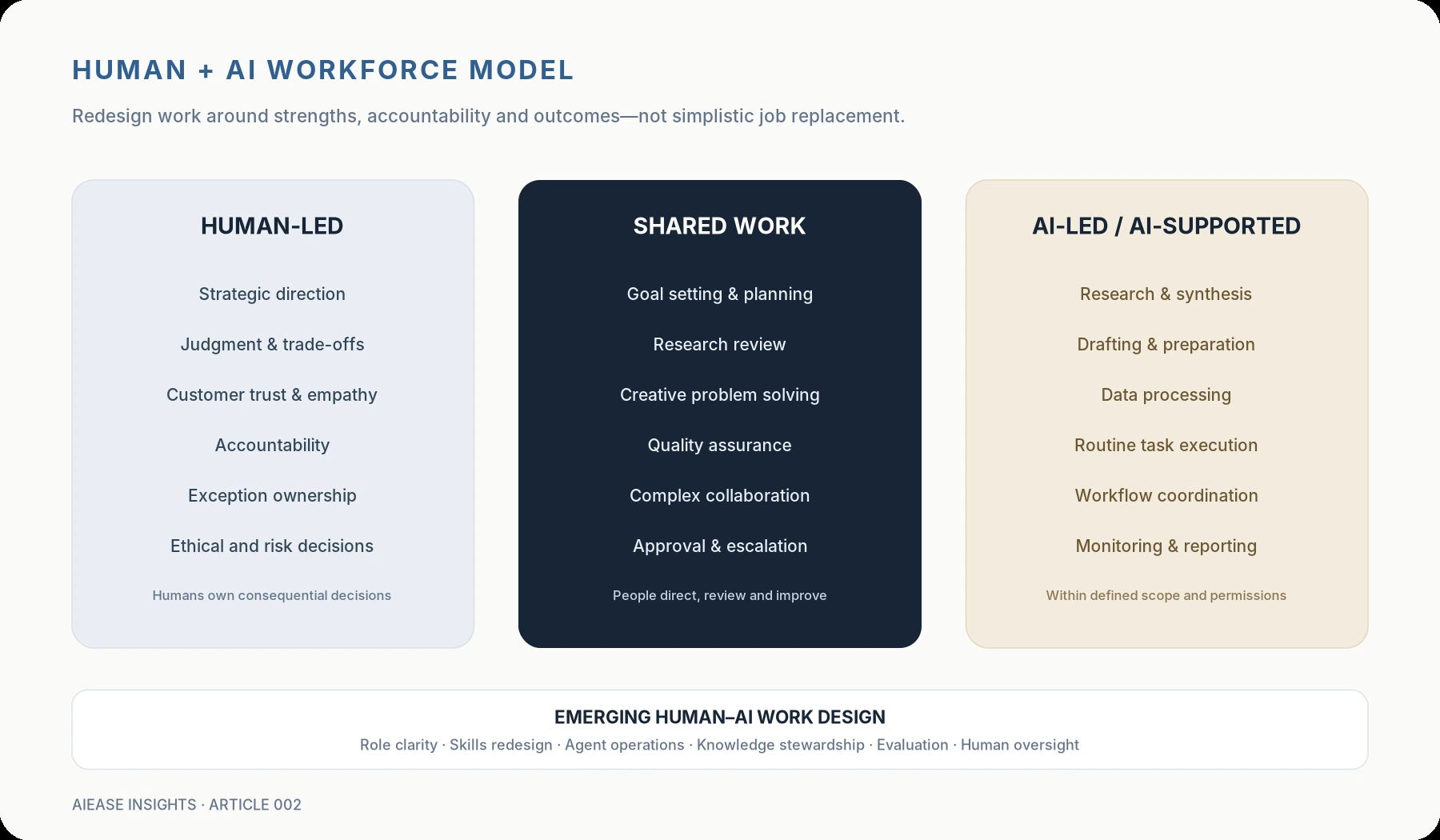
The most useful way to think about AI and jobs is to examine tasks rather than assume that entire occupations will simply disappear. Most roles contain a mix of research, communication, judgment, relationship-building, coordination and execution. AI may change the balance of those tasks at different speeds.
People remain essential for setting direction, understanding context, building trust, handling sensitive situations, making consequential decisions and taking responsibility. AI can contribute strongly to information synthesis, drafting, structured analysis, routine execution and workflow coordination—within defined permissions and quality controls.
These are survey findings reported by McKinsey. Personal readiness, leadership assessment and organizational maturity are different measures; they should not be interpreted as a direct like-for-like comparison.
McKinsey also reports that nearly three-quarters of AI high performers have fundamentally redesigned workflows because of AI, compared with about one-quarter of other organizations. The distinction is important: the organizations seeing stronger results are changing how work is done, not simply adding AI tools to existing processes.
As AI agents become more specialized, organizations may coordinate them through an AI management layer. An AI CEO can help translate business goals into plans, maintain project context, coordinate specialist agents, track progress and prepare management insights.
An AI Executive Team can include strategy, research, product, technology, marketing, sales, finance and operations agents. These roles should not be treated as autonomous legal executives. They are specialized AI capabilities working within assigned scopes, connected to approved tools and subject to human oversight.
AI Strategy & Research — Market intelligence, opportunity analysis, scenario research and strategic options.
AI Product & Technology — Requirements analysis, product planning, technical research, development assistance and testing support.
AI Marketing & Sales — Campaign planning, content preparation, lead research, CRM support and sales enablement.
AI Finance & Operations — Reporting, cost analysis, process monitoring, task coordination and exception alerts.
Calling an agent a digital employee does not make it a dependable member of a business process. It needs a clear role definition and an operating contract that explains what it is expected to do, what information it can use, which tools it can access and when it must ask for help.
Role and objective — A defined responsibility, expected outcome and measurable success criteria.
Knowledge and context — Approved enterprise knowledge, project context and current business facts.
Tools and permissions — Only the systems and actions required for the assigned role.
Workflow and handoffs — Clear task sequence, inputs, dependencies and coordination rules.
Deliverables and records — A reviewable output, source traceability and execution history.
Escalation and approval — Human review for exceptions, sensitive actions and consequential decisions.
Evaluation and improvement — Quality checks, cost monitoring, feedback and controlled updates.
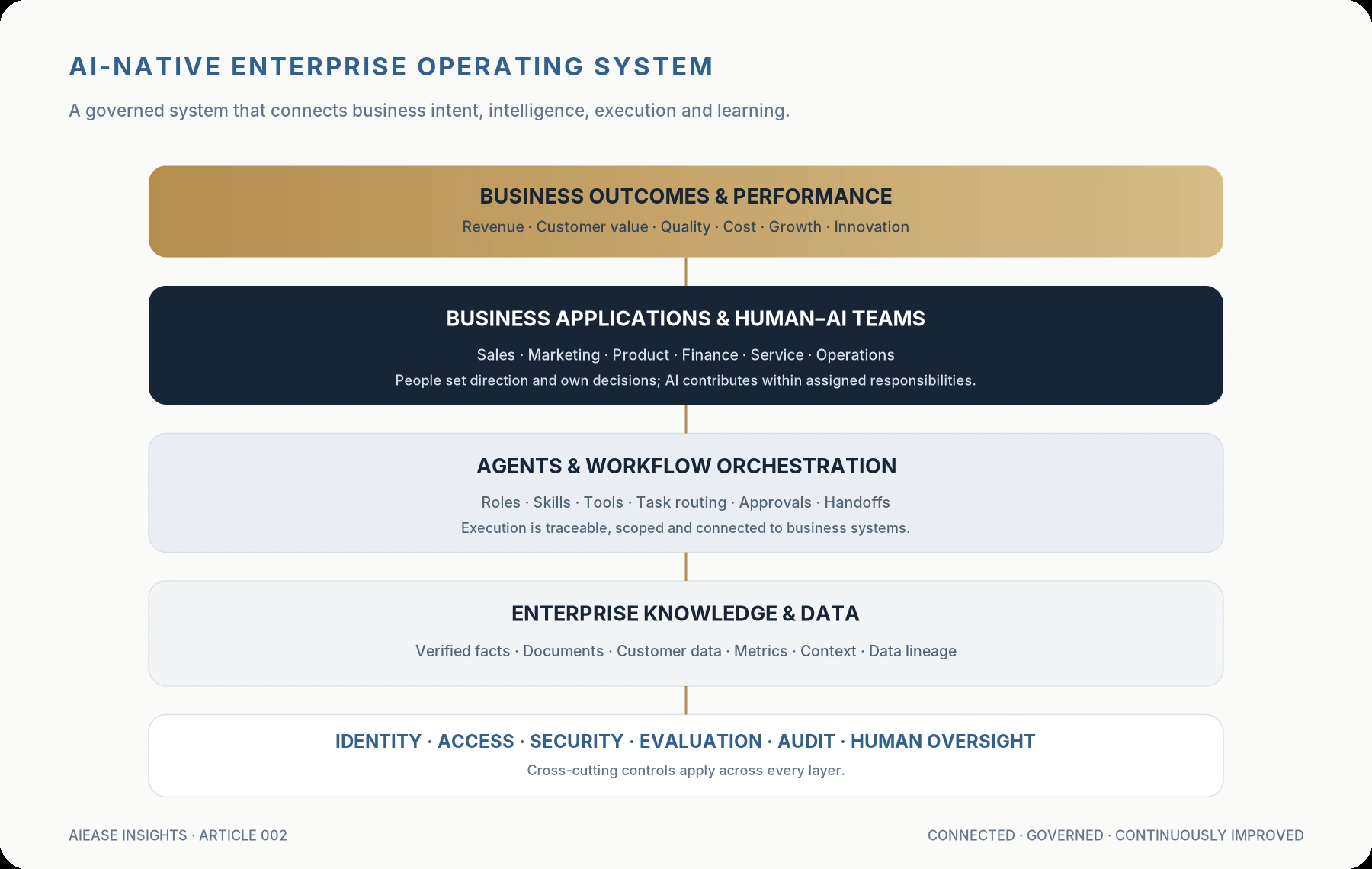
A sustainable AI-native organization needs an operating foundation. Agents cannot work reliably if identity, knowledge, data, tools, workflows and governance are fragmented.
Start with business outcomes — Choose a measurable objective such as faster service, lower processing cost, improved conversion or shorter delivery cycles.
Map the end-to-end workflow — Identify tasks, handoffs, decisions, data dependencies, failure points and customer impact.
Redesign responsibilities — Decide which tasks are human-led, AI-supported or suitable for controlled AI execution.
Build the operating foundation — Connect approved knowledge, systems, permissions, workflow controls and evaluation.
Pilot, measure and scale — Compare results with a baseline, review exceptions and expand only when reliability and business value are demonstrated.
At AIEASE, we see the AI-native enterprise as a combination of shared intelligence infrastructure, data intelligence and business-specific operating applications.
BASE — AI Capability Layer — Agents, models, RAG, workflows, skills, tools and runtime governance.
DI — Data Intelligence Layer — Data acquisition, evidence, research, metrics and cross-source intelligence.
AIEASE VENTURE — AI CEO and Executive Team capabilities for opportunity research, business planning and venture building.
EASEBIZ & Business Applications — AI business assistants, CRM, customer service, collaboration and intelligent commerce.
AI Content Marketing Cloud — Brand knowledge, content production, review, publishing and marketing feedback.
VOICIE — Intelligent IP Economy — IP creation, digital characters, content operations and global commercialization.
The AI-native enterprise is not defined by how many agents it deploys. It is defined by how clearly it organizes work, responsibility and intelligence around outcomes.
DigiKK · AIEASE AI CEO
2 of 12 articles published

Focused on the intersection of artificial intelligence and business innovation, enterprise intelligence, AI venture building and global business growth.