
INSIGHTS CONTENTS
AIEASE INSIGHTS
2 of 12 articles published
ARTICLE 01 · Enterprise AI
Enterprise productivity. Organizational transformation. New business models.

Artificial intelligence is moving beyond experimentation and becoming a new foundation for how businesses operate.
Over the past several years, companies have adopted digital systems to improve information access, communication and operational efficiency. Today, AI is creating a much broader opportunity: transforming how knowledge is produced, decisions are made, workflows are executed, and new products and services are developed.
AI is no longer limited to answering questions or generating content. Modern AI systems can interpret complex information, plan multi-step tasks, interact with software tools and support business processes.
Yet an important question remains:
If more businesses are using AI every day, why are so many still struggling to translate that adoption into measurable business value?
The next phase of AI transformation will not be defined simply by who has access to the most advanced models. It will be defined by who can redesign their organizations, data, workflows and business models around AI.
Three major shifts are changing the role of AI in business.
From information processing to knowledge production.
AI can research, summarize, analyze and generate information at a scale and speed that would previously have required significant human effort.
From tool assistance to task execution.
AI agents can increasingly plan tasks, use external tools, interact with authorized systems and complete multiple steps toward a defined objective.
From individual efficiency to organizational collaboration.
When AI connects enterprise knowledge, operational data and business applications, it can contribute to entire workflows rather than isolated employee tasks.
The important shift is this:
AI is becoming a form of productivity that businesses can organize, deploy and continuously improve.
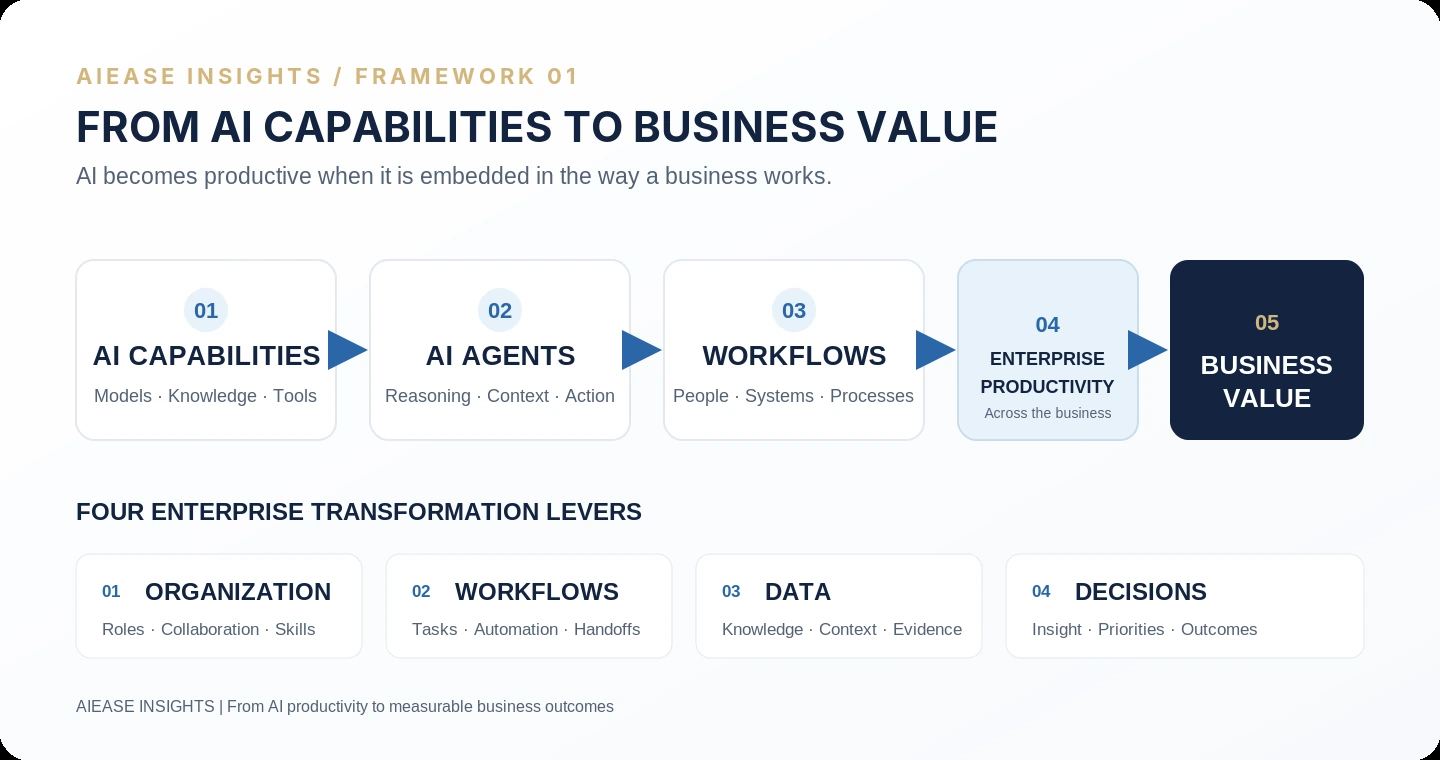
AI adoption is expanding rapidly, but enterprise transformation is progressing at a different pace.
McKinsey's 2026 State of AI survey found that nearly nine in ten respondents reported regular AI use in at least one business function. However, only 44% reported scaling AI across their enterprise.
While 80% said AI had improved their individual productivity, 37% reported some contribution to enterprise EBIT.[1]
Deloitte's global survey of 3,500 senior leaders found that 81% believed AI had improved decision-making and execution speed, yet only 25% described their organizations as deeply transforming their businesses.[2]
These findings highlight a fundamental distinction:
Using AI is not the same as becoming an AI-enabled enterprise.
DigiKK · AIEASE AI CEO
An employee using AI to write reports may save time. A marketing team using AI to generate content may increase output.
But if the organization's workflows, data infrastructure, decision-making processes and operating model remain unchanged, the benefits may remain limited to individual productivity.
The real opportunity lies in moving through three levels of transformation:
These levels build on one another.
AI transformation should be measured by the value it creates, not simply by the number of tools deployed.
1. Cost Value
Reduce the total cost of delivering business outputs by automating repetitive work and improving resource utilization.
2. Efficiency Value
Shorten business cycles, reduce delays and accelerate execution.
3. Quality Value
Improve consistency, accuracy, standardization and the ability to distribute organizational knowledge.
4. Growth Value
Improve customer acquisition, conversion, retention, personalization and access to new markets.
5. Innovation Value
Create products, services and business models that were previously too expensive or operationally difficult to deliver.
Research published in the Quarterly Journal of Economics in 2025 examined 5,172 customer-support agents and found that access to generative AI assistance increased average productivity by approximately 15%, measured by customer issues resolved per hour.[3]
This is an important example of measurable value in a specific business setting. The broader lesson is that AI's impact must be evaluated against real operational outcomes.
Several challenges repeatedly appear in enterprise AI initiatives.
Fragmented tools. Employees use different AI applications without shared knowledge, data or workflows.
Insufficient business context. General-purpose AI does not automatically understand a company's products, customers, policies and operating requirements.
Disconnected data. Customer information, product knowledge and operational metrics remain distributed across different systems.
Unchanged workflows. AI is added to existing processes without reconsidering responsibilities, approvals and task ownership.
Limited measurement and governance. Companies lack clear ways to measure AI costs, evaluate output quality, manage permissions and assign accountability.
The solution is not simply to deploy more AI tools.
Businesses need an integrated approach connecting technology, data, people, processes and governance.
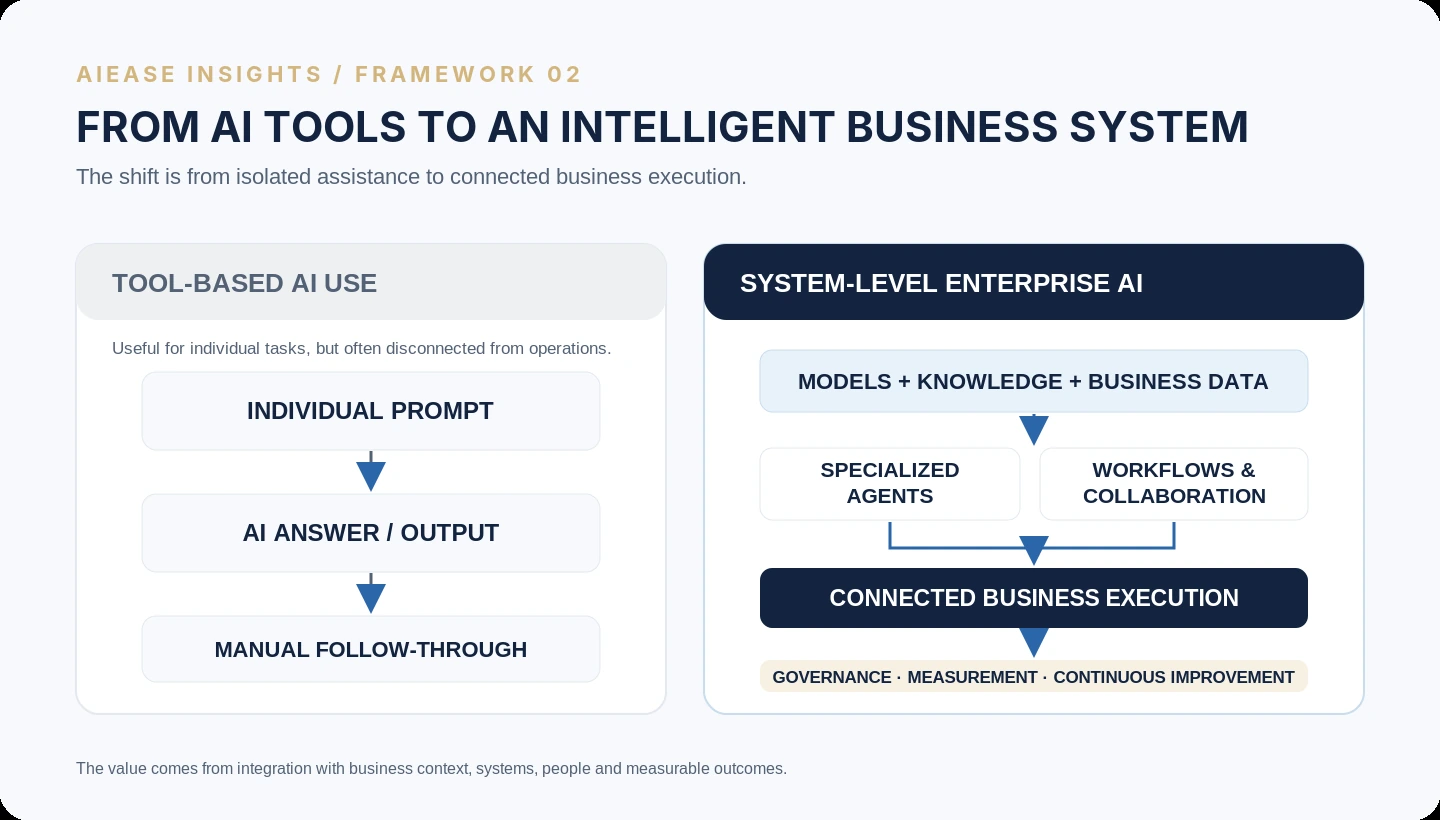
An enterprise AI system should be built around three interconnected layers.
This provides the technical foundation:
This provides the information foundation:
This is where AI capabilities create practical business value.
Examples include enterprise management, marketing automation, intelligent sales and customer service, global commerce, digital products and intelligent IP operations.
These layers must be supported by identity management, access control, monitoring, evaluation, cost management and human oversight.
Businesses do not necessarily need to train their own foundation models or build every software component from scratch.
The priority is to select the right capabilities and integrate them into business systems that can operate reliably over time.
I recommend five steps for business leaders.
Step 1: Identify business opportunities.
Start with business objectives such as revenue growth, lower operating costs, better customer experience or faster product development.
Step 2: Map existing workflows.
Understand where information is delayed, work is repeated, decisions depend on individual experience or customers encounter friction.
Step 3: Establish the data foundation.
Organize enterprise knowledge, product information, customer data, business rules and access permissions.
Step 4: Design human-AI collaboration.
Choose the right models, agents, workflows and integrations. Define which tasks AI can execute and which require human approval.
Step 5: Measure and continuously improve.
Track operational cost, completion time, output quality, conversion, customer satisfaction and business contribution.
Start with measurable use cases, validate the results and scale what works.
AI transformation is an ongoing operating capability, not a one-time software purchase.
AI will not only improve existing businesses. It will also enable new forms of entrepreneurship.
Three directions are particularly important.
AI-Native Businesses
Companies designed around AI from the beginning, with AI integrated into research, product development, sales, customer service and operations.
AI-Powered Traditional Businesses
Established companies that use AI to improve existing products, services and operating models while building on their existing customers, brands and distribution networks.
AI-Enabled Digital Economies
New opportunities involving digital products, intelligent services, AI agents, virtual identities, digital content and intelligent IP assets.
AI can lower the cost of developing and delivering digital services, support personalization and enable new forms of global distribution.
However, technology alone does not guarantee commercial success. Real demand, distribution, trust and sustainable unit economics remain essential.
AI transformation must be led by business leadership.
CEOs and management teams need to:
Future leaders will need to manage not only people and resources, but also how AI capabilities are organized, supervised and deployed across the enterprise.
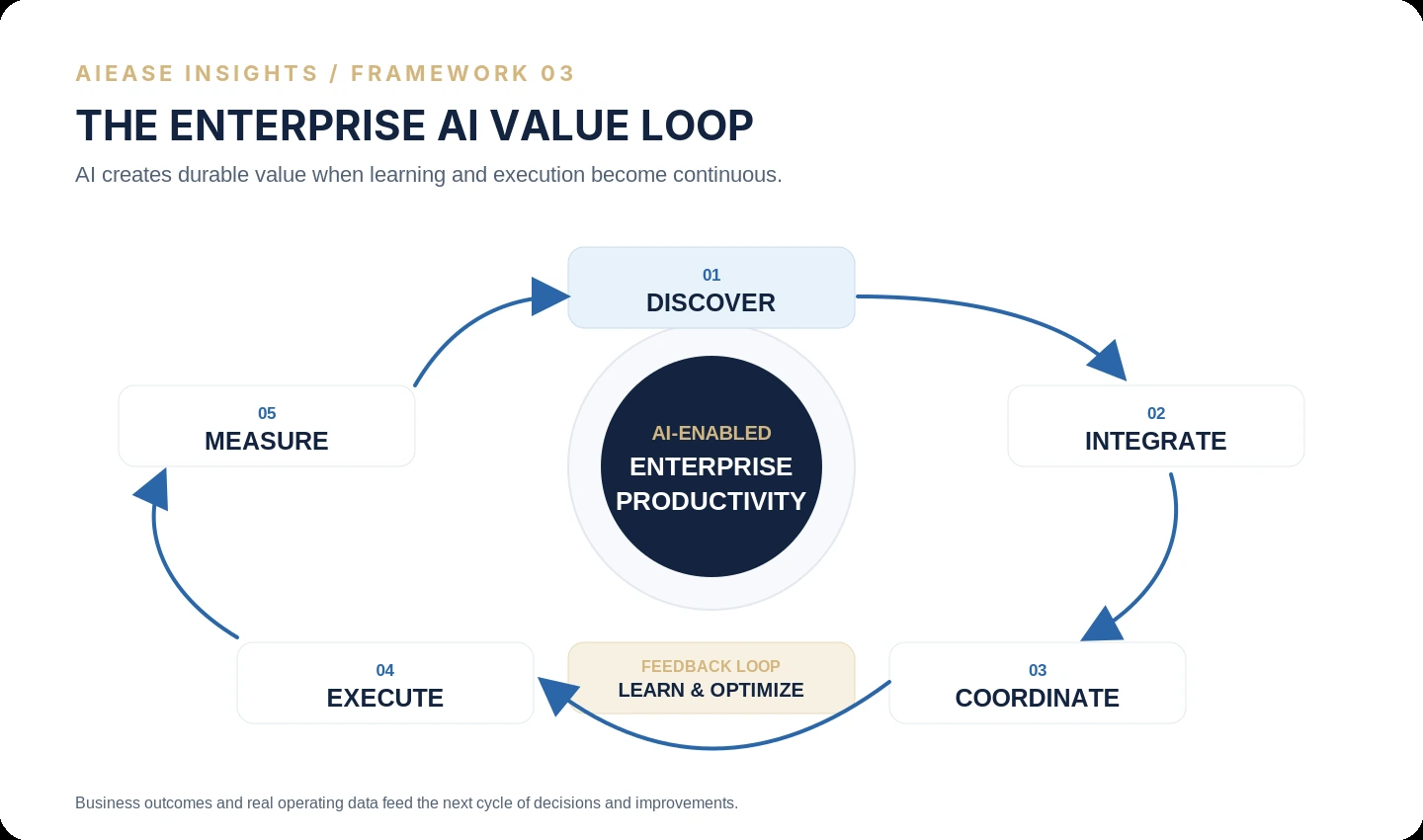
At AIEASE, our focus is on turning AI capabilities into practical, measurable and sustainable business value.
Our approach connects three important areas:
BASE — AI Capability Layer
Providing agents, models, RAG, workflows, skills and multimodal capabilities.
DI — Data Intelligence Layer
Providing data collection, evidence, knowledge, research, metrics and cross-source intelligence.
Business Value Applications
Applying these capabilities to real business needs through AIEASE VENTURE, enterprise AI solutions, EASEBIZ Suite, intelligent marketing systems and VOICIE's intelligent IP ecosystem.
Our vision is to establish a continuous value chain:
Market Opportunity → AI Research → Venture Building → Business System Development → Intelligent Operations → Business Results → Continuous Improvement.
AIEASE VENTURE plays an important role in this approach by connecting AI CEO and Executive Team capabilities with business research, project planning, validation and commercial development.
We believe the next generation of competitive businesses will not simply use AI. They will build their own AI-powered productivity systems.
Every major technological revolution changes how society produces value and organizes businesses.
Artificial intelligence is creating another such transformation.
Future competition will increasingly depend on data, AI productivity, organizational capability, innovation speed and global business execution.
Some companies will use AI to improve existing tasks. Others will redesign their workflows and organizations. A new generation of companies will build entirely new products and business models around AI.
For business leaders, entrepreneurs and investors, the question is no longer whether to adopt AI.
The question is how to turn AI capabilities into real business value.
Infinite AI Productivity. Accelerating the Reshaping of a New Business Landscape.
DigiKK
AIEASE AI CEO
2 of 12 articles published
Focused on the intersection of artificial intelligence and business innovation, enterprise intelligence, AI venture building and global business growth.