Over the past several years, AI investment has expanded from algorithm research, cloud computing and data infrastructure to generative AI, foundation models and agents. Capital markets increasingly view AI as a new general-purpose technology platform, while enterprises are reassessing how research, production, marketing, sales, service and management should work.
But technological momentum does not automatically translate into investment returns. Better models do not guarantee that customers will pay; larger funding rounds do not prove that a business model works; and building compute capacity or data centers does not guarantee sufficient utilization. Investment analysis must distinguish technical progress, capital deployment, industrial adoption and actual economic value.
AI investment is entering a second phase. Competition is shifting from technical leadership alone toward industry use cases, customer relationships, data assets, workflow access, delivery capabilities and long-term operating outcomes. Businesses that embed AI into real work have a stronger opportunity to build durable advantages.
AI investment is expanding, with capital concentrating in core capabilities and industrial applications
$258.7BGlobal venture capital invested in AI firms in 2025OECD
$109.3B2025 VC investment in AI infrastructure and hostingOECD
OECD's VC data and Stanford AI Index's corporate AI investment use different definitions and should not be added or directly compared. China's AI industry scale is an industry measure, not a funding total.
01. AI Investment Is Entering a New Cycle: From Technical Breakthroughs to Industrial Value
AI investment did not begin today. Earlier capital built chips, cloud computing, data centers, foundational software, research teams and model ecosystems. The spread of generative AI has allowed these accumulated capabilities to reach enterprises and consumers through more direct product experiences.
OECD analysis of global venture capital in 2025 found that AI firms attracted about US$258.7 billion, representing 61% of global VC. AI infrastructure and hosting alone attracted about US$109.3 billion. This shows AI's importance in venture allocation, but also the concentration of capital in large transactions and infrastructure projects.
The Stanford 2026 AI Index uses a broader measure of corporate AI investment and reports about US$581.7 billion globally in 2025, including approximately US$344.7 billion in private investment and other activity such as M&A. This is not the same measure as OECD's AI-company VC data. Definitions must be understood before comparing growth trends.
The investment logic is changing. The first phase focused on building AI capability. The next phase must prove that these capabilities can generate frequent use, clear willingness to pay, repeatable deployment and durable customer relationships. Investors and founders need to move from asking what technology can do to understanding why customers will keep buying it.
02. Understand the AI Investment Value Chain: Capital Goes Beyond Models
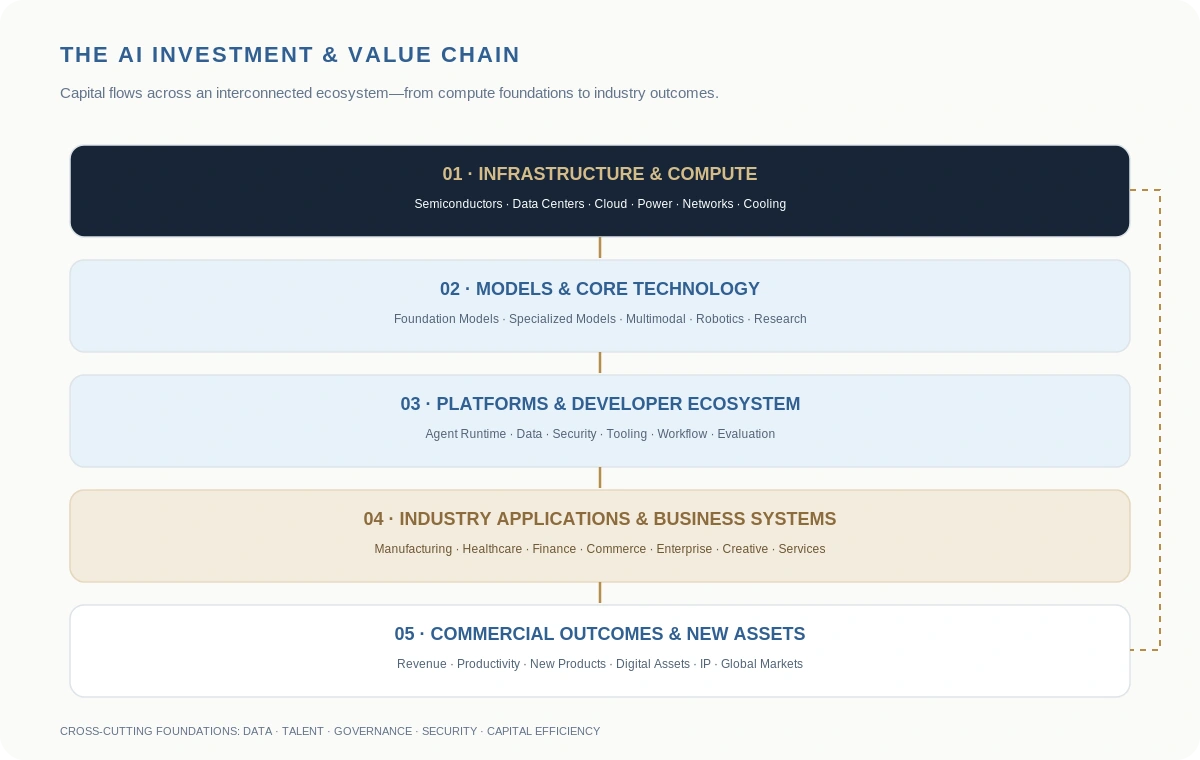
AI is not a single industry. It is a value chain spanning infrastructure, core technology, platforms and tools, industry applications and commercial services. Each layer has different capital requirements, technical barriers, revenue cycles, economies of scale and risk profiles.
The AI Investment & Value ChainCapital flows from compute infrastructure and models through platforms and industry applications toward commercial outcomes. Data, talent, security governance and capital efficiency cut across every layer.AIEASE INSIGHTS · DigiKK
Investment Layer
Typical Areas
Capital Characteristics and Questions
Investment Layer
Typical Areas
Capital Characteristics and Questions
Infrastructure
Chips, servers, data centers, cloud, networks, power and cooling
Capital intensive and long-cycle; utilization, power, depreciation and supply chains matter
Models and Core Technology
Foundation models, industry models, multimodal AI, inference, robotics and research
High R&D needs; differentiation, training cost, inference efficiency and recurring revenue matter
Platforms and Tools
Agent runtime, data platforms, security, developer tools, evaluation and workflows
Developer ecosystem, integration depth, usage frequency and platform stickiness matter
Industry Applications
Manufacturing, healthcare, finance, retail, education, enterprise operations and professional services
Business pain, willingness to pay, delivery time and repeatability matter
Commercial Businesses and Assets
AI-native ventures, digital products, brands, IP, content and global services
Customer relationships, distribution, IP rights, repeat purchases and long-term cash flow matter
Upstream layers often require larger fixed capital and longer investment horizons. Downstream businesses are closer to customers and workflows, but may face fragmented industries, integration complexity and delivery costs. Investors must understand the economic structure of the layer they are funding, not just its market size.
03. Where Is Capital Flowing? Five Opportunity Areas to Watch
The first area is AI infrastructure. Chips, servers, data centers, cloud services, networks, power and cooling form the compute supply system. The IEA expects major data center operators globally to spend more than US$700 billion in capital expenditure in 2026, mostly on new data centers. This signals a major infrastructure cycle, but it does not mean every project will earn an attractive return.
The second area is models and core technology. General-purpose models, multimodal models, inference efficiency, on-device models, industry models and robotics remain strategically important. But technical leadership requires continuous investment. Companies must show how capability becomes developer adoption, enterprise contracts, API revenue or sustainable products.
The third area is enterprise platforms and agent infrastructure. Organizations need to connect models, knowledge, data, tools, workflows, permissions and evaluation. Agent runtimes, data governance, security, connectors, workflows and evaluation systems are becoming important foundations for scaling enterprise AI.
The fourth area is vertical industry applications. Manufacturing, supply chains, healthcare, finance, legal services, retail, education, construction, energy and professional services contain deep domain knowledge and workflow barriers. General models provide capabilities; commercial opportunities emerge when those capabilities become usable, verifiable and deployable industry solutions.
The fifth area is AI-native businesses and digital assets. AI can lower the cost of creating and operating digital products, content, brands, virtual services and IP. The opportunity is not one-off content generation. It is the ability to build brands, customer relationships, intellectual property, memberships, digital products and sustainable operating channels.
04. Infrastructure Investment: AI Growth Depends on Compute, Power and Utilization
AI infrastructure has become a strategic global investment area. UNCTAD's 2026 World Investment Report states that announced greenfield investment in five strategic sectors reached US$576 billion in 2025, or 44% of global greenfield investment. AI infrastructure was the largest segment, with about US$341 billion in announced projects. The five sectors also include semiconductors, energy-transition technologies, critical minerals and other advanced technologies.
Infrastructure returns depend on more than construction scale. Data centers need reliable power, networks, land, cooling equipment, chip supply and committed customers. Projects must also manage equipment depreciation, technology cycles, financing costs, grid capacity, permitting and changing customer demand.
Infrastructure investors should assess long-term utilization, customer contract quality, power availability, capital expenditure and operating costs. Overbuilding can create stranded assets, while insufficient capacity can constrain AI adoption. Supply and demand must be evaluated directly rather than extrapolating returns from sector enthusiasm.
For industrial parks and local governments, compute infrastructure should align with local power, industrial demand, talent, networks and suppliers. A data center alone is not an industrial ecosystem. Durable regional value requires links to model services, software developers, industry applications, research institutions and customers.
05. Industrial Innovation: AI Enters Production, Supply Chains and Business Operations
AI's industrial value is expanding from office assistance into research and design, manufacturing, equipment maintenance, quality inspection, supply-chain scheduling, energy management, marketing, sales, customer service and enterprise decision-making. Industrial innovation is not placing a chatbot inside a factory; it is coordinating AI with equipment, data, workflows, people and management systems.
In manufacturing, AI can help engineers analyze design materials, suggest process improvements, detect equipment anomalies, predict maintenance needs, inspect product defects, optimize scheduling and organize quality records. Each use case must be validated against the production environment, equipment interfaces, process constraints, data quality and safety requirements.
In RSM's 2026 survey of 129 manufacturing respondents, 88% said AI was at least partially integrated into their organizations, while 32% reported full integration across core operations and processes. Another 84% expected to increase AI investment in the next fiscal year. These findings describe the surveyed organizations and should not be treated as a universal adoption rate for manufacturing.
A separate study by Augury and IndustryWeek surveyed 501 manufacturing professionals in the United States and Europe. It found that 83% of surveyed manufacturers planned to increase AI investment in 2026, while the share scaling AI across more than half of their facilities rose from 14% to 42% year over year. The study also identified data quality, operational barriers and unclear ROI as major scaling challenges.
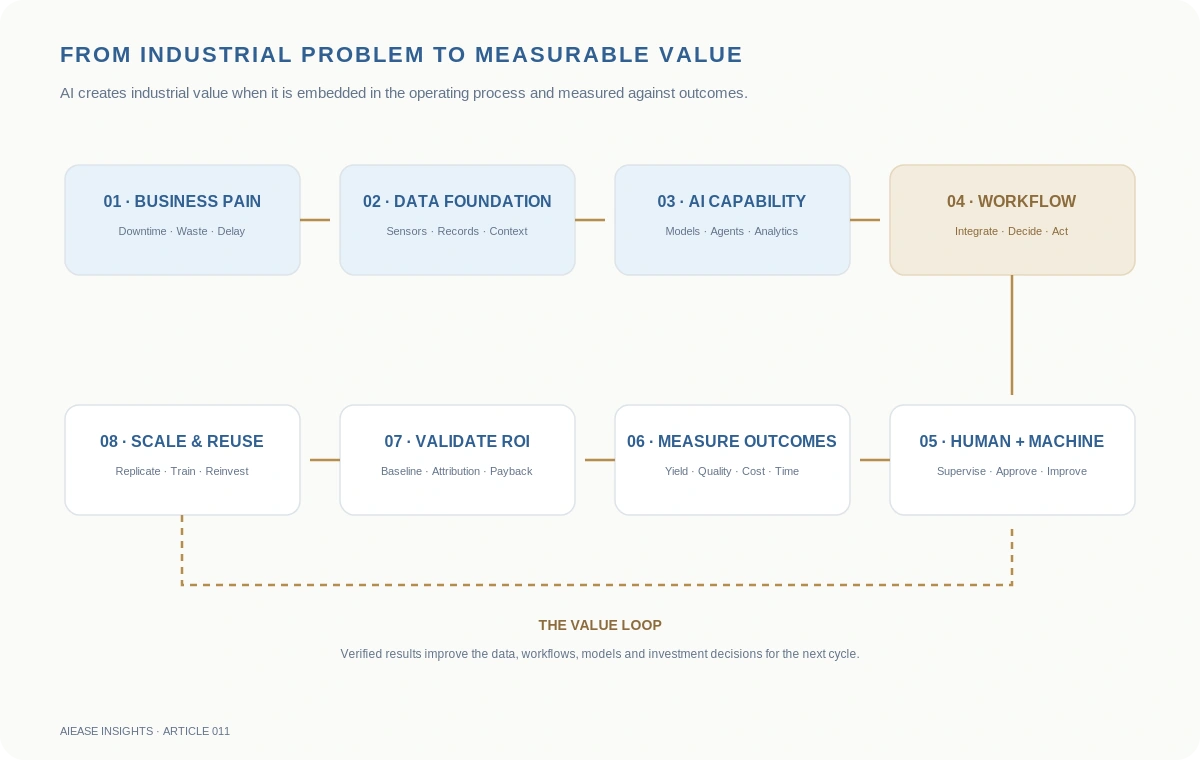
From Industrial Problem to Measurable ValueIndustrial innovation begins with a business problem, builds a data foundation, applies AI, integrates the workflow, combines human and machine judgment, validates ROI and creates a continuous improvement loop.AIEASE INSIGHTS · DigiKK
This means industrial AI value is not defined by model accuracy alone. It depends on whether the system can enter real production workflows and reduce downtime, waste, rework and management cost while improving quality, capacity, delivery and customer experience.
06. From Selling AI Tools to Operating AI Businesses: Business Models Are Changing
AI businesses are adopting a wider range of revenue models. Seat-based SaaS remains relevant, but AI products may also charge by usage, task volume, compute consumption, business outcome, deployment service or ongoing operations. Each model creates different requirements for cost, customer relationships, margins and scalability.
Business Model
Typical Pricing
Investment Questions
Business Model
Typical Pricing
Investment Questions
Subscription software
Per user, organization or feature tier
Renewal, seat expansion, product stickiness and service cost
Usage-based AI service
Per token, call, task or generation
Inference cost, gross margin, usage volatility and customer budgets
Industry solutions
Per project, module, site or business scope
Delivery efficiency, industry reuse, integration cost and acceptance cycle
FDE / dedicated deployment
Discovery, engineering delivery, deployment and ongoing services
Project margin, knowledge transfer, reusable components and customer dependency risk
Outcome-oriented services
Based on cost savings, conversion improvement or task completion
Attribution, baselines, data verifiability and accountability
AI-native businesses
Products, memberships, transactions, licensing, IP and digital assets
Customer acquisition, repeat purchases, brand, distribution and long-term asset value
For enterprise AI, a software license alone may not cover business discovery, data preparation, system integration, permission governance, employee training and continuous optimization. FDE brings engineering into real business environments, but if every customer project is built from scratch and nothing is reusable, the business can become an inefficient customization outsourcing model.
A healthier model turns recurring needs into platforms, modules, connectors, industry templates, agents, skills and evaluation methods, while customizing only the workflows, data structures and permissions that are unique to each customer. This preserves business differentiation while improving delivery efficiency and margins over time.
07. AI-Native Companies: Investing in the Next Generation of Business Organizations
An AI-native company is not a traditional company with a few AI tools added. It designs AI, agents, data and automation into its operating model from the beginning. Product development, market research, content production, sales support, customer service, operating analysis and internal management can be carried out through human-agent collaboration.
This may change the capital structure of startups. Building a global business traditionally required larger teams, specialist departments and long organizational build-out cycles. AI can reduce some costs in research, content, customer service, software development and operating automation, allowing smaller teams to validate markets earlier. It does not automatically solve customer acquisition, product quality, supply chains, trust or cash flow.
Promising AI-native companies usually have a clear target customer, a high-value problem, recurring product use, effective customer acquisition and business data, brands or intellectual property that accumulate over time. AI improves production efficiency, but the business still needs to own its customers and market.
Investors should also be cautious about AI-wrapped startups: products that place a general model behind a simple interface without proprietary data, workflows, distribution or customer relationships. Such products can be displaced by model providers or more mature applications. Durable defensibility must come from accumulated business advantages, not merely prompts and interfaces.
08. How Should Investors Evaluate an AI Company?
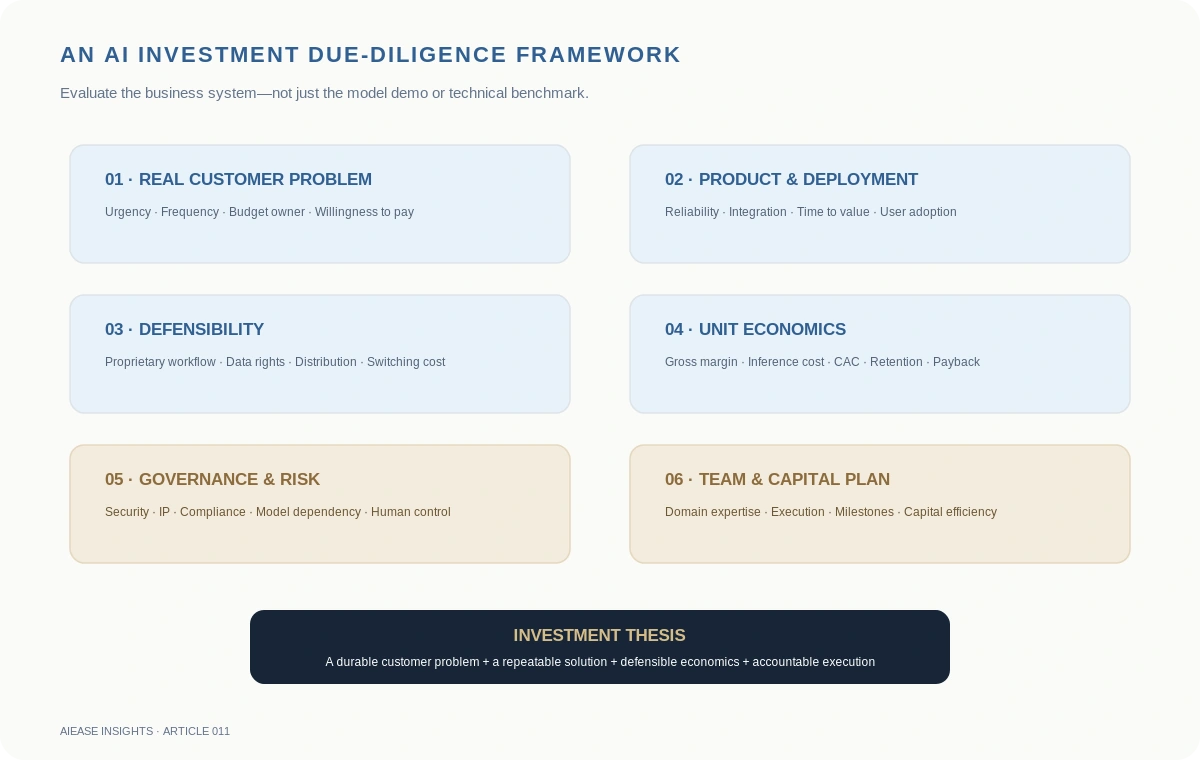
Due diligence on an AI company cannot rely only on model demos, technical leaderboards, funding headlines or founder credentials. It must assess customer problems, product capability, delivery, unit economics, technology dependencies, data rights, intellectual property, governance and capital efficiency.
An AI Investment Due-Diligence FrameworkEvaluating an AI company requires examining customer problems, product delivery, defensibility, unit economics, governance risk, team and capital plan.AIEASE INSIGHTS · DigiKK
Real Customer Problem — Is the problem frequent, costly and urgent? Who owns the budget? Are customers already paying for alternatives?
Product and Deployment — Does the product work reliably in real environments? How much human delivery is required? How long from contract to value?
Defensibility — Does the company own differentiated workflows, data rights, domain knowledge, distribution, brand, ecosystem or high switching costs?
Unit Economics — Are inference and cloud costs, implementation cost, CAC, gross margin, renewal, payback and cash flow sustainable?
Technology and Supply Dependencies — Does the business depend on one model provider, cloud platform or critical chip? Does the product remain valuable if the model changes?
Governance and Rights — Are data sources, privacy, copyright, model safety, audit and customer contracts clear?
Team and Capital Plan — Does the team combine technical and industry understanding? Is funding tied to milestones rather than endless pursuit of scale?
For model and infrastructure companies, assess whether technical leadership translates into recurring revenue, compute utilization and capital returns. For industry application companies, focus on deployment success, customer renewal, delivery cost and workflow stickiness. For AI-native businesses, examine customer acquisition, product margin, repeat purchase, brand and asset accumulation.
09. Corporate Innovation: From Internal Pilots to Industrial Transformation
For established enterprises, AI investment does not necessarily mean founding an AI company or building a complete platform at once. A more practical approach is to identify high-value workflows, assess data and system readiness, and then decide whether to build, buy, partner or co-develop.
Approach
When It Fits
Key Questions
Approach
When It Fits
Key Questions
Build
Core workflows, differentiated capabilities or long-term strategic assets
Does the company have the team, data, technology and maintenance capacity?
Buy
Standardized needs already served reliably by mature products
Can the product meet security, integration, permission and industry requirements?
Partner
Industry expertise, technology platforms or distribution resources are complementary
Are responsibilities, data rights, service levels and exit terms clear?
Co-create
The problem is unique but could become a reusable product or industry solution
Will the customer contribute real workflows, domain experts and commercial validation?
Corporate innovation projects should establish a business baseline before defining pilot goals. Examples include equipment downtime, defect rates, quotation cycles, service response, order processing time, marketing conversion or R&D cycle time. Every pilot needs an accountable owner, data access, acceptance criteria and a rollback plan.
A successful pilot does not mean the solution can immediately be replicated across the company. Teams must verify whether interfaces are reusable, workflows are consistent, data can be transferred, employees will adopt the system, costs are controlled and new compliance requirements arise across sites, departments or regions.
10. China's AI Opportunity: Policy Is Accelerating Two-Way Integration with Manufacturing
China's AI industry is developing an ecosystem spanning infrastructure, models and frameworks, and industry applications. CAICT-related statistics put the industry's 2025 scale above RMB 1.2 trillion, up about 40% year over year. China had more than 6,600 AI companies by June 2026. Applications accounted for about 55% of the industry chain, showing the growing importance of commercial deployment.
China's eight-department Action Plan for AI Plus Manufacturing sets targets for 2027: deep application of three to five general-purpose models in manufacturing, 1,000 high-quality industrial agents, 100 high-quality industrial datasets and 500 typical application scenarios. It also aims to cultivate globally influential ecosystem-leading companies and industry-enablement service providers.
These policy signals point to opportunities beyond model research and compute construction: industrial software, intelligent equipment, industry datasets, industrial agents, system integration, enterprise services and SME digitalization. For industrial investors, understanding local industrial strengths, enterprise demand, supply chains and talent conditions matters more than chasing policy keywords.
Government funding, industrial funds and industrial-park resources can reduce some early innovation costs, but policy support is not itself market demand and cannot replace customer validation. Stronger industrial projects combine real enterprise scenarios, measurable indicators, repeatable solutions, compliance and a path to commercial revenue.
11. Global AI Investment: Capital, Supply Chains, Energy and Markets Are Being Repositioned
AI investment depends on global supply chains. Chip design, manufacturing, packaging, servers, networking, cloud platforms, data centers, power, cooling, model research and industry applications are distributed across countries and regions. Geopolitics, export controls, energy prices, data rules and localization requirements can all affect project location and commercial viability.
UNCTAD's 2026 report shows that greenfield investment in strategic sectors is increasingly concentrated among a limited number of source and destination economies. Capital concentration can accelerate technology clusters, but it may also widen gaps in infrastructure, talent and access to finance for some developing economies.
For Chinese companies and global investors, opportunities include connecting China's manufacturing, supply chains and industrial scenarios with overseas markets, international customers and global digital infrastructure. Cross-border cooperation requires clarity on data boundaries, intellectual property, technology licensing, export controls, tax, local compliance and service responsibilities.
12. Risks and Bubbles: The Real Constraints of AI Investment
Fast-growing technology sectors often experience valuation expansion, capital concentration and business-model experimentation. AI is no exception. Investors must recognize both long-term technological potential and near- to medium-term operating risks, rather than treating industry growth forecasts as revenue forecasts for individual companies.
Infrastructure Overbuild — Compute supply may grow faster than effective demand, creating low utilization, depreciation pressure and financing risk.
Model Commoditization — Improving capabilities and falling prices may compress margins for products without differentiation.
Slower-than-Expected Commercialization — Trials are not payments, pilots are not scale, and time saved does not automatically become profit.
Customer and Channel Concentration — Dependence on a few large customers, platforms or model providers increases bargaining and interruption risk.
Data and Intellectual Property — Data permissions, privacy, copyright, training sources and generated-content rights can create legal and reputational exposure.
Security and Accountability — Agent errors, data leaks, hallucinations, supply-chain attacks and permission failures can cause operating losses.
Weak Organizational Adoption — Insufficient training, workflow redesign, leadership support and role clarity prevent technology investment from creating results.
AI investment therefore requires technical, commercial, legal, cybersecurity and financial diligence. Capital-intensive projects need stress tests for demand, utilization, financing costs and technology cycles. Application companies should be tested on renewal, inference costs, deployment time and customer concentration.
13. AI Venture Building: Turning Industrial Opportunities into Investable, Buildable Businesses
A critical step sits between an industry trend and an investment: turning an opportunity into a validated business venture. A growing industry does not mean every startup idea is worth pursuing. Founders need to identify specific customers, define the problem, validate willingness to pay, design the product and business model, and then determine the technical scope and initial capital needs.
AI venture building connects market research, business analysis, product planning, technical architecture and MVP development. It is not simply generating a business plan. It helps founders turn an opportunity into an executable, buildable and independently deployable business system that can be tested in the market.
AIEASE VENTURE uses an AI CEO and Executive Team approach to connect project context, market research, business models, venture planning, agent design and build requests. It helps founders and enterprise leaders assess opportunities more systematically, define project boundaries and move validated plans into subsequent build and operating stages.
Investors can also use AI venture building as a method for deal screening and portfolio support: clarifying business assumptions, mapping data and system readiness, designing MVPs, defining key metrics and tracking build outcomes. AI-generated research and recommendations still require source verification, domain-expert judgment and real customer validation.
14. AIEASE: Connecting AI Technology, Industrial Applications, Venture Building and Long-Term Assets
AIEASE is not a single AI tool or merely a model API provider. It connects shared AI capabilities, data intelligence, venture building, enterprise applications, business-specific engineering and long-term operations across different stages of a company or commercial project.
AIEASE Component
Role
Investment and Industrial Value
AIEASE Component
Role
Investment and Industrial Value
BASE
Shared AI capability platform: models, agents, knowledge, memory, skills, tools, workflows and governance
Reduces duplicated engineering and creates a reusable technology foundation
DI
Data intelligence: acquisition, evidence, research, metrics and cross-source analysis
Improves opportunity discovery, industry research and operating decisions
VENTURE
AI venture building: opportunity research, business models, venture planning and deployable system design
Turns technology and industrial opportunities into testable commercial projects
FDE
Business-specific engineering: diagnosis, integration, dedicated agents, workflows and production deployment
Solves the last-mile challenges of complex enterprise environments
EASEBIZ / AI Marketing Cloud
Business applications, brand-owned sites, content, GEO and customer growth
Builds customer relationships, market channels and recurring commercial revenue
MANAGE
Long-term project operations, agent collaboration, tasks, approvals, outcomes and data feedback
Turns one-time build projects into ongoing operating capabilities
VOICIE
IP incubation, IP OS, digital content, licensing, collaborations and IP commercialization
Turns original creativity and digital characters into long-term IP assets
The value of this ecosystem is not to rebrand every business activity as AI. It is to make AI capabilities reusable, deployable, operable and verifiable in real projects. Enterprises can choose standard products, an open platform, FDE customization or venture co-creation according to their stage, rather than being forced into one deployment or commercial model.
For investors, industrial parks and partners, AIEASE aims to connect more than individual projects. It seeks to link opportunity research, company building, technology services, industrial applications, global markets and long-term assets. Whether a project deserves investment must still be determined by real customers, business metrics, team execution and risk governance.
Conclusion. The Next AI Cycle Belongs to Companies That Turn Technology into Lasting Value
AI is creating a new cycle of industrial investment. Capital will continue to build infrastructure, models, platforms and tools. But the companies that shape the next industrial landscape will be those that bring these capabilities into enterprises, change workflows, create new products, serve customers and generate sustainable economic returns.
Founders should start with customer problems, not model capabilities. Enterprises should start with business outcomes, not technology shopping lists. Investors should focus on durable advantages and capital efficiency, not sector excitement alone. Governments and industrial parks should direct resources toward real use cases, industrial collaboration, talent and verifiable commercial outcomes.
The most important assets of the AI era will extend beyond models and compute. They will include domain knowledge, data rights, customer relationships, brands, workflows, digital products, original IP and enterprise systems that can operate continuously. Organizations that bring these assets together will be better positioned to create long-term value in the next wave of industrial innovation.
The end goal of AI investment is not to own more technology. It is to build stronger companies, more productive industries and commercial value that can grow sustainably.
Focused on the intersection of artificial intelligence and business innovation, enterprise intelligence, AI venture building and global business growth.
AI TechnologyBusiness StrategyAI VentureGlobal Growth