Enterprises are accumulating more data and adopting more AI tools and automation. But more data, stronger models and more automated workflows do not automatically produce higher productivity. The real question is whether these capabilities are connected to the work the business needs to perform every day—whether they help leaders make better decisions, enable faster and more accurate action, and ultimately improve business outcomes.
If data remains trapped in reports, AI remains confined to chat windows and automation merely removes a few clicks from a process, these are still disconnected capabilities. Enterprises need an operating system that continuously senses the business, understands change, takes action, measures results and improves over time.
The gap between AI usage and enterprise value
80%Respondents said AI improved their individual productivity2026 · McKinsey
37%Respondents reported a positive AI contribution to enterprise EBIT2026 · McKinsey
49%Copilot chats involved cognitive work such as analysis and problem-solving2026 · Microsoft
~75% vs ~25%Workflow redesign reported by high performers versus other organizations2026 · McKinsey
These are respondent-reported findings and product-specific telemetry. The 49% figure classifies more than 100,000 Microsoft 365 Copilot chats and is not a measure of all enterprise AI use; see the article for definitions and survey context.
01. Why More Data Does Not Automatically Mean More Productivity
For many years, enterprise digital transformation focused on moving offline activities online, recording business events in systems and using reports to monitor performance. This is an essential foundation, but digitized data is not necessarily data that can drive decisions and operations.
Many organizations still face a fragmented landscape: sales data sits in CRM, orders in ERP, customer feedback in service platforms, marketing data across media channels, and product usage in separate analytics tools. Systems use different definitions and refresh at different intervals. Leaders see multiple partial reports but struggle to form a coherent view of the business.
Even after AI is introduced, enterprise value remains limited if AI cannot access trusted business context, connect to operational systems, follow defined workflows or be evaluated against real outcomes.
McKinsey's 2026 global AI survey highlights a meaningful gap: 80% of respondents said AI had improved their individual productivity, while 37% reported a positive contribution to enterprise EBIT. Gains in individual productivity do not automatically become financial results for the organization.
Microsoft's 2026 Work Trend Index analyzed more than 100,000 Microsoft 365 Copilot chats and found that 49% supported cognitive work such as analyzing information, solving problems, evaluating and creative thinking. Its global survey also found that organizational factors—including culture, manager support and talent practices—accounted for more than twice the reported AI impact associated with individual factors (67% versus 32%). These findings come from Microsoft product telemetry and self-reported survey analysis; they should not be generalized to every enterprise or interpreted as proof of a single causal relationship.
The next stage is therefore not simply to increase AI usage. It is to redesign the relationship between data, decisions, workflows and business metrics.
02. The Core of Intelligent Productivity: Data → Intelligence → Action → Outcome → Learning
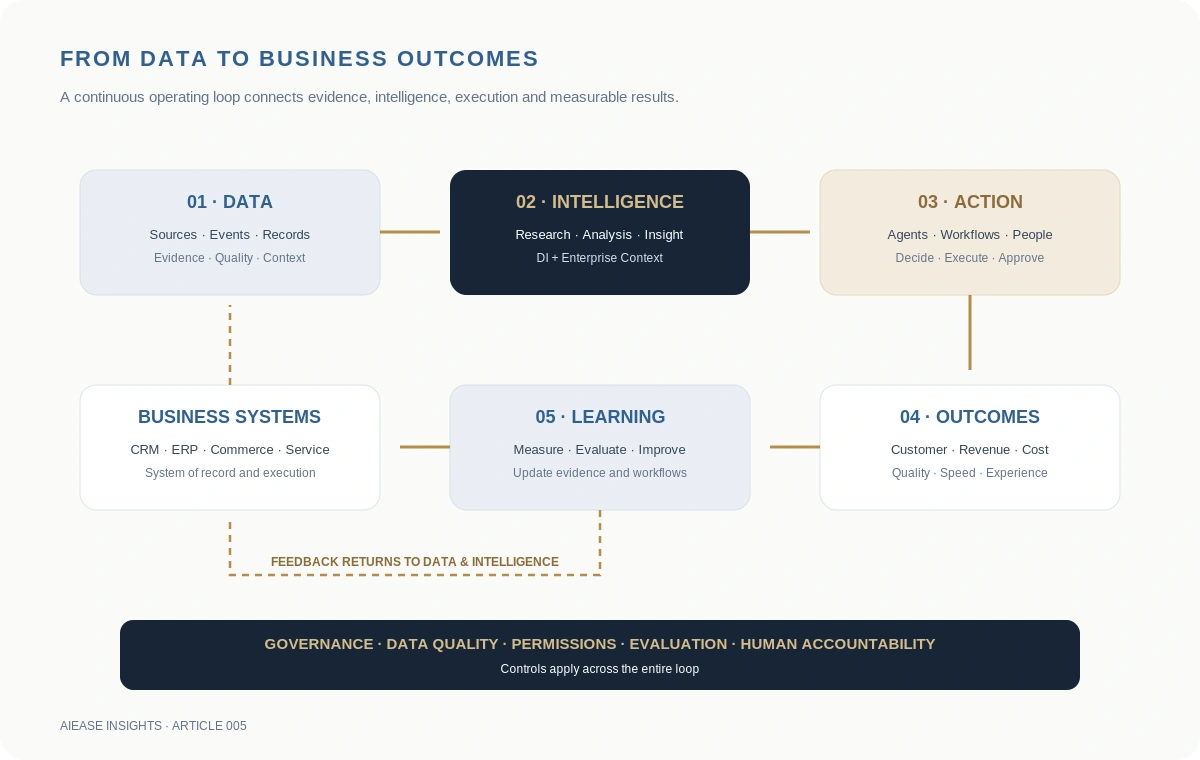
Intelligent productivity can be understood as a continuous business operating loop. It is not a one-way technology pipeline. It is a cycle that receives results, corrects assumptions and improves future action.
Data | Sense the business — Acquire information from internal systems, customer touchpoints, product usage, market conditions and external sources, preserving source, time, definitions and relevant context.
Intelligence | Develop insight — Use data preparation, metric analysis, research, correlation and AI reasoning to understand what is happening, why it is happening and what may change.
Action | Act on insight — Use agents, workflows, business applications and people to turn insight into tasks, decisions, content, services or operational actions.
Outcome | Measure the result — Determine whether the action improved efficiency, quality, customer experience, revenue, cost, risk or another defined business objective.
Learning | Feed the next cycle — Return execution records, outcome metrics, exceptions and human evaluations to the data and knowledge foundation, updating evidence, methods and future tasks.
From Data to Business OutcomesData, intelligence, action, outcomes and learning form a continuous operating loop. Governance, data quality, permissions, evaluation and human accountability apply throughout.AIEASE INSIGHTS · DigiKK
The point is not that AI must perform every step autonomously. Each step needs clear inputs, ownership, execution mechanisms and feedback. AI may support some decisions, agents may execute bounded tasks, and high-risk or consequential business decisions may still require human approval.
03. DI: Turning Enterprise Data into Trusted Business Intelligence
Data does not automatically become insight. Enterprises must first address source quality, definitions, relationships and evidence, then use research and analysis to produce information that can support decisions.
DI (Data Intelligence) provides shared data intelligence capabilities: data acquisition, evidence management, datasets, metric analysis, research, signal identification and cross-source analysis. It helps business systems and agents access a more complete and trustworthy view of internal and external information.
Data Acquisition — Connect authorized data sources, business systems, public information, industry materials and external signals.
Evidence — Preserve source, collection time, original basis, confidence and citation relationships so conclusions can be traced.
Datasets — Organize distributed information by research topic, business object and purpose of use to create reusable data assets.
Metrics and Research — Define metrics around explicit questions, conduct analysis and research, and distinguish facts from inference and forecasts.
Cross-source Analysis — Relate information from different sources to identify changes and opportunities that may not be visible in a single system or report.
An important architecture boundary must remain clear: DI is a shared data intelligence and research capability. It should not replace CRM, ERP, commerce, finance or service platforms as the system of record for business facts. Customer, order, transaction, inventory and operational status records should remain owned by their respective business systems. DI collects, researches, correlates and provides evidence; business applications maintain operational facts.
04. BASE: Turning Insight into Executable Action
Once an enterprise understands what is happening, why it is happening and what direction to take, the next challenge is to translate that judgment into action. This requires the AI capability layer to work with business systems—not merely to produce another analysis report.
Models — Select appropriate language, reasoning, multimodal and other model services for each task.
Agents — Understand goals, interpret context, plan tasks, select tools and execute work within authorized boundaries.
RAG and Knowledge — Retrieve enterprise knowledge, business rules and evidence to provide relevant, trusted context to agents.
Skills — Package validated research, analysis, creative and operational methods as reusable capabilities.
Tools and Connectors — Connect CRM, ERP, databases, marketing platforms, files and other business systems so agents can read or perform authorized actions.
Workflow and Orchestration — Coordinate task order, conditions, approvals, agent collaboration, exceptions and handoffs.
Harness and Runtime — Manage task state, tool execution, budgets, timeouts, retries, pause and resume, logs and execution traces.
Governance and Evaluation — Control identity, permissions, data access, quality, cost, security, audit and human escalation.
BASE makes AI more than an isolated conversational capability. It provides a shared layer that can be embedded in business workflows, call tools, execute tasks, operate under supervision and be evaluated continuously.
05. DI, BASE and Business Applications: Three Layers with Clear Responsibilities
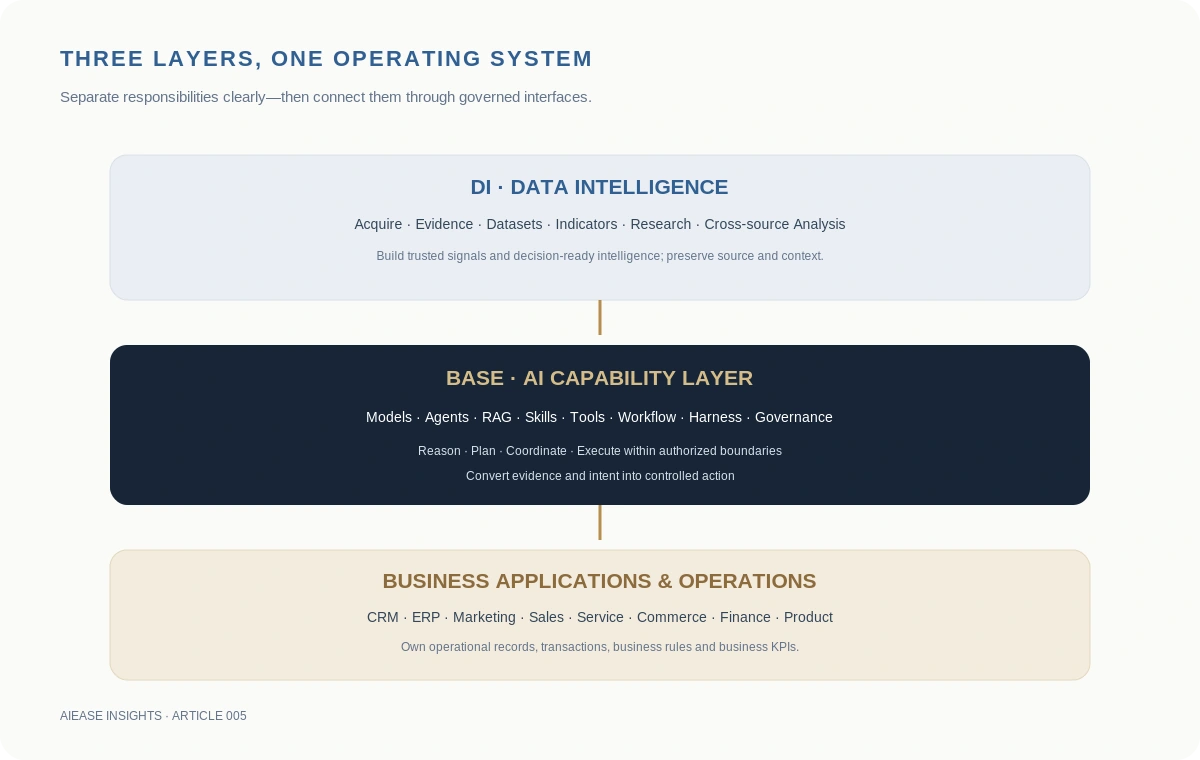
Data intelligence, AI capabilities and business applications must work closely together, but their responsibilities should not be confused. A clear architecture prevents duplicated data maintenance, inconsistent business states and unauthorized AI actions.
Three Layers, One Operating SystemDI provides trusted data and research insight; BASE provides AI reasoning, agents and controlled execution; business applications own operational facts, transactions and business metrics.AIEASE INSIGHTS · DigiKK
Layer
Core Responsibility
Primary Outputs
DI · Data Intelligence
Acquisition, evidence, datasets, metric research and cross-source analysis
Trusted data, research findings, signals and insight
BASE · AI Capability
Models, agents, RAG, skills, tools, workflows, Harness and governance
Analysis, plans, task execution and controlled automation
Business Applications
CRM, ERP, marketing, sales, service, product, commerce and finance
Business records, transaction states, customer outcomes and operating metrics
The layers connect through defined data interfaces, permissions and task contracts. Research from DI can inform an agent in BASE. The agent can submit an authorized action to a business application through a controlled tool. Once the application completes the operation, the resulting record and metrics become available for management and analysis.
06. Automation Is Not the Finish Line: Actions Must Produce Outcomes
Traditional automation often focuses on removing manual steps—for example, sending emails automatically, generating reports or synchronizing data. These capabilities are useful, but without a connection to business objectives, an organization may simply complete low-value work faster.
Intelligent automation requires a more complete chain: a system detects a signal, AI interprets context, an agent proposes or executes an action, a workflow manages conditions and approvals, the business application records the actual result, and metrics determine whether the action worked.
For example, a system may detect that product visits are increasing in a market while inquiry conversion is falling. DI can correlate traffic sources, page behavior, product information and customer feedback. A marketing agent can investigate possible causes and recommend content or page changes. A workflow can create tasks and wait for owner approval. Once approved, the content and website systems apply the changes. Traffic, inquiries and conversion are then compared to inform the next optimization cycle.
That is the shift from task automation to intelligent operations: not merely automating an action, but continuously checking whether the action produced the intended result.
07. Three Business Scenarios Where the Loop Becomes Operational
Scenario 1: Brand Marketing and Growth Operations
DI brings together market trends, competitor activity, search demand, customer feedback and website data to develop market and brand insight. Marketing agents in BASE turn that insight into strategy, content tasks and campaign recommendations. Workflows manage brand review, human approval and publishing. Once marketing systems execute, channel data, inquiries, lead quality and conversion results feed the next optimization cycle.
Scenario 2: Sales and Customer Management
DI relates market signals, customer behavior and historical business information to identify high-value leads and changes in customer needs. Sales agents use authorized CRM access to prepare customer context, communication suggestions and follow-up tasks. People remain responsible for key relationships, quotations and commitments. CRM records follow-ups, opportunity stages and closed outcomes, which then inform analysis.
Scenario 3: Operations, Service and Supply Chain
DI combines order, inventory, service-ticket, delivery and customer-support data to identify exceptions and emerging risks. Operations agents investigate causes and propose responses. Workflows route actions for automatic handling or human approval according to risk. Business systems record the result, while delivery time, stockouts, service quality, cost and customer satisfaction are monitored continuously.
08. Measuring Intelligent Productivity: Look Beyond AI Usage
Enterprises may be tempted to use model calls, agent counts, automated workflows or generated content volume as measures of AI success. These metrics help describe system activity and adoption, but they cannot independently prove productivity gains.
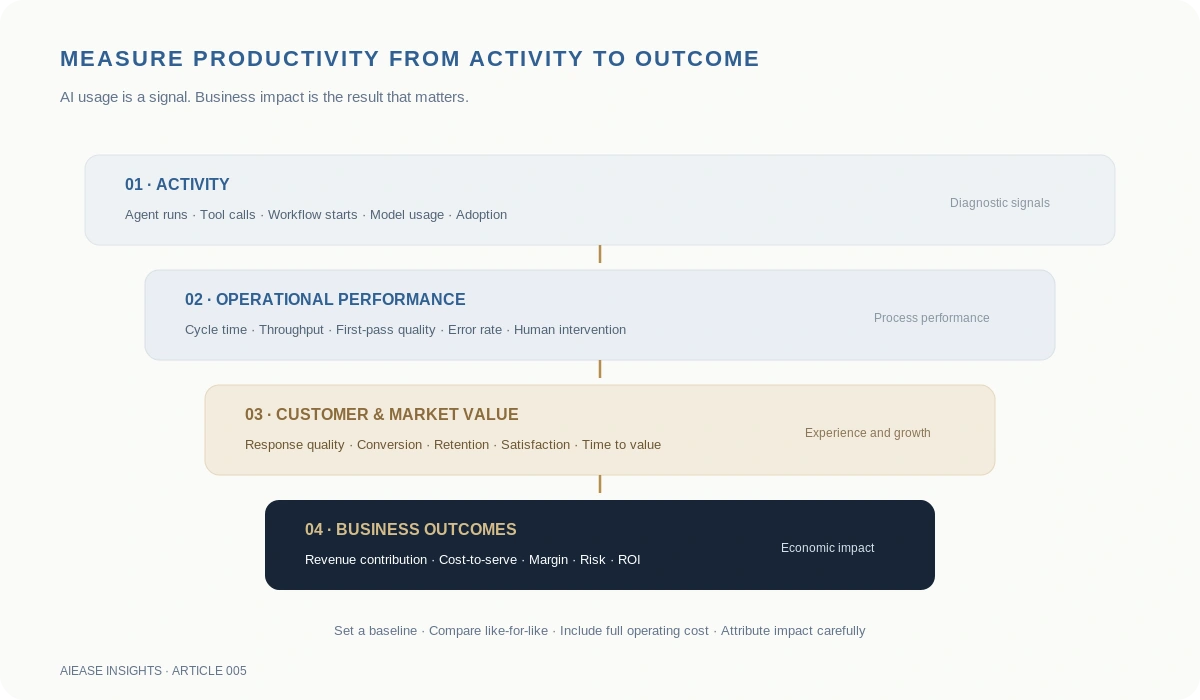
A meaningful measurement system moves from activity metrics toward business outcomes. First determine whether the system is being used. Then determine whether the workflow is faster or better. Finally, verify whether customers and the enterprise receive real value.
Measure Productivity from Activity to OutcomeActivity metrics are diagnostic signals; operational metrics measure process change; customer and market metrics measure value; revenue, cost, margin, risk and ROI measure business outcomes.AIEASE INSIGHTS · DigiKK
Metric Level
Observable Measures
Management Question
Activity
Agent runs, tool calls, workflow starts, usage
Is the system being adopted?
Operational
Cycle time, throughput, first-pass quality, error rate, human intervention
Is the process faster, more stable and higher quality?
Customer
Response quality, conversion, retention, satisfaction, time to value
Are customers actually benefiting?
Business
Revenue contribution, cost to serve, margin, risk, ROI
Is the enterprise achieving verifiable economic value?
McKinsey's 2026 survey found that nearly three-quarters of AI high performers reported fundamentally redesigning workflows because of AI, compared with about one-quarter of other respondents. In the survey, high performers were defined as respondents attributing at least a 5% EBIT impact to AI and describing the value as significant. The finding points to an important association between workflow redesign and value realization; it should not be read as proof of a single causal factor.
Every AI initiative should establish a business baseline before launch, define target metrics, data sources, attribution methods, full operating costs and an evaluation period. Total cost should include models, software, integration, human review, exception handling and operations—not only model usage.
09. Building a Trusted Loop: Data Quality, Permissions and Governance
A data-driven operating system influences management decisions and real business actions. It therefore needs trusted data and execution controls. Bad data can produce bad insight; bad insight can trigger bad action; automation can amplify the error.
Source and Provenance — Know where data came from, when it was collected, how it was processed and what evidence supports a conclusion.
Quality and Freshness — Check completeness, accuracy, consistency, refresh frequency and anomalies so stale data does not drive real-time decisions.
Definitions — Standardize core definitions for customers, orders, revenue, conversion and cost so departments do not operate with conflicting metrics.
Access and Privacy — Control data access by identity, business purpose and least privilege, protecting customer, employee and sensitive company information.
Human Approval — High-risk actions involving payments, contracts, important customer commitments, critical data changes or external publication require explicit authorization and human approval.
Audit and Evaluation — Record agents, tools, data, execution steps, approvals, outcomes and exceptions; continuously evaluate quality, cost and risk.
The loop must also handle failure. Incomplete data should be marked as uncertain. Failed tool calls should stop, retry or escalate. An unverified result must never be treated as a successful completion. A trustworthy system is not one that never fails; it is one that detects errors, limits their impact and improves continuously.
10. AIEASE: Building Data-Driven Intelligent Operations with DI + BASE
AIEASE positions DI and BASE as shared foundations with distinct responsibilities. DI provides data intelligence and research. BASE provides AI capabilities and agent operations. Business applications above them own concrete operating workflows, business facts and commercial results.
DI — Data Intelligence Layer — Provides data acquisition, evidence management, datasets, metric research, signal identification and cross-source analysis so enterprises and agents can understand markets and operations through a more complete view of the facts.
BASE — AI Capability Layer — Provides models, agents, RAG, workflows, skills, tools, Harness, runtime governance and evaluation to turn insight into executable tasks and controlled automation.
AIEASE VENTURE — Turns market and industry insight into opportunity research, business models, project plans and MVP development.
EASEBIZ Suite — Applies agents to business communication, customer relationships, service and enterprise collaboration.
AI Content Marketing Cloud — Connects brand knowledge, market research, campaign planning, image and video production, review, publishing and marketing feedback.
MANAGE — Supports long-term operations across business systems, tracking operating metrics, task progress, system costs and continuous improvement.
VOICIE IP OS — Applies data insight, agents and automation to IP creation, asset management, content operations and commercialization.
Conclusion. The Future Advantage Is the Ability to Learn and Act Continuously
Enterprises will not lack data or AI tools. The real difference will be their ability to turn distributed data into trusted insight, turn insight into the right action, and use real operating outcomes to improve the next decision.
When data, AI, automation and business systems form a closed loop, an enterprise no longer relies only on periodic reports. It can continuously sense change, understand problems, organize work, execute tasks and evaluate results.
This is a new form of intelligent productivity. It is not about asking every employee to use more AI tools. It is about giving the organization the ability to learn faster, decide better, execute more reliably and create value continuously.
True data-driven management is not about giving an enterprise more dashboards. It is about grounding every important decision in better evidence and bringing every action closer to a business objective.
Focused on the intersection of artificial intelligence and business innovation, enterprise intelligence, AI venture building and global business growth.
AI TechnologyBusiness StrategyAI VentureGlobal Growth