For years, businesses built websites so customers could learn who they were, what they offered and how to get in touch. Brand sites later expanded into product sales, content marketing and customer service. Yet many organizations still treat the website as a digital project that needs occasional redesigns and page updates—not as a business system that operates continuously.
AI is changing where product discovery begins. Consumers move between search engines, social platforms, communities and AI assistants, asking about product differences, prices, use cases and reviews. AI may help narrow the brand choices first, then send shoppers to a brand website to verify information, compare products, experience service or complete a purchase.
The role of the brand website is therefore changing. It is no longer just a business card on the internet. It is a digital operating destination that a brand can continuously manage—connecting brand knowledge, product data, content production, customer service, commerce, global markets and business analytics.
AI is reshaping product discovery and commerce
74%Of shoppers surveyed globally use AI for product discovery2026 · NIQ
200%Year-over-year growth in agentic search as a shopping starting point2026 · Salesforce
11%Of U.S. consumers willing to let AI make purchase decisions2026 · Gartner
70%Of global shoppers surveyed have bought internationally2026 · DHL
These figures come from different studies and methodologies: NIQ's global product-discovery research, Salesforce commerce surveys and shopper behavior data, Gartner's U.S. consumer survey, and DHL's global e-commerce trends survey. They do not represent one common sample.
01. Why the Brand-Owned Website Matters Again
Social platforms, marketplaces and advertising networks can help brands reach customers quickly, but they are not the same as owning a business foundation. Platform rules, traffic allocation, account access, advertising costs and relationship-management options can change. A business needs a durable digital destination that can receive visitors from different channels and provide complete, accurate and verifiable brand and product information.
The advantage of an independent site is not that a business will never depend on platforms. It is that the business can build a lasting brand center. Traffic from social media, advertising, search, creators, offline events and partners can be directed into a consistent brand experience. With appropriate consent and legal compliance, the business can then build customer relationships, membership services and repeat-purchase programs.
AI makes this role even more important. When consumers discover products through AI, the product facts, usage information, prices, availability, delivery policies, brand content and supporting evidence on a brand site may influence how AI systems understand and recommend the brand. A site must be clear to people and machine-readable to search and discovery systems.
02. A Brand Site Is More Than an Online Store
Not every brand site needs a full e-commerce checkout from day one. B2B companies, service brands, IP businesses and high-consideration products may need product information, case studies, lead capture, appointments and business collaboration. Consumer brands may need catalogs, carts, payments, membership and after-sales service. The key is to design capabilities around the business model, not force every brand into one template.
Value Layer
Role of the Website
Typical Capabilities
Brand Experience
Build brand understanding and trust
Brand story, product information, cases, insights and multilingual pages
Customer Operations
Turn visitors into serviceable customer relationships
AI consultation, lead capture, CRM, membership, email and customer service
Commerce and Transactions
Handle inquiries, orders, payments and after-sales
Catalog, quotations, cart, payment, orders, fulfillment and returns
These three layers can be built progressively or combined according to the business. A brand showcase can start with content and consultation. Online transactions can be added when products, pricing, payment and fulfillment are ready. A B2B site may prioritize inquiries, quotations, sample requests and commercial follow-up.
03. AI Is Reshaping the Customer Journey
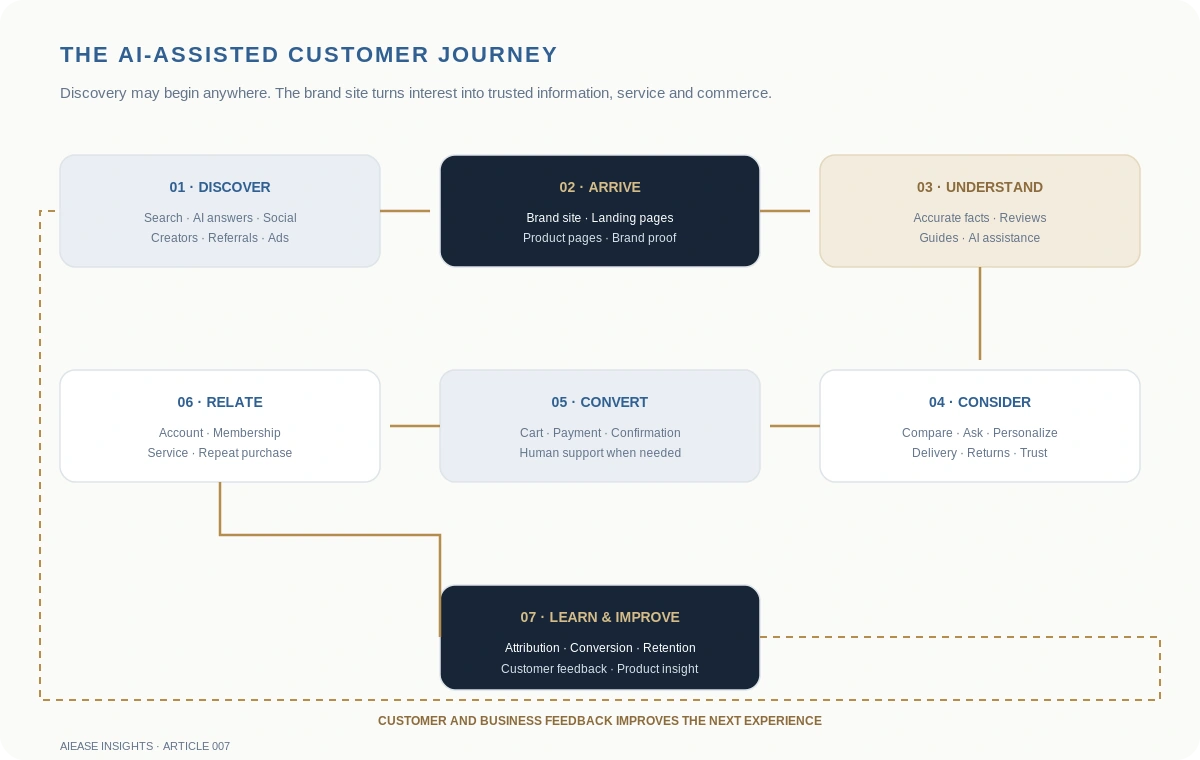
The traditional customer journey was often described as ad exposure, search, click, browse, add to cart and purchase. Today, a consumer may ask an AI first, then enter a brand site through an AI recommendation, social content, creator review or search result. Journeys are more fragmented, and brands cannot rely on one traffic source.
NIQ's August 2026 global research found that nearly three-quarters of shoppers surveyed use AI during product discovery. Salesforce's September 2026 commerce research reported 200% year-over-year growth in agentic search as a shopping starting point; its analysis also observed that traffic referred from AI conversations grew substantially faster than overall site traffic.
Consumers are not universally ready to delegate the final purchase decision to AI. Gartner's January 2026 survey of 322 U.S. consumers found that only 11% were willing to let AI make purchase decisions in lower-stakes categories. More consumers were open to AI-assisted research, price comparison and narrowing choices. Brand sites should therefore prioritize trustworthy information and decision support rather than rushing into fully autonomous purchasing.
The AI-Assisted Customer JourneyCustomers may arrive from search, AI, social and creator content. The brand site connects trusted product information, AI assistance, commerce, service and feedback into one experience.AIEASE INSIGHTS · DigiKK
A brand site must therefore serve traditional search and social traffic while adapting to AI search and agent recommendations. It must help people understand products quickly and provide AI systems with accurate, structured and verifiable information.
04. Six Capabilities of an Intelligent Brand Website
Brand Experience and Content Hub — Manage the homepage, product information, brand story, cases, insights, video, campaigns and multilingual pages in one place.
Structured Product and Service Catalog — Maintain product master data, specifications, prices, versions, inventory, market availability, service scope and policies.
AI Content and Creative Production — Use brand knowledge and marketing tasks to assist with product pages, articles, images, videos, advertising and localized content.
AI Shopping Guidance and Customer Service — Understand customer questions, retrieve trusted product information, support comparison and consultation, and provide human handoff.
Commerce, Payments and Fulfillment — Connect inquiries, quotations, carts, payments, orders, inventory, shipping, returns and after-sales according to the business model.
Customer Data and Business Analytics — Manage customer relationships with appropriate notice and consent; measure sources, behavior, conversion, repeat purchase, service and operating metrics.
These six capabilities do not mean every site must launch as a large platform. Start with the most important business objective and select the right first-stage combination. A brand entering global markets may begin with multilingual pages, a product catalog, inquiries and service. A DTC consumer brand may prioritize products, payments, fulfillment, membership and repeat purchase. A B2B brand may prioritize product information, use cases, inquiries, quotations and account follow-up.
05. Architecture: The Website Front End Is Only One Part of the System
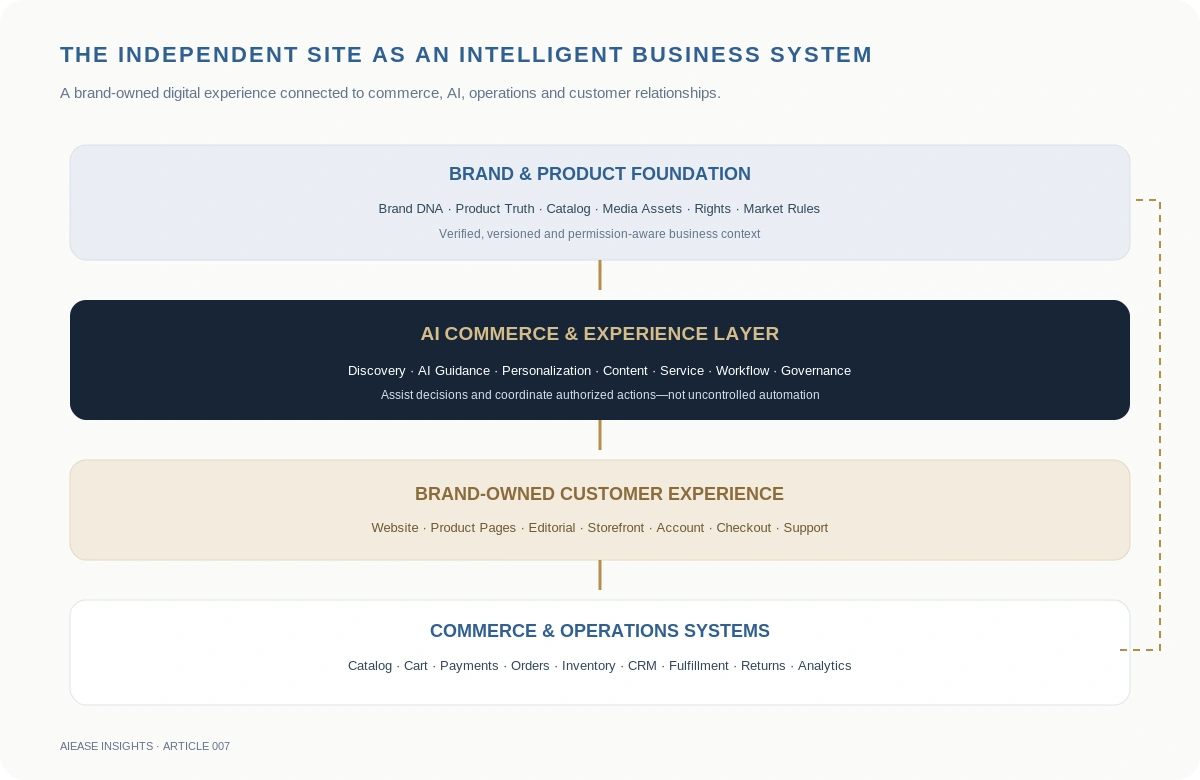
A mature intelligent brand site connects brand content, product data, AI capabilities, commerce systems and business analytics. The front end delivers the experience; the back end manages operational facts and processes; the AI layer understands, assists and orchestrates; and the data layer measures and learns.
The Independent Site as an Intelligent Business SystemFrom brand and product foundations through AI commerce experience and brand-owned customer touchpoints to commerce and operations systems.AIEASE INSIGHTS · DigiKK
System Layer
Primary Responsibility
Data and Capabilities to Connect
Brand Foundation
Brand, products, media, rights and market rules
Brand DNA, product master, asset versions, licenses and market configuration
AI Experience Layer
Discovery, guidance, personalization, content and service
Agents, RAG, tools, workflows, permissions and evaluation
Website Experience
Pages, catalog, content, accounts and checkout
CMS, product pages, search, cart and user interface
Commerce Operations
Orders, payments, inventory, delivery and after-sales
Payment services, order management, logistics, returns and CRM
Data and Intelligence
Attribution, analytics, customer insight and optimization
DI, event data, metrics, feedback and operating dashboards
The architecture should avoid putting every capability into the website front end. Product, order, inventory and payment states should be maintained by their respective systems. AI agents should use authorized interfaces; the content system should manage pages and media; analytics should consolidate events and outcomes. This keeps the experience flexible while avoiding conflicting copies of operational facts.
06. Product Data Is the Foundation of AI Commerce Discovery
Whether AI can understand and recommend a product accurately depends first on the quality of the product information a business provides. A marketing slogan or a few images cannot fully answer what the product is, who it suits, which specifications apply, how much it costs, whether it is available, how it ships or whether it can be returned.
Trust and Evidence — Certifications, test reports, genuine reviews, cases, warranty and return policies.
Media and Context — High-quality images, video, manuals, comparison information, FAQs and content sources.
Freshness and Ownership — Data owner, update time, review status, validity period and source system.
Google Search Central recommends Product structured data on e-commerce product pages and supports combining page markup with Google Merchant Center product feeds. These help search systems understand prices, availability, reviews, shipping and returns. For pages where customers can buy directly, merchant listing markup is more appropriate than product information alone.
Structured data does not guarantee search rankings or AI recommendations. It is infrastructure that makes product information easier for machines to identify and verify. Actual performance still depends on usefulness, factual accuracy, crawlability and brand trust.
07. SEO and GEO: Make the Brand Discoverable, Understandable and Citable
Search is expanding beyond keyword retrieval into AI Overviews, conversational search and shopping assistance. This does not mean traditional SEO is obsolete, nor does it mean there is a special GEO trick that guarantees inclusion in AI answers.
Google Search Central's 2026 guidance explains that AI search features continue to rely on core Search systems. Websites should follow foundational SEO, technical requirements and content-quality principles; there is no separate special technical requirement for appearing in AI features. Google emphasizes helpful, reliable, people-first content.
Technical Accessibility — Make important pages crawlable and indexable, provide a good mobile experience and avoid hiding essential information in inaccessible interactions.
Clear Site Structure — Build crawlable links between the homepage, categories, product pages and content; maintain XML sitemaps.
Useful Brand Content — Publish original product explanations, guides, comparisons, cases, industry knowledge and clear author and source information.
Structured Product Information — Use suitable structured data such as Product, Offer, Review, Organization and Breadcrumb according to page type.
Product Data Feeds — Maintain Google Merchant Center or other relevant product feeds in supported markets and keep feed prices and availability consistent with the site.
Continuous Monitoring — Observe search performance, AI referrals, brand mentions, citations and conversion; do not treat a single model response as a stable ranking.
08. AI Shopping Guidance and Service: Help Customers Decide
A brand site can evolve AI from a basic chatbot into a shopping assistant that understands products, compares options and supports purchase decisions. Customers can describe their needs in natural language. AI can use verified product data, eligibility conditions and availability to explain options—and clearly disclose uncertainty or hand off to a person when needed.
Gartner's 2026 consumer research suggests that shoppers are more open to AI narrowing choices, researching and comparing than to AI making purchases on their behalf. In the survey, 31% were willing to let AI narrow household-supply choices and 28% were open to this for personal electronics. Accuracy and transparency are therefore part of the brand experience.
Product Questions — Answer specifications, use cases, compatibility and limitations from approved product facts.
Product Comparison — Compare options against customer needs and explain the reasons and trade-offs.
Personalized Guidance — Use information the customer provides and has authorized to recommend based on budget, preferences and use cases.
Purchase Assistance — Explain prices, availability, delivery, payment and returns, and help customers through the process.
Service and After-Sales — Retrieve order status, usage instructions and service policies; escalate complex or high-risk matters.
Human Handoff — Let customers reach a person at any time and pass relevant context to avoid making them repeat the issue.
An AI shopping assistant should not invent discounts, availability, delivery dates or product performance. Nor should it make consequential purchase decisions without the customer's knowledge. The customer should confirm the transaction, or the system should follow clearly authorized transaction rules.
09. Global Commerce: Localization Goes Beyond Translation
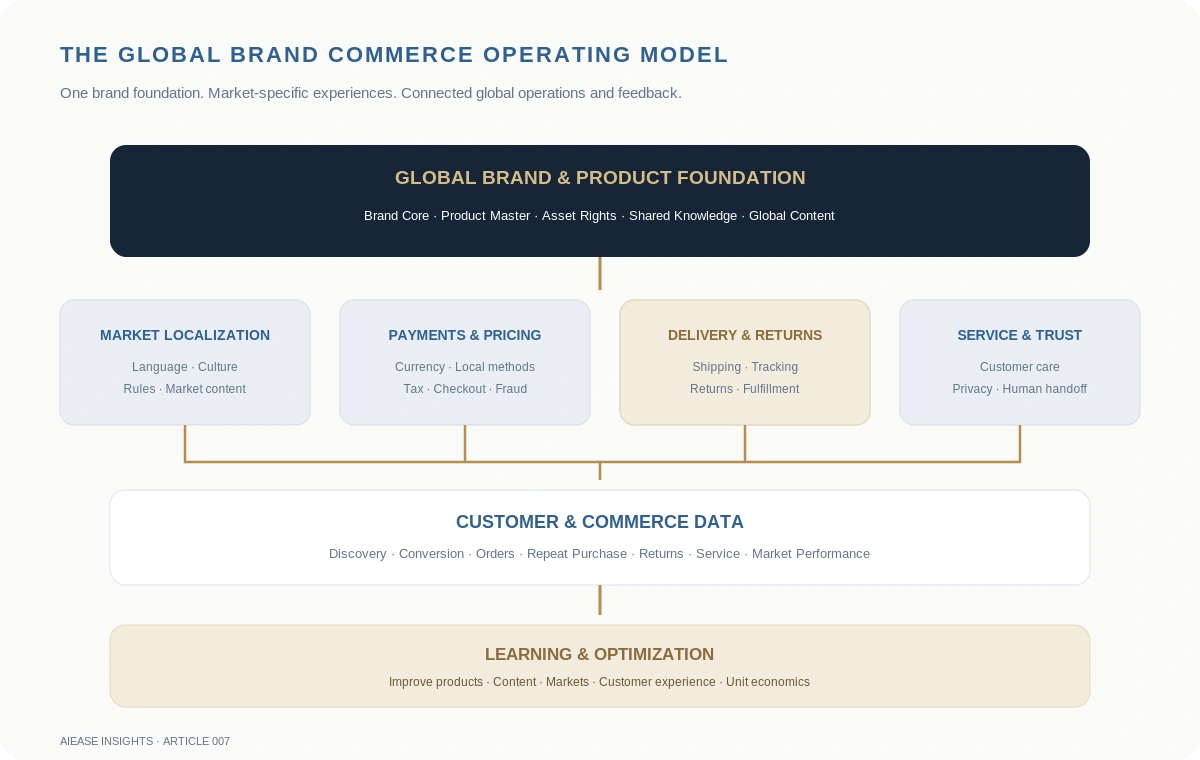
Global expansion is not simply translating a website into English. Customers need product information, prices, currencies, payment methods, delivery times, return policies, tax explanations, service languages and trust signals that fit their market. Friction at any of these points can cause shoppers to abandon checkout.
DHL's 2026 global e-commerce trends research found that 70% of shoppers surveyed had bought internationally and 45% did so at least monthly. At the same time, 67% of online shoppers had abandoned a cart because of the delivery offer. Global commerce is therefore not only a customer-acquisition challenge; it is a systems challenge involving payments, logistics, returns and trust.
The Global Brand Commerce Operating ModelA shared brand and product foundation connects market localization, payments, fulfillment, service and feedback into a global operating model.AIEASE INSIGHTS · DigiKK
Language and Culture — Adapt language, expression, examples, visuals and buying expectations to the market rather than translating mechanically.
Local Pricing and Currency — Define local prices, currencies, promotions, tax display and price validity.
Payment Methods — Offer cards, digital wallets and local payment methods commonly used in the target market.
Delivery and Returns — Explain delivery territories, costs, timelines, tracking, return addresses and refund procedures.
Tax and Compliance — Assess tax, consumer protection, privacy and product-entry requirements for each market.
Local Service — Provide local-language support, time-zone coverage, service policies and human escalation.
Worldpay's Global Payments Report 2026 states that digital wallets accounted for 56% of global e-commerce transaction value in 2025 and emphasizes that payment preferences vary by market. A brand should not only ask which payment methods it can accept; it should understand which methods customers in each target market expect to use.
A global brand site does not necessarily need one checkout configuration for every market. Different countries may require different currencies, tax handling, delivery options, return arrangements and product availability. Start with priority markets and build validated market configurations progressively rather than promising sales in every region from day one.
10. Customer Relationships and First-Party Data
One important value of an independent site is the opportunity to build direct customer relationships with appropriate notice and consent. Through membership, subscriptions, consultations, order service, after-sales, events and content subscriptions, a business can understand customer needs and provide a more continuous experience.
First-party data does not mean a company can collect or use personal information without limits. The purpose of collection, notices, consent, retention periods, access controls, deletion and export requests must be designed according to applicable laws and platform policies. Data value comes from lawful, transparent and meaningful use—not from volume alone.
Customer Identity — Connect accounts, orders, membership and service records with consent and according to applicable rules.
Customer Preferences — Record preferences and communication choices voluntarily provided by customers, and let them manage those choices.
Lifecycle Communication — Send order notifications, service reminders, content subscriptions and marketing messages based on real relationships and permissions.
Customer Service History — Give service teams the necessary order and issue context while applying least-privilege access.
Retention and Repeat Purchase — Build long-term relationships through valuable products, service, membership benefits and content.
11. Measuring an Intelligent Brand Site
A brand site should not be measured only by visits and page views. More traffic does not necessarily mean better customers, nor does it guarantee higher revenue or profit. Website performance needs to be evaluated within the broader business model.
Measurement Layer
Example Metrics
Management Question
Discovery
Organic search, AI referrals, social referrals, branded search and indexed product pages
Where do customers discover the brand?
Engagement
Product-page depth, content reading, video engagement, AI consultations and site search
Do customers understand the offer and find the information they need?
Conversion
Inquiry rate, add-to-cart, checkout completion, payment success and lead quality
Does the site turn interest into opportunities or orders?
Customer
Repeat purchase, membership activity, retention, refunds and service satisfaction
Do customers want to maintain a relationship with the brand?
Economics
Acquisition cost, average order value, gross margin, fulfillment cost, lifetime value and ROI
Does the site create sustainable economic value?
For AI search and agent-driven traffic, businesses should separately observe AI referral sources, landing pages, user behavior, conversion and assisted conversion. Some consumers may see an AI recommendation, then search for the brand themselves and visit directly. Last-click attribution may therefore understate AI's influence. Attribution should combine source data, customer research and experiments rather than assigning all direct traffic to AI.
Business dashboards should distinguish revenue, gross margin and cash contribution. Discounts, advertising, payment fees, logistics, returns, customer service and content production all affect actual profitability. A strong independent site is not necessarily the one with the most pages or traffic; it is the one that attracts the right customers and serves them with healthy unit economics.
12. AIEASE: Turning the Brand Site into an AI-Powered Business Destination
Within AIEASE, an intelligent brand site is not simply a webpage builder. It is a business destination connecting brand assets, content production, AI capabilities, customer operations, global commerce and data feedback. The site delivers the market and customer experience, while connected systems support continuous operations.
BIZSTORE — Brand Site and Commerce — Build independent brand sites, product pages, catalogs, content experiences and commerce entry points, combining brand showcase, inquiries and e-commerce according to the business model.
AI Content Marketing Cloud — Manage brand knowledge, marketing strategy, image and video production, brand review, channel publishing and performance analysis to supply the site with continuous content.
BASE — AI Capability Layer — Provide agents, RAG, workflows, skills, tools, Harness and governance to power shopping guidance, service, content and operating workflows.
DI — Data Intelligence — Connect market research, customer and business data, evidence and metrics to identify opportunities, understand change and support decisions.
BIZGEO — AI Search Visibility — Conduct SEO/GEO research, page audits, content optimization and AI visibility monitoring to improve the brand's chances of being discovered and understood.
EASEBIZ and Customer Operations — Support business communication, customer relationships, lead follow-up and enterprise collaboration.
MANAGE — Long-Term Operations — Continuously track site performance, customers, tasks, costs and outcomes to support ongoing optimization.
Conclusion. The Future of the Website Is Business Capability
Businesses will continue to need websites that are beautiful, clear and trustworthy. But competitive advantage will no longer stop at visual design or page count. It will depend on whether a site connects brand knowledge, product truth, AI discovery, customer service, commerce systems and operating data.
An independent site will not replace every social platform, marketplace or offline channel. Its value is to become the center of long-term brand operations—bringing people from different channels into a coherent experience and building lasting relationships while respecting customer choice and privacy.
In the AI era, a brand needs more than a website. It needs intelligent commerce infrastructure that people can use, AI can understand, business systems can connect to and data can continuously improve.
A website should be more than a brand's online display window. It should be the digital operating center through which the brand understands, serves and creates value for customers continuously.
Focused on the intersection of artificial intelligence and business innovation, enterprise intelligence, AI venture building and global business growth.
AI TechnologyBusiness StrategyAI VentureGlobal Growth