Artificial intelligence models are advancing quickly. They can interpret complex instructions, analyze information, generate content, write code and use tools through agents to complete multi-step tasks. Enterprises are investing in AI pilots to turn these capabilities into better productivity, lower costs and business growth.
Yet when AI enters real operating environments, a gap becomes visible: a model that performs well in a demonstration is not necessarily ready to perform work reliably; an AI system that can answer questions is not automatically integrated into the business.
01. The Deployment Gap Between Model Capability and Business Value
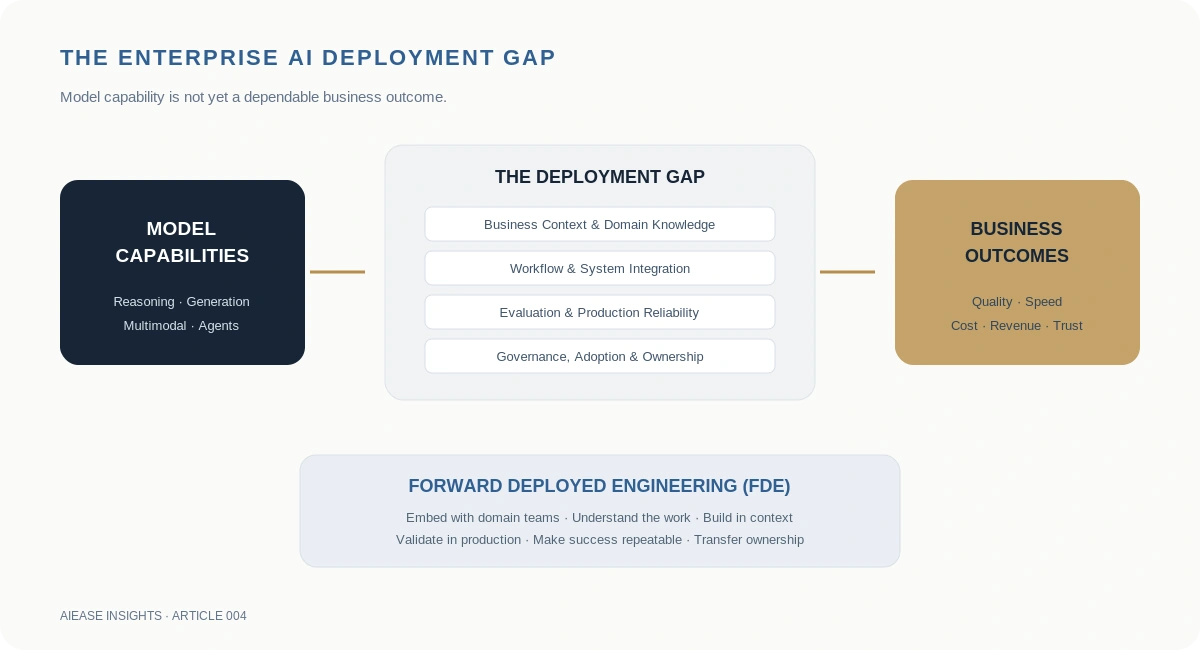
The Deployment Gap is the distance between what a model appears capable of in a test environment and what people can reliably use to perform work and produce results in a real organization.
Real enterprise environments are more complex than demonstrations. Business information is spread across systems and teams. Workflows contain exceptions. Data definitions may differ. Permissions and approval rules vary. Users must also understand, trust and adopt the system in their daily work.
Turning model capability into business value therefore requires solving at least six categories of problems: business context, data quality, system integration, workflow design, production reliability, and organizational adoption and accountability.
The Enterprise AI Deployment GapModel capabilities must pass through business context, workflow integration, production validation and governance before creating measurable business outcomes.AIEASE INSIGHTS · DigiKK
02. Why General-Purpose AI Tools Cannot Solve Every Enterprise Problem
General-purpose AI tools are effective for knowledge questions, content generation, summarization and individual productivity. For bounded, low-risk tasks, a standardized product may be entirely sufficient. Enterprises should not customize for its own sake.
When AI enters core business workflows, however, generic tools may not understand internal product definitions and business rules, access critical systems, handle specialized approvals or meet industry-specific requirements for quality, security and auditability.
General-Purpose AI / Standard Product
Real Enterprise Requirement
Engineering Work to Bridge the Gap
Generic prompts and public knowledge
Company-specific products, customers and workflow context
Enterprise knowledge integration, data governance and access controls
Standalone Q&A or content generation
End-to-end workflows across systems and multiple steps
System integration, agent orchestration and state management
Generic model evaluation
Real-world edge cases and exceptions
Representative task evaluations, human review and exception handling
A successful one-time demo
Reliable, observable and maintainable production operation
Harness, observability, cost controls and operating procedures
A vendor-delivered system
A capability the enterprise can maintain and extend
Documentation, knowledge transfer, ownership and exit arrangements
This does not mean every enterprise needs a custom AI platform. The right approach is to reuse mature models, standard products and common capabilities first. Custom engineering is justified when real business requirements, system environments or reliability standards cannot be met by a standard solution.
03. What Is FDE? An Engineering Model That Starts in the Business
FDE stands for Forward Deployed Engineering. It describes an engineering approach in which technical teams work closely with a customer's business teams, enter real operating contexts, understand problems and constraints, design and build solutions, and validate value through actual use and production deployment.
FDE is not simply sending developers to a customer site, nor is it traditional outsourcing under a new name. It is an outcome-led, engineering-centered collaboration model built around real workflows, production validation and continuous iteration.
In its October 22, 2026 article, OpenAI describes FDE as a way to close the deployment gap: model capabilities are advancing quickly, but turning them into systems and processes that people can reliably use requires working on customer problems, building alongside customers and making successful approaches reusable.
OpenAI's enterprise FDE page also emphasizes working with customer teams to observe workflows, define business outcomes, connect systems and context, prove solutions in production and package what works into reusable capabilities.
04. How FDE Differs from Traditional Custom Software and Systems Integration
FDE overlaps with custom software development, systems integration and consulting, but its emphasis is different. Traditional projects often begin with a predefined requirements and feature list. FDE begins by understanding business outcomes and how work actually happens, then explores with the customer what AI can reliably do in that context.
Model
Primary Starting Point
Typical Delivery Focus
Standard AI product
Common needs and standard features
Fast configuration and out-of-the-box use
Traditional custom software
Defined requirements specification
Development, testing and acceptance against requirements
Consulting and solution design
Business problem and improvement opportunity
Diagnosis, analysis, roadmap and recommendations
FDE
Real business outcomes and live workflows
Joint discovery, building, integration, validation, deployment and capability transfer
FDE does not mean building everything from scratch. Mature models, common components, existing agents, standard connectors and reusable workflows should be reused wherever possible. Custom engineering should focus on the enterprise's unique business context, integrations, workflows, evaluation standards and governance.
05. How FDE Works: From Problem Discovery to Production Scale
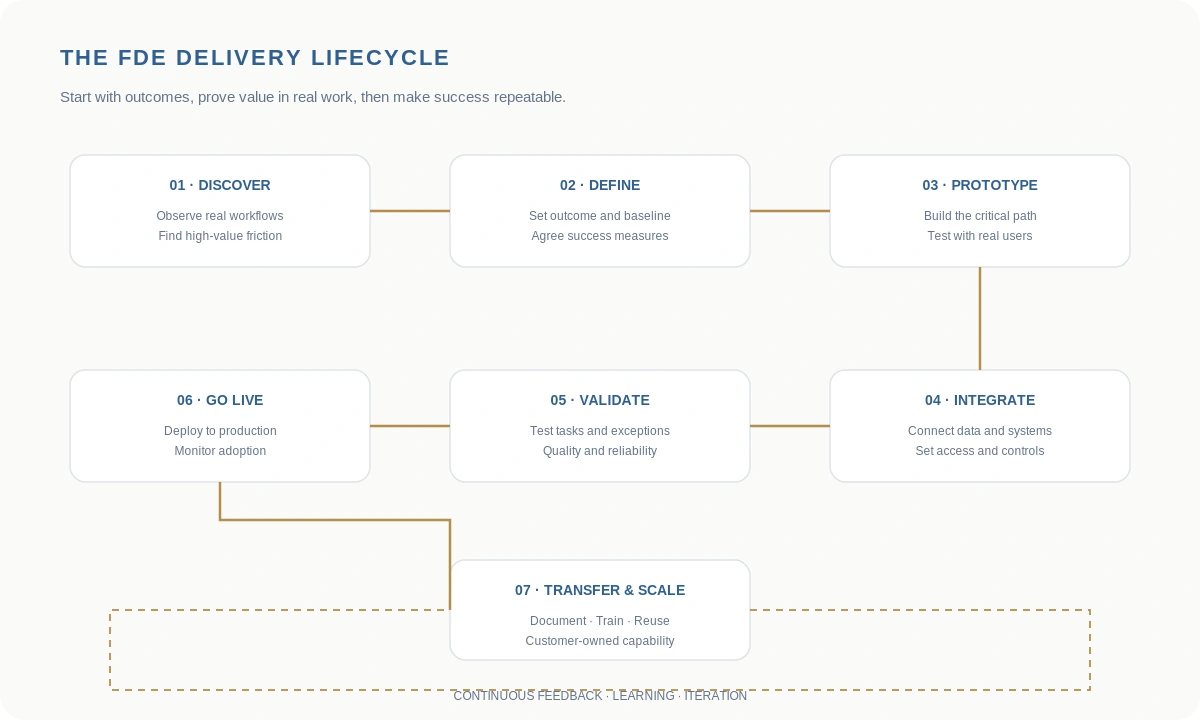
An FDE engagement should not start with “the customer wants an AI system.” It should start with “what business outcome does the customer need to improve?” A practical delivery process can be organized into seven stages.
Discover the business context — Work with leaders, domain experts and end users to map workflows, systems, information handoffs and exceptions. Find the friction that affects productivity or quality.
Define business outcomes — Set target metrics, a baseline, scope, success criteria and project boundaries—for example turnaround time, quality, throughput, manual effort or customer experience.
Prototype the critical path — Use existing models and components to build the most valuable path quickly, and involve real users early.
Integrate data and systems — Connect the required enterprise knowledge, business databases, CRM, ERP, content platforms or other systems, while establishing identity, permissions and data-access rules.
Validate on real tasks — Test accuracy, reliability, cost, latency, exception handling and human review using representative tasks and difficult cases.
Deploy to production — Complete environment deployment, monitoring, logs, permissions, budgets, operating responsibilities and user enablement.
Transfer knowledge and scale — Deliver documentation, configurations, evaluation sets, operating manuals and training. Package proven workflows as reusable modules and enable the customer team to operate independently.
The FDE Delivery LifecycleFrom business discovery and outcome definition to prototyping, integration, production validation, knowledge transfer and scale.AIEASE INSIGHTS · DigiKK
These stages are not a rigid waterfall. Real engagements iterate between prototyping, integration and validation. Each iteration should return to business outcomes and feedback from actual users, rather than optimizing only for an impressive technical demonstration.
06. The Engineering Foundation Behind FDE: A Production System, Not a Single Agent
Enterprise AI engineering typically requires several technical layers working together. The model is only one layer; it cannot replace business knowledge, system integration, workflows, runtime infrastructure and governance.
Models and multimodal capabilities — Select language, reasoning, image, voice or other model capabilities according to the task.
Enterprise knowledge and context — Use RAG, structured data and business rules to make the system understand products, customers, workflows and institutional knowledge.
Agents and Skills — Package specialized responsibilities and validated methods as reusable capabilities.
Tools and Connectors — Connect CRM, ERP, databases, files, marketing platforms and internal systems.
Workflow and Orchestration — Manage task order, conditions, agent collaboration, approvals, handoffs and exception paths.
Harness and Runtime — Manage task state, tool execution, timeouts, retries, budgets, pause and resume, and execution traces.
Governance and Evaluation — Establish permissions, security, audit, quality evaluation, cost monitoring and human escalation.
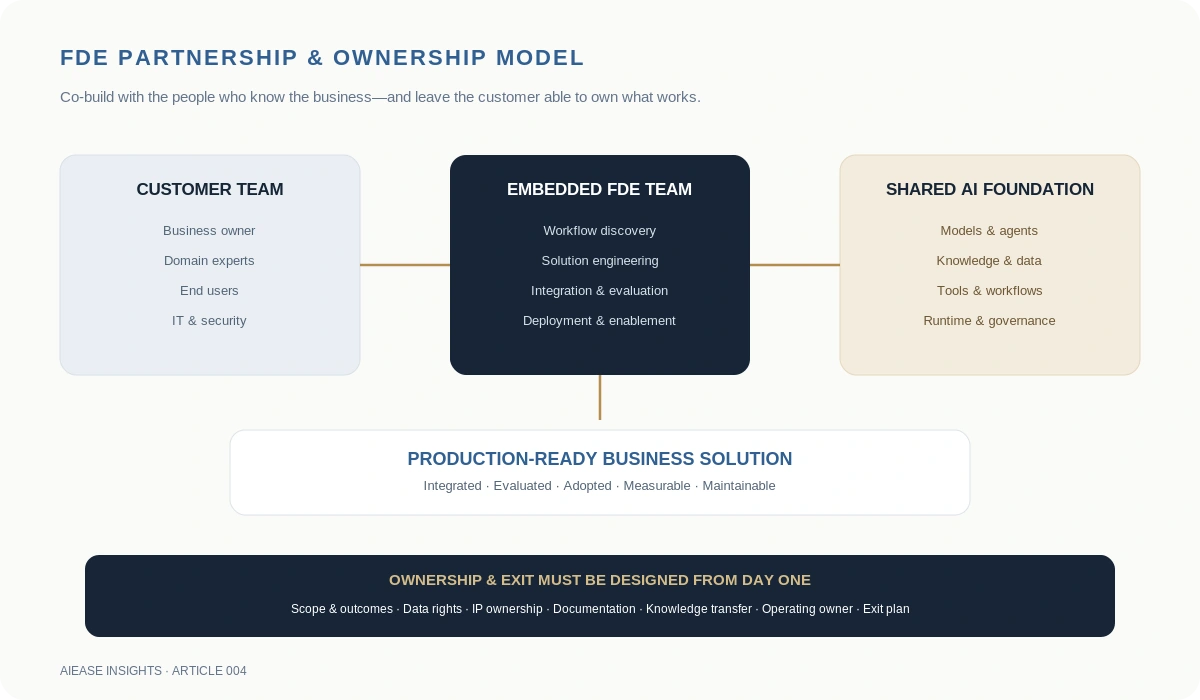
FDE Partnership & Ownership ModelCustomer business teams, embedded engineers and a shared AI foundation co-build a production system, while defining data, IP, documentation, ownership and exit arrangements from the beginning.AIEASE INSIGHTS · DigiKK
The engineering value of FDE is in combining these capabilities around the customer's actual business. Mature capabilities should be reused wherever possible, while unique business logic receives the engineering adaptation it needs.
07. Governance, Ownership and Exit Must Be Designed from Day One
Working deeply inside a customer's business means handling enterprise data, workflows, system permissions and operational knowledge. FDE must therefore answer more than “can we build it?” It must also define who owns the result, who operates it and whether the customer can maintain it independently after the engagement.
On September 29, 2026, Gartner predicted that 70% of enterprises would abandon agentic AI built through vendor FDE by 2028, citing rising costs and the inability to evolve systems independently. This forecast specifically concerns vendor-FDE-built agentic AI projects; it does not mean all FDE engagements will fail. It is a warning that engagement structure and long-term ownership matter as much as technical implementation.
Gartner highlights the need to define governance, business value, intellectual property ownership, project co-ownership, knowledge transfer and an exit strategy.
Business outcomes and scope — Define the problem, metrics, deliverables, scope and change-control process.
Data and access rights — Clarify data control, processing purpose, access scope, retention and security responsibilities.
IP and code ownership — Define ownership and licensing for existing platform capabilities, customer-specific deliverables, third-party components, model services and newly developed code.
Joint delivery and accountability — Clarify decision boundaries for the business sponsor, technical owner, FDE team and operations owner.
Knowledge transfer — Deliver architecture documents, configurations, evaluation sets, runbooks and training.
Exit and independent operation — Define vendor exit, system migration, credential handover and the customer's path to independent maintenance in the project plan and contract.
A mature FDE engagement should not leave the customer permanently dependent on the original engineering team. One measure of success is that the customer gradually gains the capability to maintain, extend and manage the system independently.
08. When Is FDE the Right Fit—and When Is It Not?
FDE is not the default delivery model for every AI project. It is most useful when business value is high, workflows are complex, systems are unique, multiple rounds of validation are needed or a standard product cannot meet the required reliability.
Good Candidates for FDE
Situations That Usually Do Not Need FDE
Core workflows spanning multiple business systems
Simple Q&A, translation or content generation
Company-specific knowledge, rules and permissions
Routine tasks already covered by a standard product
Models must handle complex exceptions and quality requirements
Low-risk, bounded tasks that work out of the box
Business experts must help discover and validate the solution
Short-term training or standard product configuration
The result can become a reusable enterprise capability
Exploratory projects without a business owner or success metric
A simple decision rule is this: if existing products and models can already perform the task reliably, use them. Consider deeper engineering when the critical barriers are business context, system integration, workflow redesign, production reliability or organizational adoption.
09. AIEASE FDE: Connecting Enterprise Business, AI Infrastructure and Long-Term Operations
At AIEASE, FDE is positioned as enterprise AI customization and engineering delivery—not generic software outsourcing. It connects AIEASE's shared technical foundation, data intelligence, venture building and the customer's real business.
DI — Data Intelligence — Identify market opportunities, business data, evidence sources and operational problems to support discovery and requirements analysis.
VENTURE — AI Venture Building — When a company is building a new business or product, support opportunity research, business models, product planning and MVP roadmaps.
BASE — AI Capability Layer — Provide shared capabilities including agents, models, RAG, workflows, skills, tools, Harness and governance.
FDE — Business-Specific Engineering — Embed in customer workflows to deliver discovery, integration, specialized agents, business workflows, evaluation, deployment and production validation.
MANAGE — Long-Term Operations — Use ongoing operations, runtime monitoring, cost management, data feedback and iterative improvement to sustain value.
This approach avoids rebuilding foundational AI capabilities for every project, while also avoiding the mistake of forcing every enterprise into one generic product. Reuse common capabilities; deeply engineer what is unique to the business.
Conclusion. The Goal of AI Deployment Is Not to Install a Model—It Is to Change How Work Gets Done
Enterprises will not lack AI models and tools. What will remain scarce is the engineering capability to turn AI into dependable business workflows.
FDE brings engineers into the business context to understand problems, design workflows, build systems, validate results and turn effective practices into lasting capabilities.
It requires technical teams to understand the business. It also requires enterprises to provide the necessary context, involve domain experts and define objectives, responsibilities and ownership.
The most important task for a business is not to chase an impressive AI system. It is to identify the workflows worth changing and transform them through engineering that is verifiable, maintainable and scalable.
Model capability defines what is possible. Engineering determines what can be deployed. Real business outcomes determine what is worth sustaining.
DigiKK · AIEASE AI CEO
FDE should not create permanent dependence on an external engineering team. It should help enterprises build their own AI capabilities, accelerate business transformation and create a foundation for continuous innovation.
Focused on the intersection of artificial intelligence and business innovation, enterprise intelligence, AI venture building and global business growth.
AI TechnologyBusiness StrategyAI VentureGlobal Growth