For many years, Chinese companies entered global markets by relying on manufacturing capabilities, supply-chain efficiency and trading partners to sell products overseas. That model remains important. But as more businesses reach comparable production capabilities, competition is no longer confined to factories and purchase orders. Brand recognition, customer relationships, channel control, service experience, product innovation and local operations are becoming new dimensions of advantage.
AI is changing the cost structure of building these capabilities. Overseas market research once required specialist teams and lengthy research cycles. Multilingual content required translation, design, marketing and local service teams. Overseas customer support and sales follow-up demanded sustained staffing. Today, AI can help businesses accelerate research, content adaptation, customer consultation, sales assistance and data analysis.
AI does not automatically create overseas demand, nor does it solve product quality, brand trust, fulfillment, tax, intellectual property or local compliance. Its real value is to help businesses build professional capabilities with lower organizational overhead, embed them in real workflows and serve global customers continuously.
China's global expansion is operating at a new scale
70%Of shoppers surveyed by DHL had purchased from another countryDHL
The cross-border e-commerce total includes both imports and exports; ODI and e-commerce are different statistical categories. DHL's figure comes from its global shopper survey and does not represent every consumer or market.
01. From Product Exports to Global Operations
China's global expansion did not begin today. Manufacturing, engineering services, cross-border e-commerce, overseas warehouses, international logistics, digital services and overseas investment have created multiple routes into global markets. In 2025, China's outbound direct investment flows reached US$213.58 billion and the year-end stock reached US$3.4 trillion. Chinese overseas enterprises numbered about 58,000 across 189 countries and regions.
China's cross-border e-commerce imports and exports reached RMB 2.84 trillion in 2025, up 4.8%. In its October 2026 trade outlook, the WTO raised its forecast for global merchandise trade volume growth to 3.9% for 2026 and noted that investment in AI-related infrastructure is boosting trade in AI-enabling goods.
These figures indicate that global opportunities remain, but they do not mean every industry, country or product is ready for immediate expansion. Global investment is also becoming more concentrated and selective. UNCTAD reported that global FDI recovered to US$1.6 trillion in 2025, while capital remained concentrated in a limited number of economies and strategic sectors.
02. There Is More Than One Way to Go Global
Going global should not be reduced to opening a cross-border e-commerce store, nor does every business need to establish an overseas subsidiary first. Different products, order values, customer types, delivery models and capital positions require different market-entry routes.
Market-entry Model
Suitable Businesses
Core Work
Key Prerequisites
Cross-border marketplaces
Standardized consumer goods and mature SKUs suited to online transactions
Marketplace operations, product pages, advertising, logistics, reviews and after-sales
Product compliance, platform rules, inventory and fulfillment
Owned brand site and DTC
Consumer brands seeking brand equity, customer relationships and repeat purchase
Brand site, content, payments, CRM, service and retention
Clear positioning, reliable supply, acquisition and fulfillment economics
B2B digital export
Manufacturers, industrial products, equipment, professional services and wholesale
Product information, use cases, inquiries, quotations and sales follow-up
Technical documentation, certifications, response capability and channel management
Overseas channels and local partners
Businesses needing local distribution, installation, after-sales or industry relationships
Agents, distributors, service partners and joint market development
Partner selection, customer protection, contracts and responsibility boundaries
Overseas investment and local operations
Businesses with sufficient long-term market potential and a need for local production or operations
Overseas entity, team, warehouse, production, service and investment management
Investment case, capital, compliance, governance and risk management
IP, digital content and licensing
Cultural IP, brand licensing, digital products, software and content businesses
IP rights, digital distribution, licensing, communities and partnerships
Clear ownership, territorial rights, localization and ongoing operations
These models can be combined. A manufacturer may validate demand through B2B inquiries before developing local distributors. A consumer brand may test product demand on marketplaces before building its own site and membership program. An IP business may begin with content distribution and licensing before expanding into merchandise and local operations.
03. Start with Market Selection, Not Website Development
Many companies start in the wrong place: they build an English website, open social accounts and buy ads before identifying their customers. A stronger sequence begins with market research. Determine where demand exists, who the target buyers are, which channels they use, who the competitors are, whether the product fits local requirements and whether the business can deliver at a sustainable cost.
Market Demand — Study industry size, search demand, purchasing habits, customer pain points, price bands and growth trends.
Customer Structure — Distinguish consumers, importers, distributors, brands, manufacturers, procurement teams and professional service organizations.
Competitive Landscape — Analyze local brands, Chinese competitors, substitute products, price ranges, channel advantages and differentiation opportunities.
Entry Channels — Decide whether marketplaces, a DTC site, B2B inquiries, distributors, trade shows or local partnerships are most suitable.
Fulfillment and Unit Economics — Calculate logistics, duties, taxes, payments, marketplace commissions, returns, service and acquisition costs.
Regulation and Risk — Check product access, certification, intellectual property, data, advertising, tax and investment requirements.
AI can help teams organize public information, compare competitors, analyze customer reviews, identify market signals and draft market reports. It cannot replace customs-data verification, customer interviews, sample testing, local channel research or professional legal advice. AI research should retain sources, dates and confidence levels.
04. How AI Changes the Cost of Entering Global Markets
AI's value is not simply reducing headcount. It allows businesses to use intelligent systems to assist with repetitive work across research, content, sales, service and operations, so that limited specialist capacity can focus on judgment, relationships and complex problems.
Market Research Agents — Continuously gather industry, competitor, channel, policy and customer-demand signals into sourced market briefs.
Multilingual Content Agents — Assist with product information, advertising, social content, cases and localized versions for target markets.
AI Sales and Customer Service — Understand customer needs, answer product questions, organize inquiries, prepare follow-ups and hand off to people.
AI Digital Workforce — Support marketing strategy, content operations, data analysis, business research and recurring workflows.
AI Business Analytics — Connect visits, inquiries, orders, costs and customer feedback to identify growth opportunities and operating issues.
McKinsey's 2026 global survey found that nearly nine in ten respondents reported regular AI use in at least one business function, while 44% said AI was scaling across their enterprise. Yet only 37% reported some EBIT impact from AI. This suggests that businesses need more than isolated tools: they need AI embedded in end-to-end workflows and validated against operating outcomes.
AI-enabled globalization should start with real business tasks, not a generic chatbot. A business needs to define task inputs, enterprise knowledge, authorized data, connected systems, human approvals, delivery standards and measurement criteria.
05. From Product Advantage to Brand Advantage
Chinese businesses often have strengths in manufacturing, supply chains, R&D and product iteration. Those strengths do not automatically create brand recognition overseas. International customers still need to understand what problem the brand solves, why it can be trusted, how it differs from alternatives, who takes responsibility when something goes wrong and whether service will continue over time.
Clear Positioning — Go beyond “high quality and low price.” Explain whom you serve, what problem you solve and what distinctive value you provide.
Proof of Product Capability — Build trust through testing, certifications, technical documentation, real cases, use cases and service commitments.
Consistent Brand Identity — Align the brand name, visual identity, product communication, tone of voice and official sources.
Local Expression — Reorganize content for local language, culture, aesthetics, purchasing behavior and industry terminology rather than translating mechanically.
Long-Term Customer Relationships — Build repeat purchase and referrals through content, service, membership, CRM, after-sales and ongoing product improvement.
Going global does not mean every business must become a consumer brand. B2B manufacturers also need strong professional brands: they must clearly present technical capabilities, industry applications, quality systems, delivery capacity and partnership cases so overseas buyers can evaluate them efficiently.
06. Global Digital Business Infrastructure
Once a business commits to a target market, it needs a digital business destination that can continuously receive and serve customers. This is more than an English-language website. It is the connected center for brand knowledge, product information, content, customer consultation, inquiries, transactions and service.
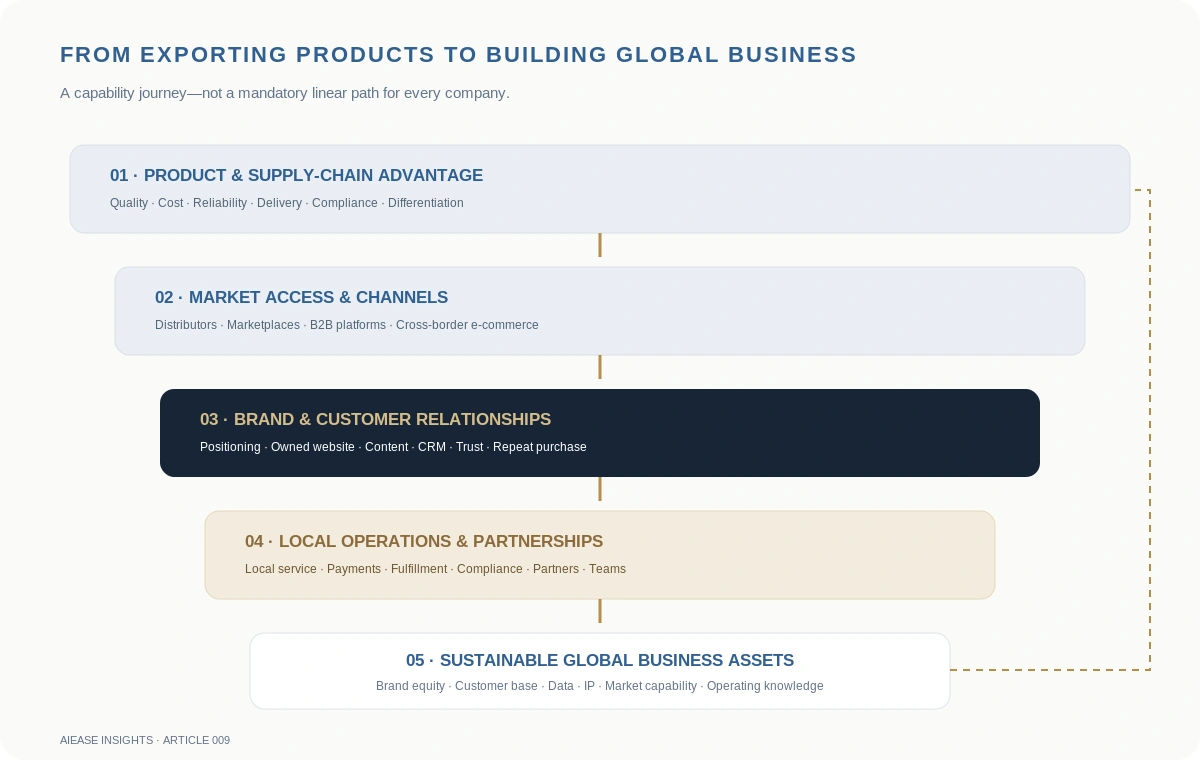
From Exporting Products to Building Global BusinessThis is a capability model, not a mandatory sequence for every company.AIEASE INSIGHTS · DigiKK
Digital Foundation
Key Capabilities
Business Value
Multilingual brand site
Brand story, catalog, cases, content hub and market pages
Create a trusted official information destination
Product and service data
Specifications, models, prices, availability, scope, certifications and FAQs
Help people and AI understand the offer accurately
AI reception and sales
Product questions, needs identification, inquiry capture, lead routing and follow-up
Reduce response time and lead leakage
Global commerce
Local currencies, payment methods, quotations, orders, taxes and logistics
Reduce transaction friction and support real sales
Customer relationship management
CRM, membership, email, after-sales, customer history and permissions
Build continuous service and repeat-purchase capability
Data and business analytics
Sources, visits, inquiries, conversion, orders, costs and margins
Help teams optimize markets and operating decisions
DHL's 2026 study surveyed 29,000 online shoppers and 5,800 e-commerce businesses across 29 countries. In the survey, 67% of shoppers had abandoned a cart because of the delivery offer. This shows that even a strong website can lose an order if shipping costs, delivery times, returns and after-sales responsibility are unclear.
A global website must therefore be designed alongside local payment, delivery, returns, customer-service time zones and commercial responsibilities. Translating a Chinese page into English is not, by itself, global readiness.
07. Global Marketing: Connect SEO, GEO, Content and Channels
Overseas acquisition cannot depend on one channel. Customers in different markets may discover products through Google, AI search, industry platforms, social media, video, trade shows, professional communities, distributors or referrals. Businesses need to combine channels around their target customers and buying journeys rather than simply copying domestic platform tactics.
SEO · Search Discoverability — Build clear site architecture, indexable pages, product data, industry content and local keyword coverage.
GEO · AI Search Visibility — Improve brand facts, product evidence, expert content and external sources; monitor how AI understands the brand.
Content Marketing — Continuously create articles, videos, cases, product explanations, comparisons and research around customer questions.
Social and Video — Plan short-form video, long-form video, communities and creator partnerships according to local platforms and audiences.
Channels and Partners — Connect local agents, distributors, trade media, professional service firms and event resources.
Performance Review — Compare channel costs, qualified leads, conversion, order margin and long-term customer value.
Global content cannot rely on mechanical translation. An advertising message that works for Chinese consumers may not work in the United States, Germany, Japan or the Middle East. Content teams need to understand local culture, aesthetics, purchasing decisions, regulations and platform rules. AI can improve multilingual production efficiency, but local review and real market feedback remain essential.
08. AI Digital Workforce: Global Operations Beyond One Time Zone
When a business serves multiple countries, languages, channels and customer groups, human teams can become overwhelmed by repetitive communication, document preparation, follow-up and content production. AI digital employees can handle standardized work within shared enterprise knowledge and permissions, allowing people to focus on relationships, negotiation, complex delivery and key decisions.
AI Role
Primary Work
Human Accountability
AI Market Researcher
Market information, competitors, customer reviews, industry trends and opportunity briefs
Verify sources and commercial judgments
AI Content Manager
Articles, product pages, social content, video scripts and localized versions
Brand review, fact review and publication approval
Pricing, contracts, commitments and key-account communication
AI Customer Service and Product Advisor
Product questions, usage guidance, order inquiries and service routing
Escalate complaints, refunds, disputes and high-risk issues
AI Data Analyst
Channel, traffic, leads, orders, costs and customer-feedback analysis
Financial definitions, causal judgments and business decisions
AI Operations Coordinator
Task assignment, progress reminders, cross-time-zone information and reports
Resource allocation, approvals and external accountability
Enterprise AI should be more than a generic chatbot. It needs to understand company products and processes, connect to CRM, commerce, orders, knowledge bases and business tools, execute tasks within permissions and leave reviewable records. Actions involving quotations, contracts, payments, refunds, personal data and external commitments should have authorization and human approval.
09. FDE: Build Enterprise AI Around Real Global Business Workflows
Global workflows differ widely by business. A manufacturer may need to connect product configuration, inquiries, technical documents, quotations, orders and distributor management. A consumer brand may need to connect content marketing, its independent site, payments, inventory, customer service and membership. A cross-border service company may need multilingual contracts, compliance documents, project delivery and cross-time-zone collaboration.
These challenges are rarely solved by buying one generic AI SaaS product. Businesses need diagnosis, workflow mapping, system integration, agent design, data permissions, deployment and continuous optimization based on actual operations. This is where Forward Deployed Engineering (FDE) is valuable: engineering teams work alongside the business to embed AI systems into real workflows.
Business Diagnosis — Define the global expansion goal, operating bottlenecks, customer journey, current systems and key metrics.
Workflow and Data Design — Map relationships across products, customers, orders, channels, knowledge and approvals.
AI Systems and Integration — Build agents, workflows, knowledge retrieval and enterprise-system connections.
Deployment and Governance — Choose public cloud, dedicated instances or private deployment as required; define permissions, logs and data boundaries.
Acceptance and Continuous Improvement — Evaluate response quality, lead quality, task completion, cost and business outcomes.
10. Local Operations: Solving the Last Mile
Globalization is not only about acquiring customers remotely. After an order is placed, a business must handle payment, tax, logistics, installation, after-sales service, returns, complaints and local support. B2B companies may also need sample delivery, technical support, on-site installation, spare parts and distributor training.
Payment Localization — Understand commonly used cards, digital wallets, local payment methods and settlement requirements in the target market.
Logistics and Fulfillment — Define warehouse locations, delivery territories, timelines, tracking, return addresses and responsibilities.
Local Service — Establish local-language support, service partners, repair and after-sales processes.
Brand and Cultural Adaptation — Make product communication, content, visuals and service fit how local customers actually understand and use them.
DHL's 2026 survey found that delivery offers are an important factor in cross-border shopping, with 67% of shoppers surveyed having abandoned a cart for this reason. Businesses must calculate not only the cost of shipping a product from China, but also the full cost of delivery, returns, service and customer experience.
11. Compliance and Risk: Global Expansion Needs Governance
Global expansion involves export, technology, capital and data rules in China, as well as product access, consumer protection, tax, advertising, intellectual property, privacy, employment and competition rules in destination markets. Requirements differ by business model, so companies must identify applicable obligations before entering a market.
China's Provisions on Outbound Investment took effect on July 1, 2026, covering the management and support of overseas investment, investor protection and risk prevention. The National Development and Reform Commission announced revised Administrative Measures for Outbound Investment in October 2026, effective December 1, 2026. Businesses should review the applicable approval, filing, reporting and overseas-investment risk-management requirements.
A company engaged only in goods exports, cross-border e-commerce or overseas customer service should not automatically treat every activity as outbound direct investment. However, goods and technology exports, cross-border funds, cross-border data, overseas entities and equity investment may each trigger different legal requirements. The actual transaction structure should be reviewed with qualified professionals.
Risk Area
What to Check
Suggested Management
Investment and capital
ODI approvals or filings, reporting, cross-border funds and foreign exchange
Map the investment route and consult qualified professionals
Products and trade
Export controls, tariffs, origin, certifications, product safety and labeling
Build compliance records by product, country and HS code
Intellectual property
Trademarks, patents, copyright, likeness, music and territorial licenses
Conduct searches, registrations and license reviews before market entry
Data and privacy
Customer-data collection, international transfers, retention, access and deletion
Establish data maps, permissions, notices and transfer mechanisms
Tax and consumer rights
VAT/GST, local tax, returns, advertising and consumer protection
Configure tax and after-sales policies by market
Commercial and geopolitical risk
Partner background, sanctions, payments, contracts and political risk
Use due diligence, contract review, insurance and contingency plans
For example, the European Commission's Access2Markets portal provides information on tariffs, rules of origin, taxes, import procedures, product requirements and trade barriers. Transfers of EU personal data outside the EU may require assessment of mechanisms such as Standard Contractual Clauses. Businesses should integrate these checks into market-entry planning rather than reacting only after a customer complaint or customs issue.
12. Measure Global Growth Through Business Outcomes
Overseas impressions, website visits and social followers do not by themselves prove that global expansion is succeeding. A business needs to know whether each market produces qualified customers, whether those customers buy, whether orders are profitable, whether customers return and whether local operating costs are sustainable.
Measurement Layer
Key Metrics
Management Question
Market Discovery
Target-market coverage, search demand, brand mentions and qualified channels
Have we found the right market and customers?
Customer Engagement
Product inquiries, content engagement, leads and sample requests
Do customers understand and value the offer?
Sales Conversion
Qualified-lead rate, quotation rate, win rate and sales cycle
Are we turning interest into real orders?
Unit Economics
Acquisition cost, gross margin, logistics, payment, returns and service costs
Is each order genuinely profitable?
Customer Operations
Repeat purchase, retention, lifetime value and referrals
Are we building long-term customer relationships?
Market Operations
Local team cost, channel contribution, inventory turns and cash collection
Is this market worth continued investment?
AI can help connect data from different channels and identify falling inquiries, unusual conversion patterns, customer churn, product issues and cost changes. Final business decisions must still rely on accurate revenue, cost, margin, cash-flow and customer facts. Model predictions must never be treated as actual financial results.
13. AIEASE: Building AI-Powered Global Business Systems
AIEASE's value for global expansion is not a single AI tool or website. It is helping businesses acquire the AI technology, business applications, brand-owned digital presence, global marketing and ongoing operating capabilities appropriate to their stage.
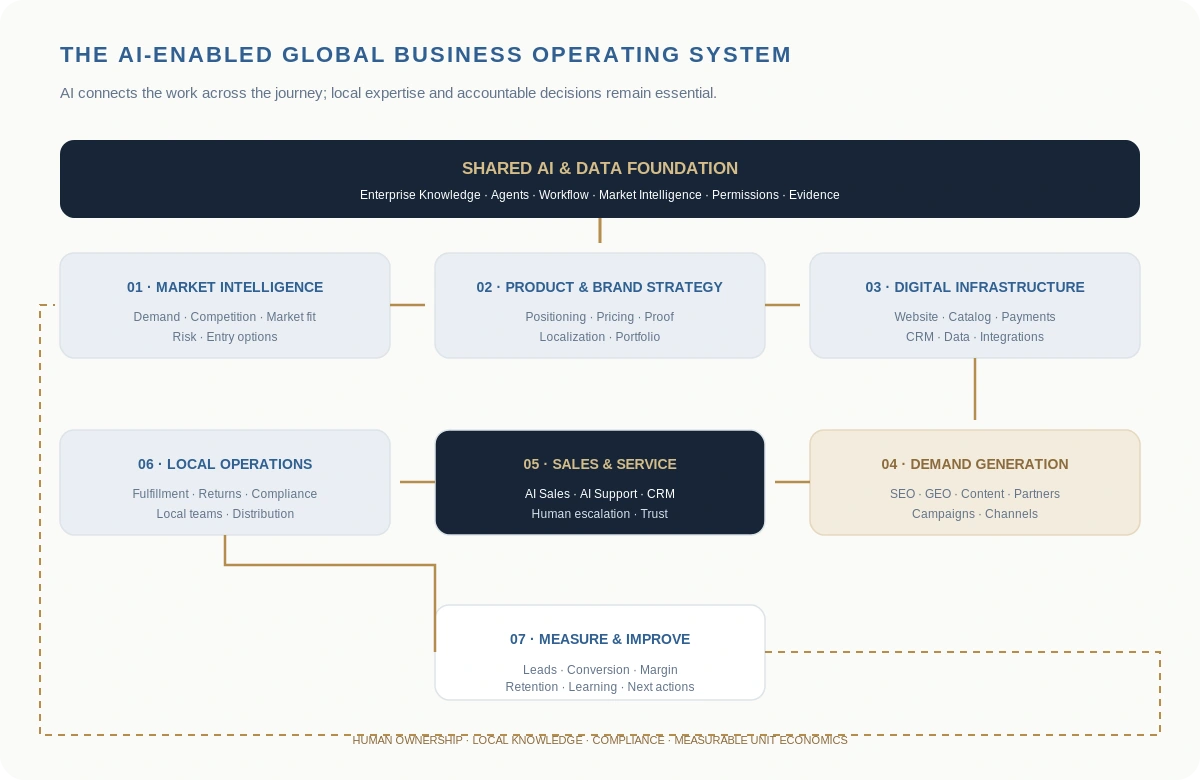
The AI-Enabled Global Business Operating SystemAI connects the global business journey, while local knowledge, human accountability and compliance remain essential.AIEASE INSIGHTS · DigiKK
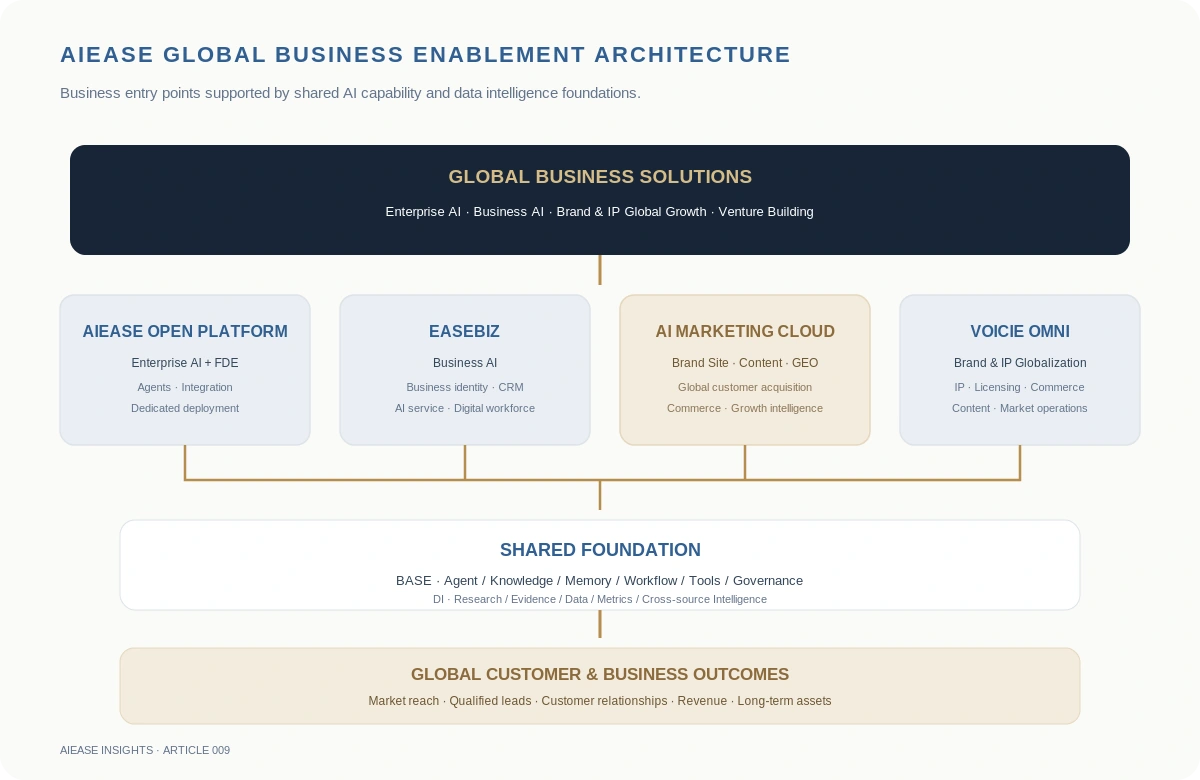
AIEASE Open Platform + FDE — For businesses requiring complex integration, provide agents, workflows, enterprise knowledge, system integration, dedicated deployment and ongoing engineering collaboration.
EASEBIZ · Business AI — Use BIZCARD, BIZSADOR, AI sales and service, digital employees and business collaboration to improve customer reception, follow-up and service efficiency.
AIEASE AI Marketing Cloud — Connect AI brand sites, content marketing, SEO/GEO, GRO intelligence and customer conversion to create a digital business destination for global customers.
VOICIE OMNI · Brand and IP Globalization — Help brands and IP build multilingual digital sites, content, licensing showcases, product commercialization and overseas customer touchpoints.
BASE + DI · Shared Foundation — Provide shared AI capabilities, agent and workflow runtime, plus market research, data, evidence and measurement capabilities.
AIEASE Global Business Enablement ArchitectureChoose the business entry point according to customer needs while reusing shared technology and data capabilities rather than rebuilding foundations.AIEASE INSIGHTS · DigiKK
A company at the beginning of its global journey may start with target-market research, a brand site, multilingual content and overseas inquiries. A business with existing overseas customers can connect CRM, AI sales, customer service, content operations and analytics. Larger enterprises or complex industries can use FDE to build AI systems deeply integrated with real business workflows.
Conclusion. The Next Competitive Advantage Is Global Operating Capability
Chinese businesses already have strong foundations in manufacturing, supply chains, R&D and product innovation. The next opportunity in the AI era is to turn these strengths into brands and business capabilities that global customers can understand, trust and continue to buy from.
A business does not need a large team in every global market from day one, nor does it need to build every system at once. A more practical path is to select priority markets, validate products and channels, establish digital infrastructure, use AI to improve research, content, sales and service, and expand investment according to real customer and operating data.
From product exports to brand globalization, from channel sales to customer operations, and from manual coordination to AI-enabled global workflows, Chinese businesses need more than overseas sales networks. They need global business systems that can learn, operate and create value over the long term.
In the AI era, businesses that truly go global do more than take products to the world. They take their brands, services, knowledge and operating capabilities with them.
Focused on the intersection of artificial intelligence and business innovation, enterprise intelligence, AI venture building and global business growth.
AI TechnologyBusiness StrategyAI VentureGlobal Growth