For many organizations, adopting AI has meant adding a chat window. Employees ask questions and receive answers; marketing teams draft copy; service teams respond to common questions; managers summarize documents. These uses are valuable, but most remain at the level of individual productivity. AI helps a person complete a task without necessarily changing how work is organized, handed off, executed or measured across the business.
Enterprise agents change the role of AI from a passive response tool into a participant in business work: one that can understand a goal, access authorized context, plan steps, use tools, coordinate with other agents and complete tasks within defined boundaries. An agent can participate in work, but it should never operate outside business accountability and governance.
A true enterprise agent system is not a screen filled with dozens of bots. It is an organized execution system that connects enterprise knowledge, data, applications, workflows, people and AI capabilities in a way that can be managed, audited, evaluated and improved.
Enterprise agent adoption is accelerating, but organizational readiness remains limited
40%Of respondents at organizations above US$1B in revenue reported scaling AI agents2026 · McKinsey
5%Of surveyed organizations said their business processes were highly prepared for agents2026 · Deloitte
72%Of surveyed leaders said they lacked unified, accessible dataDeloitte
McKinsey and Deloitte use different samples, definitions and survey scopes. The 40% figure refers to respondents at large enterprises reporting scaled agents; the other three figures come from Deloitte's survey of more than 500 U.S. business and IT leaders.
01. Enterprise AI Is Moving from Conversation to Business Execution
Generative AI first changed information work: reading, summarizing, writing, translating, researching and creating. Models then gained the ability to use tools to access files, search information, call APIs and update business records. The defining shift with agents is not tool use alone. It is the ability to work toward a goal, determine what information is needed next, select tools, interpret results and decide when to pause or request human involvement.
McKinsey's 2026 survey found that 80% of respondents said AI had improved their individual productivity, while 37% said AI had generated at least some impact on enterprise EBIT. These measures describe different things: better individual productivity does not automatically mean that business processes, revenue structures or operating outcomes have changed.
What enterprises need is not a more elaborate chat window for every employee. They need to redesign selected workflows so AI can complete defined tasks in real business context and return the results to accountable people and business systems.
02. Distinguish Assistants, Workflows, Agents and Agent Teams
There is no single universally accepted definition of an agent. A useful distinction from Anthropic's work on agentic systems is that workflows orchestrate models and tools through predefined code paths, while agents dynamically direct their own process and tool use during a task. Real products can combine both patterns.
Type
How It Works
Suitable Use Cases
Main Limitation
Type
How It Works
Suitable Use Cases
Main Limitation
AI Assistant
A user asks; AI generates an answer or recommendation
Knowledge Q&A, summarization, writing and personal assistance
Usually does not own an end-to-end business workflow
Workflow
Executes predefined steps, conditions and rules
Fixed approvals, content processing, data synchronization and standard service flows
Less flexible when unknown exceptions arise
AI Agent
Plans dynamically, selects tools and iterates toward a goal
Tasks requiring judgment, exploration and multi-step handling
Cost, latency, predictability and risk must be managed
Agent Team
Multiple role-specific agents coordinate through a manager or orchestrator
Cross-functional research, sales, operations and complex project work
Coordination cost, context consistency and accountability become more complex
This is not a mandatory maturity ladder. Simple tasks do not need agents. Stable and predictable tasks are often better served by workflows. Agents are justified when work requires dynamic judgment, exploration or adaptation based on intermediate results. Anthropic likewise recommends starting with the simplest solution that works reliably rather than adding complexity merely to call something an agent.
The first question in enterprise agent design is therefore not “How many agents should we create?” It is “What is the task input, what decisions are required, which tools are authorized, and who owns the outcome?”
03. Why a General Chatbot Cannot Own an Enterprise Workflow
A general chatbot can understand natural language, but it usually lacks company-specific product facts, customer context, process rules and system state. It may know how to draft a quotation, but not the company's current price version, customer discount authority, inventory position, approver or contractual constraints.
Missing Business Context — Products, customers, contracts, pricing, inventory, service policies and history are spread across systems.
Missing System Connections — The chatbot may not reliably query or update CRM, ERP, orders, projects, finance or content platforms.
Missing Task State — It may not know who owns a task, where it stopped, whether it failed or whether it should continue.
Missing Permission Boundaries — Natural-language instructions alone cannot establish whether a user may read, modify or approve a business record.
Missing Outcome Verification — Generating a response does not prove that a business system completed an action or that the intended outcome occurred.
An enterprise agent must operate within authorized business context. It needs to know which application it serves, which user or service identity it represents, which knowledge and tools it may access, which actions are read-only or writable, which require human approval and how outcomes are recorded.
04. What Makes an Enterprise Agent Reliable?
An enterprise agent is not just a prompt. It is a system object composed of role, context, knowledge, tools, execution policies and governance. Implementations vary by business, but the following elements should be explicit.
Role and Instructions — Define whom the agent serves, what it owns, what it must not do and what successful completion means.
Context — Provide relevant project, customer, product, task, time and user-intent information.
Knowledge — Retrieve authorized product information, business rules, documents, FAQs and verified facts.
Memory — Retain necessary interaction history, preferences, task state or long-term project context within authorization; do not turn every document into one unlimited memory store.
Tools and Connections — Use controlled interfaces to look up customers, create leads, read orders, generate content or submit approvals.
Workflow and Orchestration — Manage steps, conditions, delegation, agent handoffs, approvals and exception paths.
Runtime and Harness — Manage state, timeouts, retries, budgets, pause/resume, execution records and tool calls.
Governance and Evaluation — Manage identity, permissions, quality, safety, cost, audit, versions and human escalation.
These elements do not mean every agent needs a complex multi-agent framework. An agent that only retrieves product information may need retrieval, permissions and a clear output format. An agent handling customer complaints across systems may also need task state, tool calls, approvals, exception handling and more rigorous evaluation.
05. Agent Teams: Coordinate Work Instead of Collecting Bots
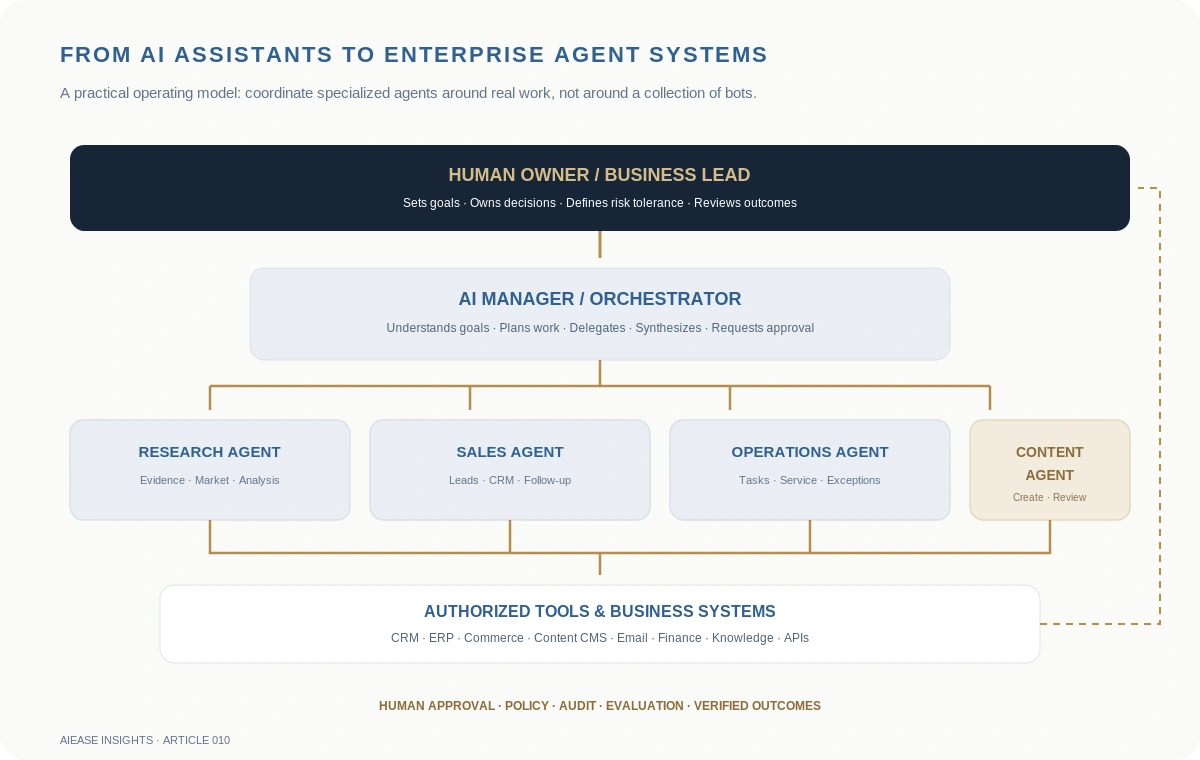
When a task spans several areas of expertise, an AI Manager or orchestrator can understand the goal, break down the work, delegate to specialist agents, synthesize results and report to the accountable owner. Specialist agents may handle market research, product, sales, content, customer service, data analysis or operations.
The point is not to give every agent unrestricted autonomy. It is to coordinate them within clear responsibilities. A research agent can provide sourced market findings; a sales agent can read authorized customer records and prepare follow-up recommendations; a content agent can draft against brand rules; publication remains subject to workflow and authorization.
From AI Assistants to Enterprise Agent SystemsOne AI manager coordinates specialist agents; people retain ownership of goals, approvals and business accountability.AIEASE INSIGHTS · DigiKK
Multi-agent collaboration needs explicit task contracts: inputs, output schemas, required evidence, authorized tools, failure behavior and the recipient of the result. Without these rules, adding more agents can create duplicated work, conflicting outputs and unclear accountability.
06. The Critical Boundary: AI Infrastructure Must Not Own Business Records
Enterprise agent systems must connect AI technology, data intelligence and business applications, but their responsibilities must remain distinct. Otherwise, organizations risk duplicate customer records, inconsistent business states and unauthorized changes to transaction data.
Layer
Primary Responsibility
What It Should Not Own
Layer
Primary Responsibility
What It Should Not Own
DI · Data Intelligence
Acquisition, evidence, research, metrics, cross-source analysis and insight
Does not replace CRM, ERP or commerce systems as the source of business records
Does not own customers, orders, inventory, contracts or transaction facts
Business Applications
Own business objects, business rules, customer records, transaction states, permissions and business metrics
Should not need to rebuild general model and agent runtime capabilities
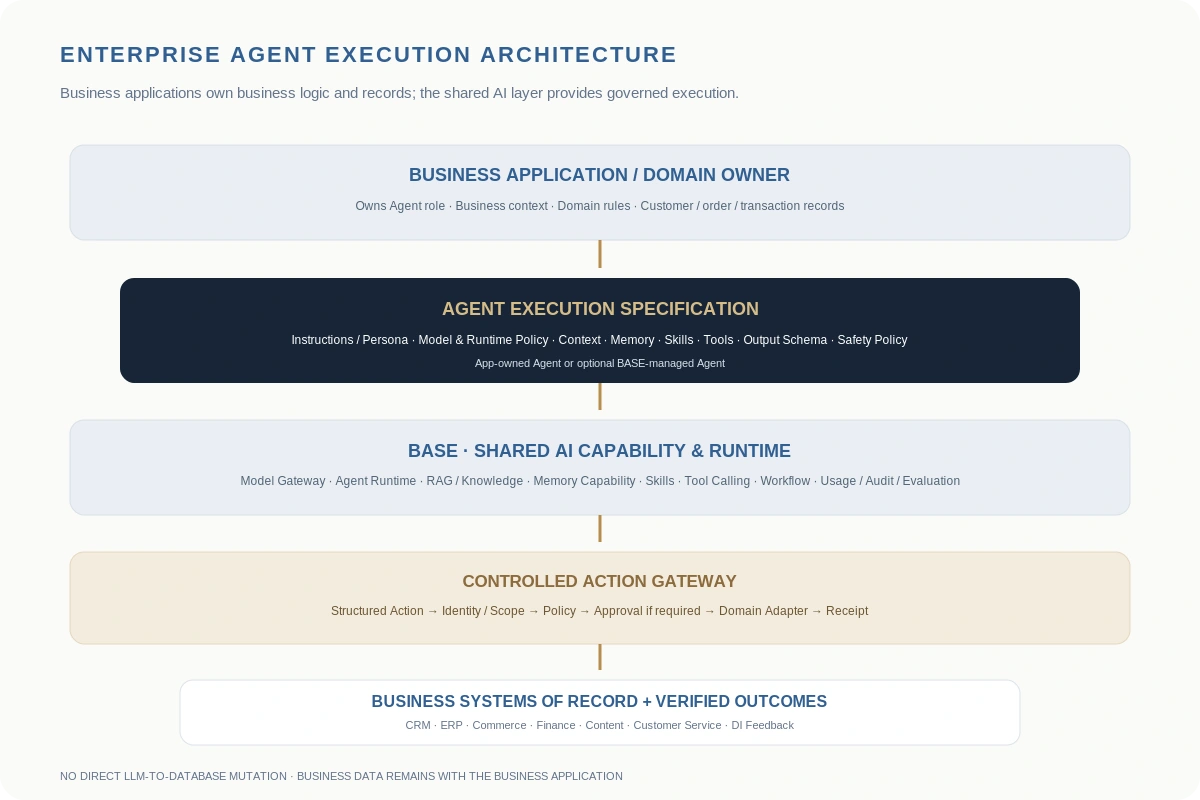
BASE provides agent execution capability, while a business application may own its own agent definitions, prompts, workflows and business context. Lightweight applications without their own management console may instead use optional BASE-managed agent hosting. Both models can coexist.
Knowledge and memory should also remain distinct. Knowledge is retrievable enterprise information and facts; memory is authorized, ongoing interaction and task context. Customer orders and financial transactions should remain in their business systems rather than being copied into an uncontrolled memory store simply because an agent needs context.
Enterprise Agent Execution ArchitectureBASE provides general execution; business applications own business facts; all writes pass through identity, permissions, policy and required approval.AIEASE INSIGHTS · DigiKK
AIEASE follows a clear architecture principle: BASE provides capabilities without taking over business ownership; business applications own their logic and data; the runtime executes; and DI provides research, evidence and analysis. This allows shared foundations while preserving the distinct business boundaries of different companies, products and industries.
07. From Agent Reasoning to Real Actions: Use a Controlled Execution Chain
The riskiest part of an enterprise agent is often not generating text but performing write actions: creating customers, changing orders, publishing content, sending email, adjusting prices or triggering payments. A model's suggestion must never become a direct database mutation.
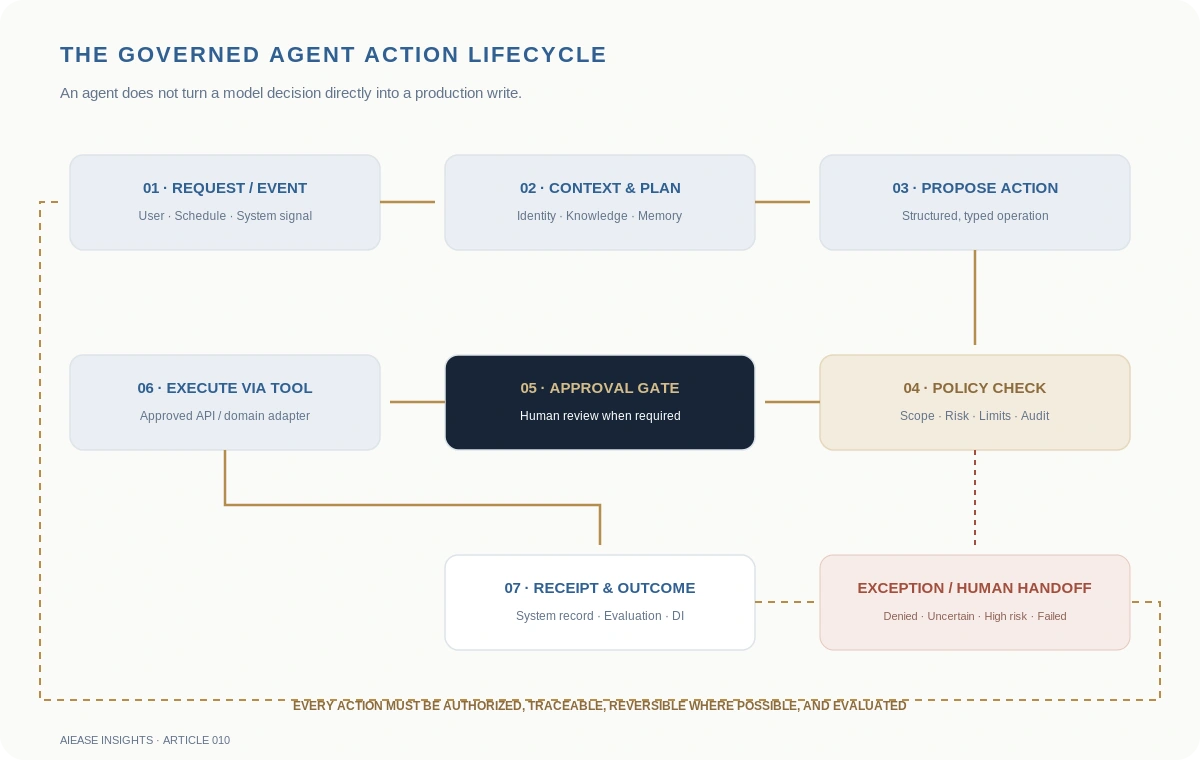
A safer execution pattern converts the agent's intent into a structured action. The business application and policy layer then determine whether it is allowed. Only after identity, permissions, parameters, business rules and required approvals are satisfied should a formal tool or business API perform the operation and return a traceable receipt.
Request or Event — Starts from a user instruction, scheduled task or business-system signal.
Context and Plan — Retrieve authorized enterprise knowledge, current task state and relevant business records; form an execution plan.
Proposed Action — Produce a structured action with target object, parameters, destination system and expected result.
Identity and Policy Check — Verify user or service identity, app, scope, data boundaries, risk level and business rules.
Approval Gate — Wait for an authorized person when an action is high-risk, irreversible or creates an external commitment.
Tool Execution — Call the business system through an authorized tool, connector or domain adapter—not arbitrary SQL or unrestricted HTTP writes.
Receipt and Outcome — Record execution receipt, system status, errors, actor, approval and subsequent outcome.
The Governed Agent Action LifecycleDenied, uncertain, high-risk or failed actions enter an exception and human-handoff path.AIEASE INSIGHTS · DigiKK
The essential principle is to separate model reasoning from business execution. An agent may propose an action, but whether it is allowed, who executes it, when it happens and whether it succeeded must be governed by explicit system rules and accountable people.
08. Governance: Permissions, Approvals, Audit and Human Oversight
The more authority an agent receives, the greater both its potential value and its risk. Being able to call tools does not mean it should call every tool; being able to run automatically does not mean approval is unnecessary. Permissions should start with the minimum required access and expand according to task risk.
Identity and Ownership — Define whether the agent acts for a user, business application or service identity; never mix identities.
Least Privilege — Grant only the data and tools needed for the task; distinguish read, create, update, delete, send and payment permissions.
Human Approval — Set approval gates for payments, refunds, price changes, contracts, important external publications and sensitive data exports.
Data Isolation — Control access by customer, project, application, department and role to prevent cross-tenant or cross-project exposure.
Audit and Traceability — Record inputs, context sources, tool calls, policy decisions, approvers, execution receipts and model versions.
Exceptions and Rollback — Handle timeouts, duplicate execution, tool failures, invalid parameters and business conflicts; design undo or compensating actions where possible.
Cost and Quality — Monitor model calls, tool usage, runtime, failure rate, human handoffs and task-completion quality.
OpenAI's Workspace Agents documentation provides a practical example of these controls: connected apps can authenticate as the end user or an agent-owned identity; write actions default to asking during a run; and specific action constraints can be added. NIST's Generative AI Risk Management Framework provides a cross-sector reference for identifying and managing risk. Both reinforce that permissions and accountability belong inside the agent system, not as an afterthought.
09. When to Use an Agent—and When Not To
Not every enterprise process should become agentic. An agent is not a universal replacement for a workflow. Architecture choices should consider uncertainty, the need for dynamic planning, cross-system information requirements and the consequences of failure.
Task Characteristics
Recommended Pattern
Examples
Task Characteristics
Recommended Pattern
Examples
Simple, low-risk, clear input and output
Single model call + RAG / structured output
FAQs, document summaries, product lookup
Fixed steps and clear rules
Workflow / traditional automation
Approval flows, invoice sync and scheduled reports
Requires exploration, judgment and dynamic tool selection
Single agent with controlled tools
Competitor research, complex inquiry analysis and anomaly diagnosis
Spans multiple disciplines and can be decomposed
Orchestrator with a small set of specialist agents
Market-entry research and cross-functional project planning
High-risk, irreversible or legally/financially consequential
Agent assistance plus human approval
Payments, refunds, contract signing and material price changes
Agent systems often add model calls, execution latency and operating cost, and may introduce less predictable failure modes. The design goal is not to maximize autonomy. It is to balance task value, accuracy, speed, cost and risk.
A practical rule is simple: if a process can be completed reliably through clear rules, use a workflow. Consider an agent when the next step must be chosen dynamically from intermediate results and that flexibility creates enough value to justify the added complexity.
10. Practical Enterprise Agent Use Cases
Business Area
What Agents Can Do
Responsibilities That Must Remain
Business Area
What Agents Can Do
Responsibilities That Must Remain
Manufacturing and supply chain
Read inquiries, match specifications, check inventory, organize technical information and prepare quotation drafts
Pricing approval, technical commitments, delivery confirmation and formal quotations remain with authorized people
B2B sales
Qualify leads, research accounts, summarize CRM context, plan follow-ups and draft emails
Account ownership, discounts, contracts and key commitments remain with sales owners
Marketing and brand
Research trends, plan content, draft multilingual materials, check brand rules and organize publishing tasks
Brand facts, copyright, advertising compliance and public release require review
Customer service
Identify intent, retrieve product and order information, draft responses and route complaints
Refunds, disputes, personal data and high-risk complaints require escalation
Finance and procurement
Organize invoices, detect anomalies, compare procurement documents and prepare reconciliation or approval packs
Business goals, resource allocation and major decisions remain with management
The common pattern is that agents do not replace existing enterprise systems. They become an intelligent coordination layer between information, people and systems. CRM still owns customer records, ERP still owns orders and inventory, and finance systems still own actual transactions. Agents understand tasks, use authorized capabilities and move workflows forward.
11. How to Move from One Agent Pilot to Enterprise Scale
An enterprise agent program should not begin with building a large multi-agent platform. A safer path is to select one real, frequent, valuable and bounded workflow, establish a baseline and expand incrementally.
Select a Business Workflow — Find work that is time-consuming, information-fragmented, repetitive or sensitive to response speed and customer experience.
Define Success Metrics — Record current processing time, accuracy, human intervention, conversion, error cost and customer experience.
Map Data and Systems — Identify data sources, system-of-record owners, APIs, tool permissions and exceptions.
Define Agent Boundaries — Specify role, inputs, outputs, tools, permissions, prohibited actions, approvals and failure handling.
Build an Evaluation Set — Use representative real tasks with appropriate anonymization or authorization, covering normal cases, edge cases and difficult exceptions.
Launch Narrowly — Start with one team or workflow, retaining human review and a rapid rollback path.
Monitor and Improve — Track quality, latency, cost, completion, exceptions, adoption and real business outcomes.
Reuse What Works — Package proven agents, skills, workflows, connectors, evaluation sets and operating practices into reusable capabilities.
Evaluation must go beyond whether an agent's response sounds fluent. It should test whether the agent retrieves the right information, calls the right tools, respects permissions, handles exceptions, routes work to the right person and whether the business system actually completes the intended operation. A successful demo is not a substitute for ongoing production evaluation.
12. FDE: Bringing Enterprise Agents from Prototype into Real Work
When workflows are complex, data is fragmented, system environments are unique or standard products cannot perform reliably, an enterprise may need Forward Deployed Engineering (FDE). FDE brings engineers and business teams together to identify critical workflows, connect systems, build agents, validate quality and move into production.
Microsoft's October 2026 perspective describes FDE as evolving from an individual engineering role into a small multidisciplinary delivery team spanning software and AI engineering, domain expertise, data, process, delivery management and security governance. The goal is not merely to deliver a prototype, but to redesign critical workflows, build production systems and transfer capability to the customer team.
FDE is not the default delivery model for every agent project. Standard capabilities should be preferred for simple Q&A, content generation and tasks already handled reliably by mature products. Deeper engineering is justified when business context, system integration, workflow redesign, production reliability or organizational adoption becomes the critical barrier.
13. AIEASE: From BASE to Enterprise Agent Teams and Ongoing Operations
AIEASE's enterprise agent approach does not require every customer to rebuild models, agent runtimes and tool platforms. BASE provides shared AI capabilities; business applications own their context and data; and DI, workflows, business systems and long-term operations are connected according to the complexity of the enterprise.
AIEASE Enterprise Agent Execution ArchitectureShare common capabilities, keep business definitions with applications and route writes through controlled execution.AIEASE INSIGHTS · DigiKK
AIEASE Capability Layer
Primary Responsibility
Role in an Enterprise Agent System
AIEASE Capability Layer
Primary Responsibility
Role in an Enterprise Agent System
BASE · AI Capability Layer
Model services, agent runtime, knowledge, memory capability, skills, tools, workflows, usage, audit and evaluation
Provides reusable, authorized and governed AI execution capabilities
DI · Data Intelligence
Data acquisition, evidence, research, metrics, cross-source analysis and insight
Provides market, customer and operating evidence for decisions and feedback
Business Applications
CRM, ERP, marketing, sales, service, commerce, finance and industry applications
Own business facts, rules, transaction states, user interfaces and business metrics
OPERATE / MANAGE
AI manager, specialist-agent collaboration, goals, plans, actions, approvals, outcomes, memory and ongoing operations
Supports long-running projects and business operations beyond one-off task execution
FDE · Business-Specific Engineering
Business diagnosis, system integration, dedicated agents, workflows, production validation and capability transfer
Addresses enterprise-specific requirements that standard products cannot reliably meet
For business applications, AIEASE BASE supports both App-owned agents and optional BASE-managed agents. Mature applications can manage agents, prompts and workflows in their own backends while consuming BASE execution capabilities; lightweight applications may use BASE-managed configuration. This preserves business ownership while avoiding duplicated infrastructure.
For long-running projects, an AI Manager can serve as the primary interaction point and coordinate specialist agents for product, marketing, sales, service and intelligence. Goals, tasks, approvals, operation records and outcome feedback are managed by the business operating system, while business applications continue to own actual customer, order and transaction records.
Conclusion. The Goal Is Better Work, Not More Agents
Enterprises are not short of AI tools that can answer questions. What remains scarce is an intelligent operating system that understands business context, connects enterprise systems, executes within permission boundaries and continuously verifies outcomes.
The competitive advantage of the future will not come from the number of agents deployed. It will come from which workflows are redesigned, which business knowledge is captured, which tasks can be completed reliably through collaboration and whether the organization can continuously manage and improve those capabilities.
Agents are new participants in work. Workflows organize execution. Business applications own facts and transactions. Governance creates trust. Only when these elements work together can AI move from a personal productivity tool to an enterprise productivity system.
The real value of enterprise AI is not having machines answer more questions. It is enabling people and agents to complete work that was previously difficult to coordinate, connect and continuously improve.
Focused on the intersection of artificial intelligence and business innovation, enterprise intelligence, AI venture building and global business growth.
AI TechnologyBusiness StrategyAI VentureGlobal Growth