For years, businesses wanted their pages to appear near the top of search results. A user entered keywords, a search engine returned links, and the user opened pages one by one to read, compare and decide. Digital visibility was largely measured through indexing, rankings, click-through rates and website traffic.
Generative AI is changing that journey. A user can ask a much richer question—for example, “Which AI customer-management systems are suitable for small businesses? How do they differ? Which support multilingual and cross-border operations?” An AI search system may expand the question, retrieve multiple sources, synthesize information and produce an answer with links for further exploration.
In this environment, a brand may have well-ranked pages and still be absent from a particular AI answer. Conversely, a page with clear evidence, accurate product information and a distinctive point of view may become a source used by AI to understand a topic. Competition is expanding from the ranking of individual pages to the way a brand's information participates in generated answers.
AI search visibility is becoming more observable
GoogleSearch Console reports visibility in generative AI featuresAI Overviews
BingAI Performance reports cited pages and grounding queriesCopilot
OpenAIPublishes OAI-SearchBot search crawler guidance and controlsChatGPT Search
PerplexityDocuments PerplexityBot and user-triggered fetchingPerplexity Search
Coverage, metric definitions and sampling methods differ by platform. First-party visibility data is not a complete log of user queries and does not represent brand rankings or traffic share.
01. What Is GEO—and What It Is Not
GEO (Generative Engine Optimization) generally describes work intended to improve how a brand and its content are discovered, cited, understood and represented in generative AI search and answer experiences. Other terms include AEO (Answer Engine Optimization) and AI Search Optimization. Terminology is still evolving, and there is no reason to assume that every platform uses the same algorithm or measurement standard.
GEO is not a mysterious ranking system that operates independently of search foundations. Google's 2026 guidance states that generative AI search features remain rooted in its core Search systems and foundational SEO practices. From Google's perspective, optimizing for generative AI search is still part of optimizing the search experience. Its official guide also cautions site owners against unsupported GEO hacks.
GEO is therefore better understood as an ongoing operating discipline spanning technical accessibility, brand entities and facts, content quality, third-party trust, platform measurement and business attribution—not as a single tactic that guarantees an AI recommendation.
02. From Keyword Search to Generated Answers
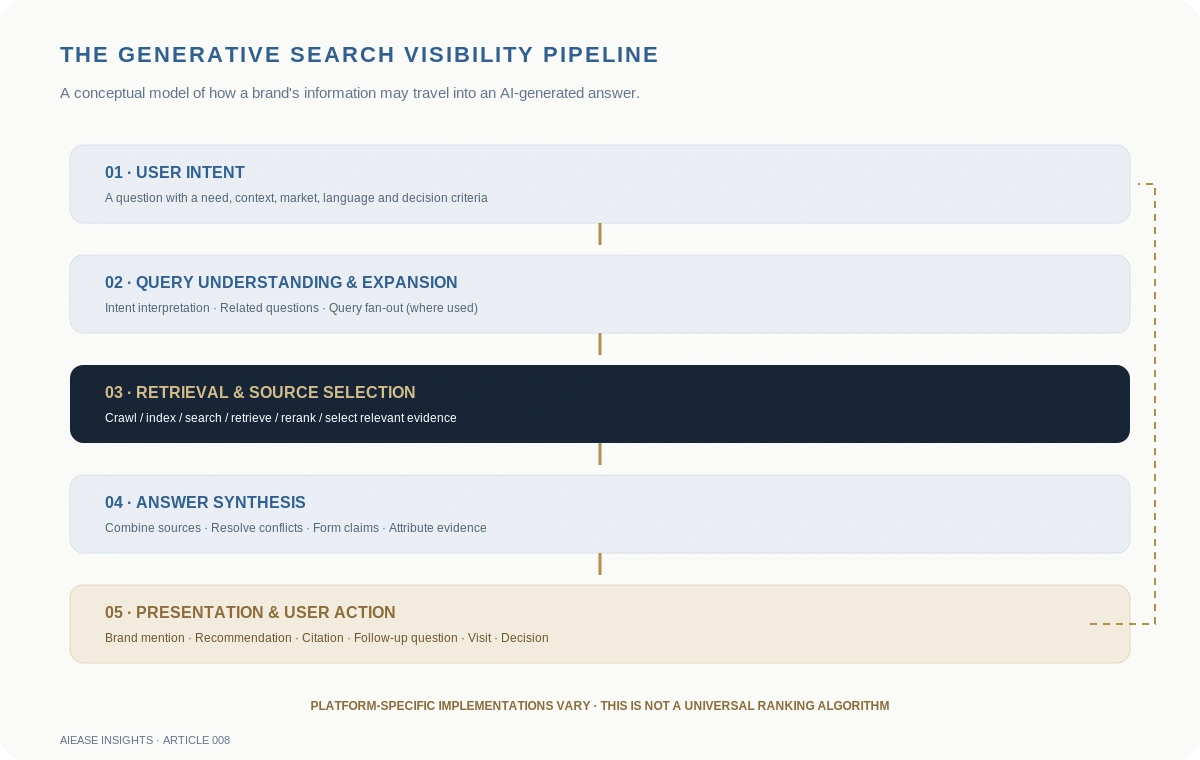
Traditional search primarily presents a list of pages. Generative search may first interpret the user's full intent, break a question into related sub-queries, retrieve different sources and synthesize evidence into an answer. Google describes one such mechanism as query fan-out: the system can issue multiple related queries around the original question to gather more information.
The final answer may include brand names, product comparisons, factual explanations, recommendation reasons and citations. A user may visit the official site, ask a follow-up question, consult another source or form an initial judgment without opening the original page. Brand visibility therefore occurs not only on a search-results page, but also in how an answer is assembled, which information is used and how sources are presented.
This is why a business cannot rely only on tracking the ranking of a keyword. It needs to understand the real questions customers ask, which pages AI cites for which topics, whether product information is represented accurately and whether those answers lead to visits or qualified inquiries.
The Generative Search Visibility PipelineThis is an explanatory model, not a claim that every AI search platform uses the same internal steps or ranking algorithm.AIEASE INSIGHTS · DigiKK
03. SEO and GEO: Complementary, Not Competing
SEO remains a foundational capability for a brand website. Crawlability, indexability, clear site architecture, useful content and page accessibility all affect whether search systems can discover and understand a site. Generative AI search has not made these fundamentals irrelevant.
GEO adds a further set of questions: Does the brand appear in relevant AI answers? Which pages are cited? Does AI understand the product or service accurately? Is brand information attributed incorrectly? Are results consistent across questions, markets and platforms?
Dimension
SEO
GEO
Primary object
Web pages and search traffic
Brands, content, citations and understanding in generated answers
Foundations
Crawling, indexing, page quality and site architecture
SEO foundations plus platform sampling, answer participation and factual accuracy
Common observations
Impressions, rankings, clicks and organic traffic
Mentions, explicit recommendations, citations, answer accuracy and AI referrals
Content focus
Meet search intent with useful pages
Provide verifiable facts, complete explanations, unique evidence and clear context
Business validation
Visits, leads, sign-ups and orders
The same outcomes, including assisted conversions
Main limitations
Search algorithm and competitive changes
Black-box systems, answer variability, sampling bias and difficult causal attribution
The most effective approach is not to build a separate GEO content universe that competes with SEO. It is to connect SEO, brand content, product data, AI-search monitoring and business analytics. A site that is technically inaccessible or factually incomplete does not become a trustworthy source simply because it adds GEO prompts.
04. Visibility Is More Than a Mention
A brand appearing in an AI answer does not necessarily mean that the AI recommended it. The brand may be mentioned as an example or used to explain a category. A cited page may also have little influence on the answer's central reasoning. GEO therefore needs to distinguish different layers of visibility.
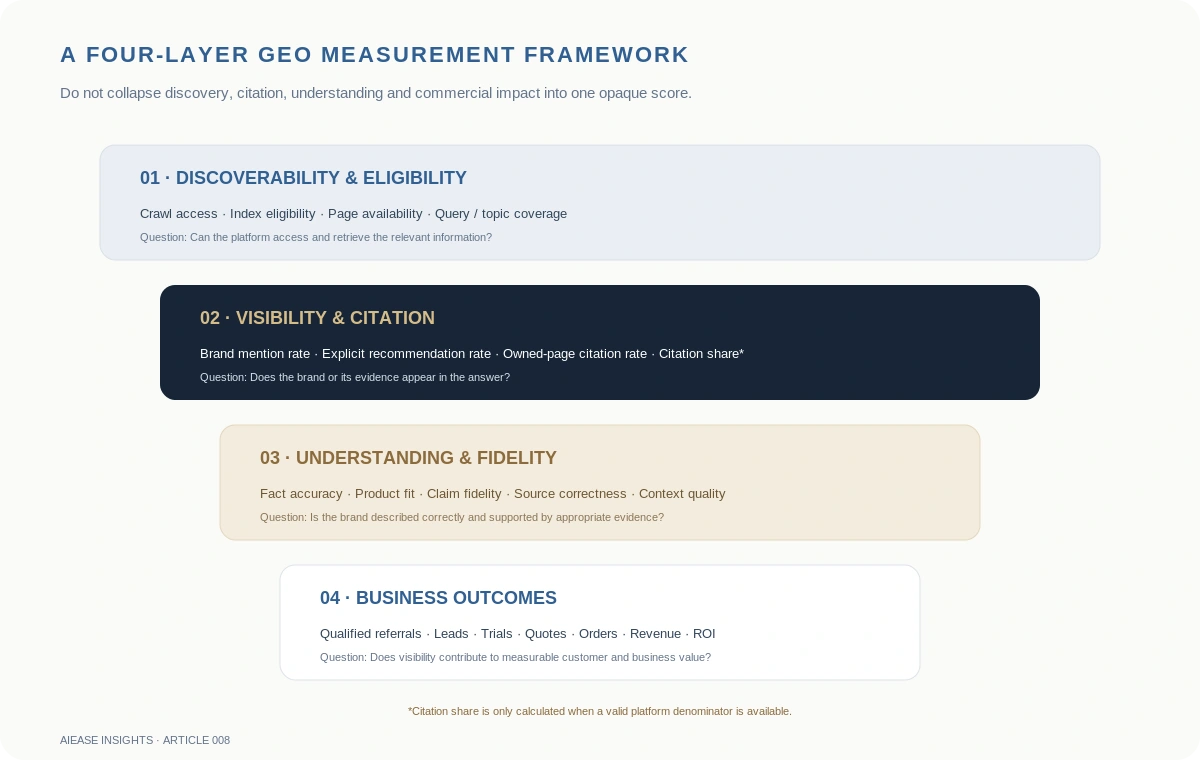
Discoverability — Can the platform access, crawl, index or retrieve information related to the brand?
Citation Selection — Is the brand or one of its pages selected as a source, and how is it presented?
Citation Absorption — Does the cited information actually shape definitions, facts, comparisons, reasoning or recommendations in the answer?
Business Impact — Does the answer contribute to visits, inquiries, trials, partnership opportunities, orders or revenue?
A 2026 research working paper examining ChatGPT, Google AI Overviews/Gemini and Perplexity separates citation selection from citation absorption. It highlights that appearing in a citation list and actually influencing the generated answer are different outcomes. Its findings come from a controlled prompt set and a public dataset, so they should be treated as observations within that study—not universal rules for every brand.
A Four-Layer GEO Measurement FrameworkEach layer answers a different question: can it be found, does it appear, is it understood correctly, and does it create business value? Do not collapse them into one opaque score.AIEASE INSIGHTS · DigiKK
05. Build a Clear and Trustworthy Digital Brand Entity
For AI to understand a brand accurately, it first needs to identify what the brand is. A brand may have Chinese and English names, abbreviations, former names, product brands and a corporate entity. Different companies may also share similar names across countries and industries. Without consistent identity information, AI may confuse the company, its products, people, sub-brands or competitors.
Canonical Identity — Maintain the official brand name, corporate entity, website, domains, aliases, industry and primary markets.
Product and Service Facts — Keep product names, features, intended users, pricing definitions, service scope, limitations and update dates consistent.
People and Organization — Describe founders, executives, experts, partners and their actual relationships accurately.
Official Sources — Keep the website, product pages, help center, public materials and official social profiles consistent.
Evidence and Provenance — Support important claims with verifiable cases, data, documents, research or third-party sources.
This does not mean creating more pages. It means establishing a reliable foundation of brand facts. Product features, prices, certifications, customer cases and licensing information must be confirmed by accountable business owners, and related pages and materials should be updated when facts change.
06. Create High-Quality Content Worth Citing
AI can generate large amounts of generic explanation. The content that truly differentiates a business is the set of facts, experience, viewpoints and evidence that other sources cannot easily replace. Brands should start with real customer questions: what the product is, which problem it solves, whom it serves, how it differs from alternatives and when it may not be suitable.
Original Expertise — Share real business experience, professional judgment, original research and verifiable project practice—not rewrites of generic web content.
Evidence-Rich Explanations — Support important claims with data, methods, cases, images, diagrams and source citations.
Clear Product Comparisons — State the comparison set, evaluation criteria, intended use and differences; avoid unsupported claims such as “best” or “number one.”
Useful Page Structure — Use descriptive headings, natural paragraphs, tables, processes and relevant FAQs to help people understand and navigate the content.
Named Responsibility — Identify authors, reviewers, update dates and scope, especially for pricing, policies and technical information.
Consistent Multilingual Content — Adapt expression for each target market while keeping product facts and brand promises consistent.
Google's 2026 guidance emphasizes original, helpful, reliable and people-first content. It explicitly cautions against mass-producing low-value pages merely to cover every query variation. Clear structure helps readers and retrieval, but there is no universal ideal page length and no need to mechanically split every article into tiny fragments for AI.
07. Technical Accessibility and Platform Crawler Controls
Even excellent content may not enter retrieval if search systems cannot access it, pages cannot be indexed or essential facts exist only in unreadable images. A technical audit should first verify site stability, access to important pages and machine-readable presentation of content.
Crawl Access — Review robots.txt, CDN/WAF rules, HTTP status, access restrictions and whether relevant platforms can read target pages.
Index and Canonical — Check indexing eligibility, canonical URLs, duplicate pages, redirects, sitemaps and internal links.
Readable Content — Ensure key facts are available as text; review JavaScript rendering, mobile presentation and main content accessibility.
Structured Data — Use accurate structured data where appropriate and ensure it matches information visibly present on the page.
Freshness and Stability — Maintain product facts, prices, availability, policies, authors and update dates; prevent important pages from becoming stale.
Human Experience — Make it easy for visitors to understand the product, find evidence and complete an inquiry or transaction.
AI platforms do not all use the same crawler or user-triggered access mechanism. OpenAI documents OAI-SearchBot for discovery in ChatGPT search and GPTBot for crawling that may be used for model training; the controls are independent. Perplexity likewise documents different roles for PerplexityBot and Perplexity-User. A website should make access decisions according to its content rights, privacy and business strategy—not simply allow or block every AI crawler.
By August 31, 2026, Google had rolled out its Search generative AI control to websites worldwide. Site owners can manage whether their content is included in Google's generative AI Search features through Search Console; inclusion is the default. This control is distinct from ordinary Search ranking and from model-training controls, so owners should review the platform's official documentation before changing it.
Platform / Tool
What Can Be Observed or Controlled
Important Caveat
Google Search Console
Generative AI visibility, pages, countries, time; Search generative AI control
Visibility data is not a fixed ranking and does not guarantee citation
Bing Webmaster Tools
Cited pages, grounding queries, topics and citation share
Some capabilities are Beta/Preview; a citation is not a click or visit
OpenAI
Crawler access controls such as OAI-SearchBot and GPTBot
Search discovery and model-training controls are independent
Perplexity
PerplexityBot and Perplexity-User access mechanisms
Automated crawling differs from user-triggered fetching
08. Build Real Third-Party Trust and Source Coverage
A brand's official website is one of its most important sources of truth, but AI search may also draw on media coverage, industry research, professional organizations, partners, product reviews, community discussions and public databases. If a brand only repeats its own claims on its website, it may not fully answer questions about market reputation, real-world use and competitive differences.
Businesses should build a verifiable information network through genuine customer cases, industry partnerships, expert interviews, original reports, media coverage, public talks, partner materials and authentic user feedback. Cases, reviews and partnerships must be real, appropriately authorized and traceable.
Google explicitly cautions against seeking inauthentic brand mentions to manipulate search visibility. Fake reviews, mass-produced low-value links and fabricated endorsements do not create durable trust and may expose the brand to reputational and compliance risks.
09. How to Measure GEO Without an Opaque Score
Businesses should measure GEO in layers. Different metrics answer different questions. Brand mentions, citations, traffic and revenue should not be mixed together, and one AI answer should never be treated as a stable measure of market share.
Brand Mention Rate — The share of valid observations in a fixed prompt set where the answer contains the brand or approved aliases. It measures appearance, not recommendation.
Explicit Recommendation Rate — The share of valid observations where the answer clearly considers the brand suitable or recommends it for the user's need; recommendation context requires rule-based or human review.
Owned-Page Citation Rate — The share of valid observations that cite at least one brand-owned page. Record the exact URL and platform.
Citation Share — When a platform exposes a complete citation denominator, calculate the brand site's share of citations for the same query or topic. If no denominator exists, mark it unavailable.
Brand Fact Accuracy — The share of sampled AI descriptions of product features, prices, markets, certifications and service promises that match approved facts.
Business Outcomes — AI referral visits, qualified inquiries, trials, quotations, partnership applications, orders, revenue and assisted conversions.
Bing AI Performance provides observations such as cited pages, grounding queries and citation share. Microsoft explicitly states that citation volume and citation share are not rankings, traffic or content-quality scores, and a change alone does not prove that a particular content update caused the result. Google Search Console's generative AI report measures visibility in Google's own AI Search features. Platform data must be interpreted separately.
A meaningful GEO evaluation should answer four questions: Can the brand be found? Is it cited appropriately? Does AI understand the brand accurately? Do these changes contribute to customers and business value?
A Four-Layer GEO Measurement FrameworkDo not combine different layers into an unexplained score. Each metric should disclose its source, sample size, platform, market and time window.AIEASE INSIGHTS · DigiKK
10. Make GEO Measurement Reproducible
AI answers change with model versions, search indexes, user questions, regions, languages, time and competing content. The same prompt can produce different answers at different times without any change to the brand. Businesses therefore need a reproducible sampling method.
Build a Prompt Set — Organize questions by information seeking, problem solving, research, product comparison, purchase intent, brand navigation and local needs.
Lock Sampling Conditions — Record platform, exact surface or API, country, language, prompt version, date, model information and repetition count.
Preserve Raw Observations — Store original answers, citation URLs, source method, timestamps, failures and parser version—not only summary scores.
Separate Source Methods — Verified consumer-surface or authorized sampling, official search APIs and non-search model proxy tests must be labeled separately and never mixed as one GEO visibility measure.
Show Sample Size and Variability — Report valid samples, failures, coverage and time windows. When evidence is insufficient, show insufficient data rather than false precision.
Use Controlled Verification — After content changes, retest with the same prompt set, platform and conditions. Where useful, maintain an unchanged control set and disclose other possible influences.
AIEASE GEO v1.2 distinguishes three source methods: verified consumer-surface or authorized surface sampling, official search API sampling and ordinary model-only proxy testing. A model API response must never be presented as if it were the result a consumer saw in the ChatGPT or another platform's consumer interface. This is a foundational requirement for trustworthy GEO data.
A 2026 critical survey of GEO research finds that metrics, sampling and evidence standards remain heterogeneous, with substantial variability across platforms. It recommends repeated measurements, prompt paraphrases, controls and human validation rather than relying on one sample or one platform.
11. From Monitoring to Growth: Build a Continuous GEO Operating Loop
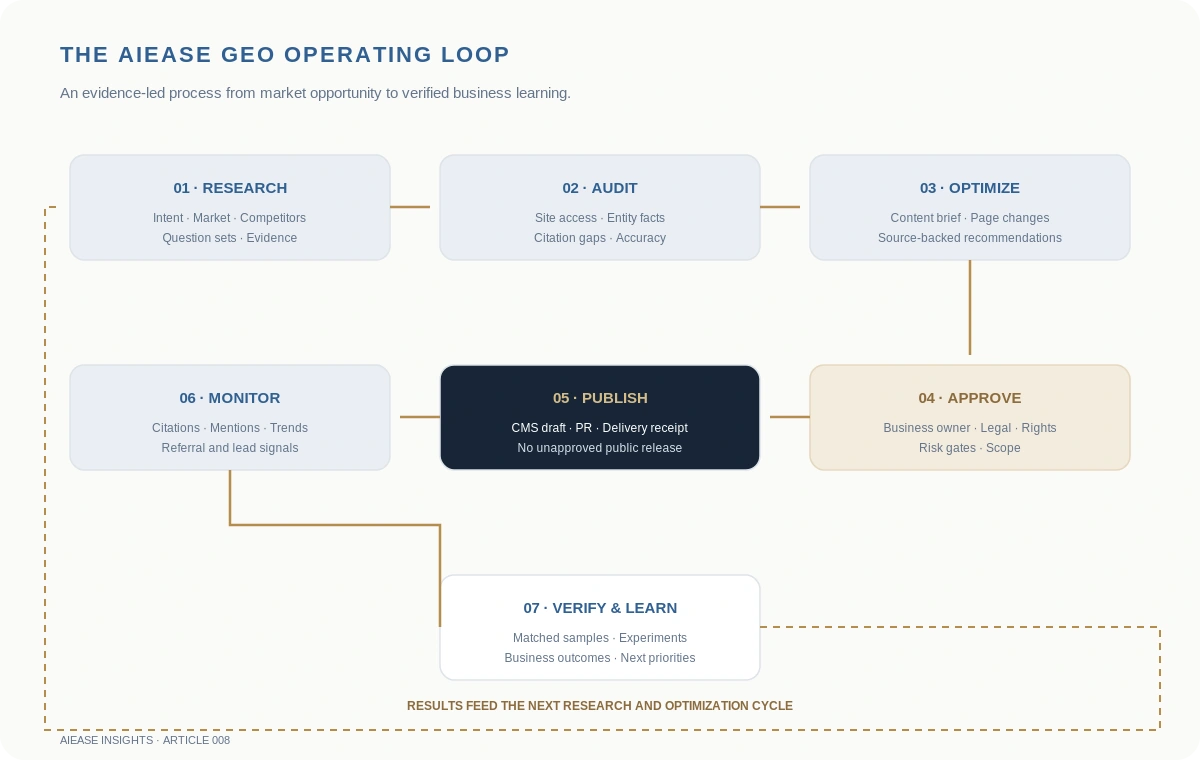
AI-search monitoring alone tells a business whether its brand appeared in selected answers. GEO becomes an ongoing operating capability only when monitoring is connected to content improvement, approved publication and business remeasurement.
Research — Study real customer needs, market intent, competitors and high-value questions; create an evidence-based prompt set.
Audit — Review brand facts, product information, site accessibility, page content, citations and competitive gaps.
Approve — Have brand, product, legal, IP or website owners review facts, rights, risks and external commitments.
Publish — Deliver approved content to the CMS, official site or authorized publishing workflow; retain URLs, versions and delivery receipts.
Monitor — Use fixed prompt sets and sampling rules to observe mentions, citations, brand understanding and changes.
Verify — Compare pre- and post-publication observations with website visits, qualified leads and business events to determine the next improvement cycle.
The AIEASE GEO Operating LoopAgents support research, diagnosis, planning and drafts; business owners approve public content; consistent remeasurement and business metrics feed the next cycle.AIEASE INSIGHTS · DigiKK
12. AIEASE GEO and BIZGEO: Turning GEO into an Ongoing Growth Capability
Within AIEASE's product architecture, GEO should be more than a content-generation tool, and it should not simply be absorbed into DI or BASE. It is a shared GEO domain service responsible for brand and site assets, prompt sets, sampling observations, citations, diagnostics, recommendations, approvals, delivery receipts and experiment data.
System
Responsibility in the GEO Architecture
Relationship
DI · Data Intelligence
Market intent, competitor research, opportunities and evidence
Supplies query discovery and market research context
BASE · AI Capability
Identity and entitlements, models, agents, skills, tools and workflow runtime
Provides general AI execution; does not own GEO metrics
Owns shared GEO business data and cross-entry APIs
BIZGEO
EASEBIZ commercial entry and commercial Domain Profile
Applies shared GEO capabilities to business brands and websites
AIEASE GEO SaaS
Standalone GEO product entry
Serves independent customers with monitoring, analysis and optimization
VOICIE / Other Entries
Authorized domain-specific profiles and skills
Reuse GEO CORE without duplicating the monitoring foundation
OPERATE
Optional long-term operations, cross-team tasks and complex coordination
Not a mandatory dependency for standalone GEO customers
The architectural principle is one shared GEO CORE, multiple authorized business entries, and domain-specific profiles and skills. AIEASE GEO and BIZGEO do not need separate monitoring data foundations. Authorized entries access the same brand and site assets. Commercial brands use a commercial profile, while future IP workflows can use an appropriately authorized IP profile.
At the execution layer, agents can identify issues, analyze citation gaps, recommend content strategies and create drafts. Public publication, product pricing, commercial commitments, copyright permissions and high-risk page changes must be approved by the appropriate owner. Every recommendation should retain evidence, versions and execution records, followed by verification of whether it improved brand information and business outcomes.
Conclusion. The Goal Is Not a Mention—It Is an Informed Customer Decision
AI search is changing how customers discover information and form judgments. Yet brands still build lasting trust through real products, credible evidence, clear communication and reliable service. No business can fully control how a third-party AI system retrieves, selects and organizes its answers.
What a business can control is the quality of its digital information, site accessibility, brand facts, content assets, third-party trust and customer experience. What it can observe is brand mention, citation, understanding and referral across different platforms. What it must ultimately validate is qualified inquiries, customer choice and business outcomes.
GEO should not become a game of chasing short-term AI rankings. It should become part of long-term digital brand building: help the brand be understood accurately in more real-world questions, ground every public claim in evidence and make every optimization cycle reviewable.
True AI visibility is not about making AI repeat a brand name. It is about ensuring that when customers ask important questions, the brand can contribute accurate, credible and useful information to the answer.
Focused on the intersection of artificial intelligence and business innovation, enterprise intelligence, AI venture building and global business growth.
AI TechnologyBusiness StrategyAI VentureGlobal Growth