Over the past few years, rapid AI progress has produced a growing range of models, tools, agents, applications and startup concepts. Founders can prototype at lower cost, enterprises can test new workflows faster, and investors can see new industry opportunities. Yet technical feasibility is not the same as market demand; a working prototype does not prove willingness to pay; and raising capital does not mean a sustainable business model has been established.
Real AI venture building is not asking AI to turn an idea into a business plan. It is a disciplined process connecting opportunity discovery, customer-problem validation, market analysis, business design, product testing, technical build and operating review. Each stage needs a clear question, evidence, decision and next investment.
This process applies to startups built from scratch, new business initiatives inside established companies, industrial innovation projects, internal AI transformation, investment screening and new ventures created by teams with existing brands, distribution, technology or IP assets.
AI is widely entering organizations, but the path from adoption to business value remains unfinished
88%Of surveyed organizations reported using AI in at least one business function in 20252026 · Stanford HAI
70%Of surveyed organizations reported using generative AI in at least one business function2026 · Stanford HAI
11%Of surveyed leaders said their organizations had reached the AI reinvention horizon2026 · McKinsey
20%Of surveyed organizations reported AI revenue gains in Deloitte’s January 2026 resultsJanuary 2026 · Deloitte
The surveys use different samples, definitions and measures. McKinsey's 11% refers to surveyed leaders reporting that their organizations reached the AI reinvention horizon; Deloitte's 20% refers to surveyed organizations reporting revenue increases from AI, not an AI project success rate. This is the January 2026 figure; Deloitte’s later 2026 update reports 28%.
01. The Biggest AI Venture Mistake: Starting with Technology Instead of the Customer Problem
Many AI projects begin with a technical capability: a model that generates video, an agent that browses the web, a multimodal model that recognizes images or an open-source framework that connects tools. The team then searches for a use case and tries to package it as a product.
This creates a technology-first, demand-later problem. A demo may look impressive while users have no urgent pain; a product may perform a task that existing processes already handle cheaply; customers may try it but refuse to pay for it. The result is a project that attracts attention during demonstrations but lacks sustained usage in the real market.
A stronger starting point is a specific customer group and a real work problem: who experiences what difficulty, in which context? How often does it occur? How much time, cost, revenue or risk does it create? How is it solved today? Who owns the budget and purchasing decision?
02. Is an AI Opportunity Worth Pursuing? Six Fundamental Questions
Before committing to extensive research, development or fundraising, every opportunity should pass an initial structured screen. The answers do not need to be perfect, but the team must identify the most important unknowns and decide what to validate next.
Is the problem real? — Can you identify target users and show that the problem actually occurs rather than being imagined by the team?
Does the problem matter? — Is it frequent, urgent or costly, or does it affect revenue, customer experience, safety or compliance?
Will customers pay? — Who uses it, benefits from it, owns the budget and makes the purchase decision? Will they commit budget or resources?
Is the market viable? — Is there a sufficient number of potential customers in the target segment and a credible path to reach them?
Does AI create a material advantage? — Does AI meaningfully improve cost, speed, quality, accessibility or create a new capability—not merely add a chat interface?
Can the team deliver? — Does the team have the domain knowledge, technical ability, distribution, data rights, capital and implementation conditions?
These six questions are not simply a scoring system for deciding whether a venture lives or dies. They reveal its weakest assumptions. If the market looks large but the customer problem is unclear, conduct customer research. If demand is real but the technical path is uncertain, run a feasibility test. If the product works but willingness to pay is unknown, test payment before adding more features.
03. From Opportunity Discovery to Product-Market Fit: A Six-Stage Venture-Building Method
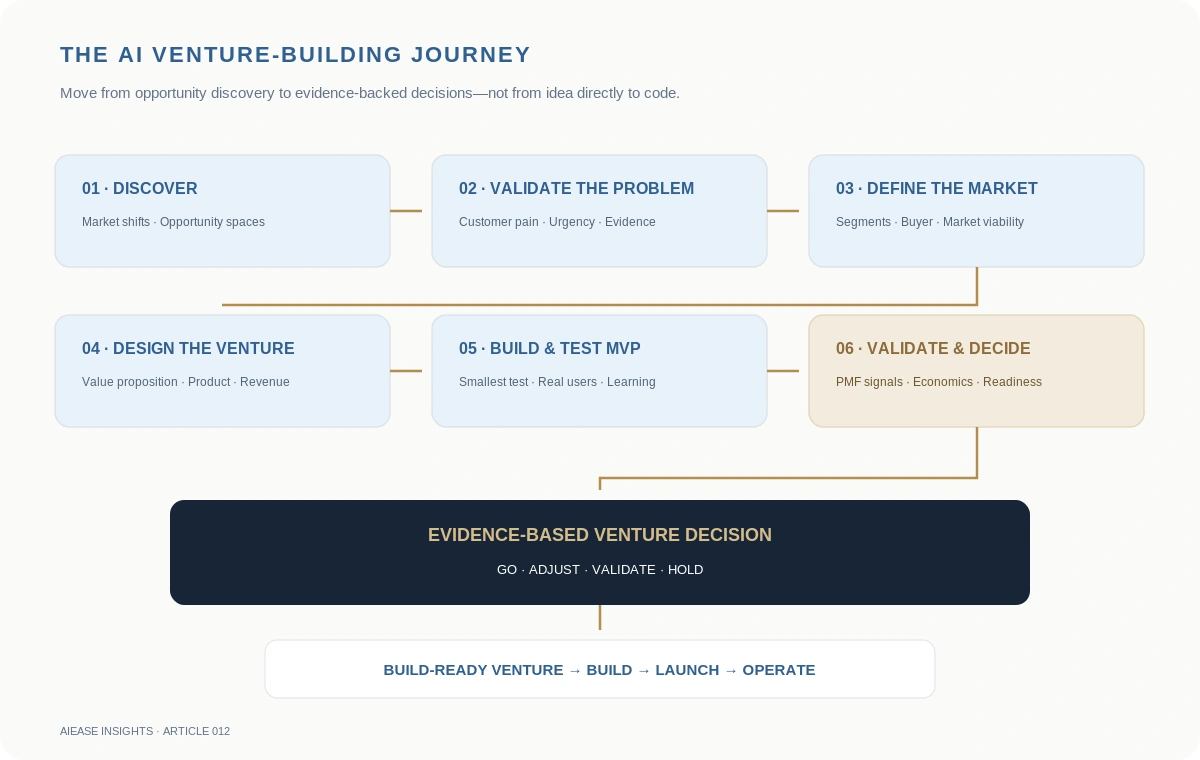
In “How GenAI Can Prompt a Faster, Less Risky Future of Venture Building,” published through the Singapore Economic Development Board, BCG X describes six stages of early venture building: discover opportunities, prioritize and validate user problems, define the target audience, assess market viability, rapidly build and test an MVP, and iterate toward product-market fit.
These six stages provide a useful foundation for AI ventures. Projects that must progress into real development and commercial operations also need decision readiness, engineering delivery, market launch and long-term operations. The key is to keep these stages distinct and avoid heavy development investment before critical assumptions have been tested.
The AI Venture-Building JourneyMove from opportunity discovery and problem validation through market definition, venture design, MVP testing and evidence-based decisions. Only then proceed to build and ongoing operations.AIEASE INSIGHTS · DigiKK
Stage
Core Work
Main Deliverable
Evidence to Advance
Stage
Core Work
Main Deliverable
Evidence to Advance
01 Opportunity Discovery
Research market shifts, technology trends and industry pain points
Opportunity hypothesis and initial use case
Clear opportunity source and potential customer group
02 Problem Validation
Interview users, observe workflows and quantify losses
Problem definition and evidence log
Real problem, frequency and current alternatives
03 Market Definition
Segment customers, buyer roles, market size and channels
Target customer and market analysis
Reachable customers and credible market assumptions
04 Venture Design
Value proposition, product scope, revenue and cost structure
Venture plan
Customer value and business logic support one another
05 MVP Validation
Build the smallest product and test core tasks and willingness to pay
MVP and experiment results
Real usage, feedback, payment or commitment evidence
06 Decision and Iteration
Assess product-market signals, economics and build readiness
Decision record and next-stage plan
Clear GO / ADJUST / VALIDATE / HOLD judgment
The six stages are not a rigid waterfall. New customer evidence may require revisiting the problem definition; MVP testing may reveal that the target customer is wrong; market research may change pricing and product scope. Mature venture building allows teams to revisit and revise decisions rather than pushing forward simply to complete a checklist.
04. Market Research: Go Beyond TAM to Customers You Can Actually Reach
AI projects often use a huge industry market size to justify an opportunity. For example, an industry may be worth hundreds of billions of dollars, so capturing one percent would create enormous revenue. This calculation says little about whether the product can find customers, whether they need it or whether the company can enter the market.
More useful market analysis starts with the target customer and buying context. Define who the customer is, who uses the product, who pays and who approves procurement. Then examine current alternatives, budget ownership, buying cycles and the channels required to reach them.
Market Layer
Question to Answer
Common Mistake
Market Layer
Question to Answer
Common Mistake
TAM · Total Addressable Market
What is the theoretical scale of all relevant demand?
Treating the entire industry value as the product market
SAM · Serviceable Available Market
How much demand can the current product, geography, customer type and channels serve?
Ignoring geographic, language, regulatory and industry differences
SOM · Serviceable Obtainable Market
How many customers can be realistically won with available resources, competition and time?
Arbitrarily assuming one or five percent market share
Beachhead Market
Which first customers are easiest to reach, most willing to pay and most likely to create references?
Trying to serve every industry and user from day one
AI can accelerate market research by organizing industry information, analyzing competitors, synthesizing customer reviews, identifying search demand and forming hypotheses. But every market figure must be checked for source, date, geography and definition. Unsourced market-size and customer-count claims should not be used as investment evidence.
05. Validate the Customer Problem: Replace Team Assumptions with Evidence
Customer interviews are not product demos followed by the question, “Do you like it?” The goal is to understand what customers have actually done: When did they last face the problem? How did they handle it? How much time and money did it cost? What happened as a result? What alternatives have they tried, and why did they stop using them?
Evidence has different strengths. A user saying “This is a great idea” is weak evidence. A user scheduling a second meeting, sharing real data or inviting colleagues into a trial is stronger behavioral evidence. A pilot agreement, budget commitment or payment provides further evidence of willingness to buy. The interpretation must still account for procurement cycles and industry context.
Interview Real Experiences — Ask about the most recent concrete occurrence; do not start by pitching the solution.
Observe the Current Workflow — Map roles, systems, files, handoffs, approvals and exceptions.
Quantify the Cost of the Problem — Record time, labor cost, errors, lost revenue, risk and customer impact.
Identify the Buying Structure — Separate users, business owners, budget holders, procurement and final approvers.
Test Willingness to Pay — Present a real price, pilot scope or purchasing condition and observe behavior rather than verbal enthusiasm.
Preserve the Evidence — Record interview date, respondent role, raw facts, inferences and unresolved questions.
06. Business Model: Who Pays, Why They Pay and Why They Keep Paying
An AI product's business model cannot stop at “subscription pricing.” It must define what value customers buy, how it is priced, who bears inference and deployment costs, how much human delivery is required and whether customers will continue using it.
Pricing Model
When It Fits
Key Metrics
Pricing Model
When It Fits
Key Metrics
Subscription
Software, platforms and workspaces used continuously
Renewal, seat expansion, active usage and gross margin
Usage or task-based
Services with variable calls, generation, analysis or execution volume
Unit cost, usage volatility, margin and budget predictability
Project or deployment fee
System integration, dedicated applications, private deployment and complex delivery
Project margin, delivery cycle, reuse rate and acceptance
Ongoing operations service
Businesses requiring continuous monitoring, optimization and human collaboration
Renewal, service cost, outcome quality and retention
Transaction or outcome-related
Transactions, leads or business outcomes with clear attribution
Attribution rules, refund risk, data integrity and accountability
Licensing / IP / digital assets
Brands, content, characters, software assets and intellectual property
License scope, renewal, territory and clarity of rights
AI products especially need a unit-economics model. Only after subtracting inference, cloud resources, third-party APIs, data acquisition, human review, customer support, deployment and channel costs can the business understand real gross margin. If every new customer requires substantial customization and manual service, subscription revenue may not create software-like economics.
Pricing should connect to customer value. A product may charge by user, site, task, project, usage or business scope, but customers must understand the relationship between the pricing unit and the value received. Price should not be derived only from model cost or copied blindly from competitors.
07. Define AI's Role in the Product: AI-Native Does Not Mean AI Everywhere
A strong AI venture clearly defines what AI does in the product and why traditional software, rules engines or manual processes cannot deliver the same result at comparable cost and quality. AI can interpret unstructured information, support natural-language interaction, generate content, recognize patterns, forecast, plan and assist with complex tasks. Stable, deterministic and auditable business rules may still be better controlled by conventional software.
Product design should separate model capability, business rules and system facts. The model interprets and proposes; business logic validates conditions; business systems store customer, order, inventory, contract and transaction facts; agents use authorized tools to act. This reduces hallucinations, privilege violations and inconsistent state.
AI for Understanding — Process language, images, documents, voice and complex context.
AI for Reasoning and Planning — Compare options, decompose tasks, propose plans and identify information gaps.
AI for Generation and Assisted Execution — Generate content, code, reports, work plans or structured business actions.
Software for Deterministic Rules — Pricing, permissions, inventory, tax, contract state and approval conditions are controlled by explicit logic.
Business Systems for Facts — Customers, orders, payments, assets and operating metrics must have authoritative sources of truth.
People for Critical Judgment — High-risk decisions, legal responsibility, financial commitments and important external actions remain with authorized people.
08. MVP: Not a Smaller Product, but the Most Valuable Test
An MVP is not a full product with half the features removed. It is the smallest experience or service that can test the most important business assumption. It may be a clickable prototype, a manually assisted service, a limited web application, an agent workflow or a paid pilot with a clearly defined scope.
For AI ventures, an MVP should test whether the core task works, output quality meets requirements, users return, human review cost is acceptable, inference cost is reasonable and customers are willing to pay. Proving that a model can complete one demo is not enough to prove that a product works.
Assumption to Test
Recommended Test
Key Metrics
Assumption to Test
Recommended Test
Key Metrics
The problem exists
Customer interviews, workflow observation and historical data analysis
Problem frequency, financial impact and current cost of solving it
The solution is useful
Prototype testing, concierge service or limited agent tasks
Task completion, quality, time saved and user feedback
Users will adopt it
Real-work trials and repeat-use observation
Activation, weekly/monthly active usage and repeat rate
Customers will pay
Paid pilot, quotation, procurement intent or prepayment
Paid conversion, contract value and sales cycle
The business model is sustainable
Cost accounting, usage simulation and delivery review
Gross margin, inference cost, service hours and payback
The project is build-ready
Technical validation, integration testing, permission and security review
Technical feasibility, deployment time and risk register
Every MVP experiment should define its hypothesis, participants, duration, success criteria and what will change if it fails. Without this discipline, teams may mistake polite feedback for product-market fit.
09. Product-Market Fit: From One-Time Trials to Retention and Repeatable Growth
Product-market fit is not a score produced by a model or traffic from a launch campaign. It means a defined customer group repeatedly receives value, returns to use the product, pays or recommends it, while the company can serve them at sustainable cost.
Different AI products need different PMF signals. Enterprise software should track renewal, seat expansion, workflow coverage and customer success. Consumer products should track retention, frequency, paid conversion and referrals. Project-based solutions should track acceptance, repeat business, delivery margin and reusable modules. IP and digital assets should track audience relationships, licensing demand, content consumption, product conversion and long-term brand value.
Retention — Do customers return after the first usage cycle?
Depth of Use — Has the product entered a core workflow rather than remaining an occasional experiment?
Willingness to Pay — Will customers continue paying, and does the price cover delivery cost?
Referral and Expansion — Do customers recommend it, invite colleagues or expand usage?
Unit Economics — Can revenue cover acquisition, inference, deployment and service costs?
Repeatability — Can the solution be delivered to similar customers or markets without starting from scratch each time?
AI products must also account for model evolution. Falling model prices may improve margins, but better models can turn existing features into commodities. Durable advantages should come from data rights, workflow integration, brand trust, customer relationships, distribution, intellectual property and ongoing service—not merely temporary model leadership.
10. AI System Building: Turn the Business Plan into a Working Product
The business plan and AI system blueprint must align. Product positioning, user roles, key tasks, revenue model and service commitments should map to application interfaces, agents, data structures, APIs, permissions, workflows, third-party integrations and deployment architecture.
At the technical design stage, distinguish reusable capabilities from venture-specific requirements. Model gateways, agent runtimes, general knowledge, memory, skills, tools, workflows and governance can be provided by a shared platform. Customer-specific business objects, rules, transaction facts, interfaces and application logic should remain owned by the relevant business system.
Do not turn every function into an agent merely to demonstrate AI capability. Fixed rules belong in workflows; complex judgment and dynamic tool selection may justify agents; payments, contracts, sensitive data and external commitments require permissions, approvals and audit.
Product Architecture — Define admin and user applications, agent entry points, core modules and business boundaries.
Deployment and Delivery — Choose cloud, dedicated instance or private deployment, and define testing, acceptance and operations.
11. Capital Allocation and Stage Gates: Do Not Commit Everything While Uncertainty Is Highest
AI ventures need capital, but investment should match the maturity of the evidence. Early-stage work should reduce the largest uncertainties rather than build the full system. As the problem, customer, market, technology and unit economics become clearer, the venture can move into larger product builds, team expansion and market investment.
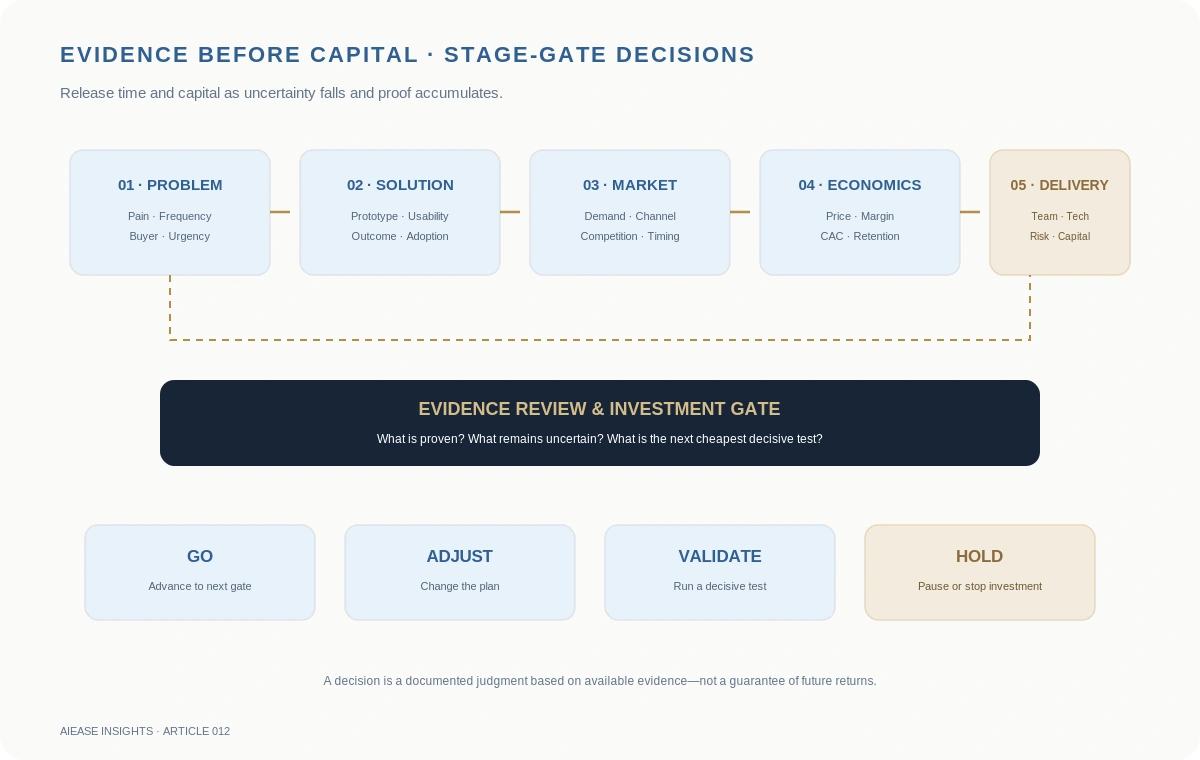
Evidence Before Capital · Stage-Gate DecisionsAccumulate evidence across problem, solution, market, economics and delivery before deciding to GO, ADJUST, VALIDATE or HOLD.AIEASE INSIGHTS · DigiKK
Stage
Main Uncertainty
Investment Focus
Decision Question
Stage
Main Uncertainty
Investment Focus
Decision Question
Discovery
Does the problem exist, and who is affected?
Research, interviews, data and domain experts
Is it worth further validation?
Validation
Do customers need it and will they pay?
Prototype, pilot, sales tests and MVP
Is there real demand evidence?
Build
Can the system be delivered reliably?
Product development, integration, testing and deployment
Is it ready for build or launch?
Growth
Can acquisition and delivery be repeated?
Channels, sales, customer success and operations
Does growth have sustainable unit economics?
Expansion
Can it be replicated across regions, industries or product lines?
Team, infrastructure, compliance and capital
Is the venture ready to scale?
Stage-gate decisions should allow four outcomes. GO means evidence is sufficient to advance. ADJUST means the customer, product or business model needs to change. VALIDATE means a critical assumption still needs testing. HOLD means pausing investment until conditions change. HOLD is not necessarily failure; it can prevent further capital from being spent in the wrong direction.
Fundraising is not a substitute for venture success. Capital can buy time, talent and build capacity, but it cannot replace customer demand, product value or operating outcomes. Founders should explain what the funding will solve, which milestones it will achieve, which assumptions it will test and how the plan will change if results fall short.
12. From Venture Decision to Real Business: Separate Build, Launch and Operate
A venture passing business analysis and a CEO decision only means the current plan has reached the conditions for entering build planning or development. It does not mean the product is complete, the system is live, the market has validated it or revenue has been generated.
The Build stage turns the approved product and system blueprint into a real application through design, development, data and system integration, testing, security, deployment and acceptance. Launch introduces the product to target customers, establishes sales and service processes and collects real usage data. Operate manages ongoing goals, tasks, budgets, agent collaboration, approvals, outcomes and learning.
Stage
Core Responsibility
Completion Signal
Stage
Core Responsibility
Completion Signal
VENTURE
Opportunity research, venture planning, AI system blueprint, CEO decision and build inputs
A reviewable, confirmable and transferable Venture Decision Pack
Build with AIEASE
Engineering, integration, testing, deployment and delivery
A real product or AI system passes acceptance and can run
Launch
Customer onboarding, channels, pricing, sales, support and market validation
Real users begin using it and generate feedback and commercial data
MANAGE / OPERATE
Long-term goals, tasks, agents, approvals, outcomes and continuous improvement
Ongoing operating cycles and measurable business outcomes
Confusing these stages creates unrealistic promises—for example, treating an AI CEO's GO decision as proof of commercial success, or treating an MVP demo as a production launch. Professional venture building must define responsibilities, acceptance criteria and handoff conditions at every stage.
13. Long-Term Advantage: Build Compounding Business Assets, Not Just a Single Product
AI models and development tools will continue to change. A feature advantage today may quickly be replicated by a foundation-model upgrade or a new product. Durable competitiveness must come from harder-to-replace assets and relationships: domain knowledge, lawfully obtained data, workflow-embedded systems, customer trust, brand, distribution, intellectual property, content assets and ongoing service capability.
Domain Knowledge Assets — Capture expert experience, process rules, cases and business judgment in an evolving knowledge system.
Data and Evidence Assets — Accumulate high-quality business data, feedback and research evidence under lawful permissions and clear governance.
Workflow and System Assets — Embed the product into critical customer workflows with reliable integrations, task state and switching costs.
Brand and Customer Assets — Build a trusted brand, durable customer relationships, channels and communities.
IP and Intellectual Property Assets — Protect original software, content, design, characters, trademarks and licensing rights.
Operating and Organizational Assets — Accumulate delivery methods, quality standards, agent collaboration and continuous improvement capabilities.
For AI IP ventures, asset building also means defining character identity, visual and content standards, copyright ownership, licensing scope, derivative products, content operations and cross-market commercialization. For enterprise AI ventures, it means clarifying data rights, customer relationships, system integration, service capability and reusable industry modules. Different venture types require different asset-building paths.
14. AIEASE VENTURE: Connect Opportunity Research, Venture Planning and AI System Design
AIEASE VENTURE is an AI Venture Building Platform powered by an AI CEO and Executive Team working around a real commercial project. It is not generic startup project-management software, and it does not promise to automatically create a successful company. Its responsibility is to turn an initial idea or business need into a project with research evidence, commercial logic, system design and documented decision conditions.
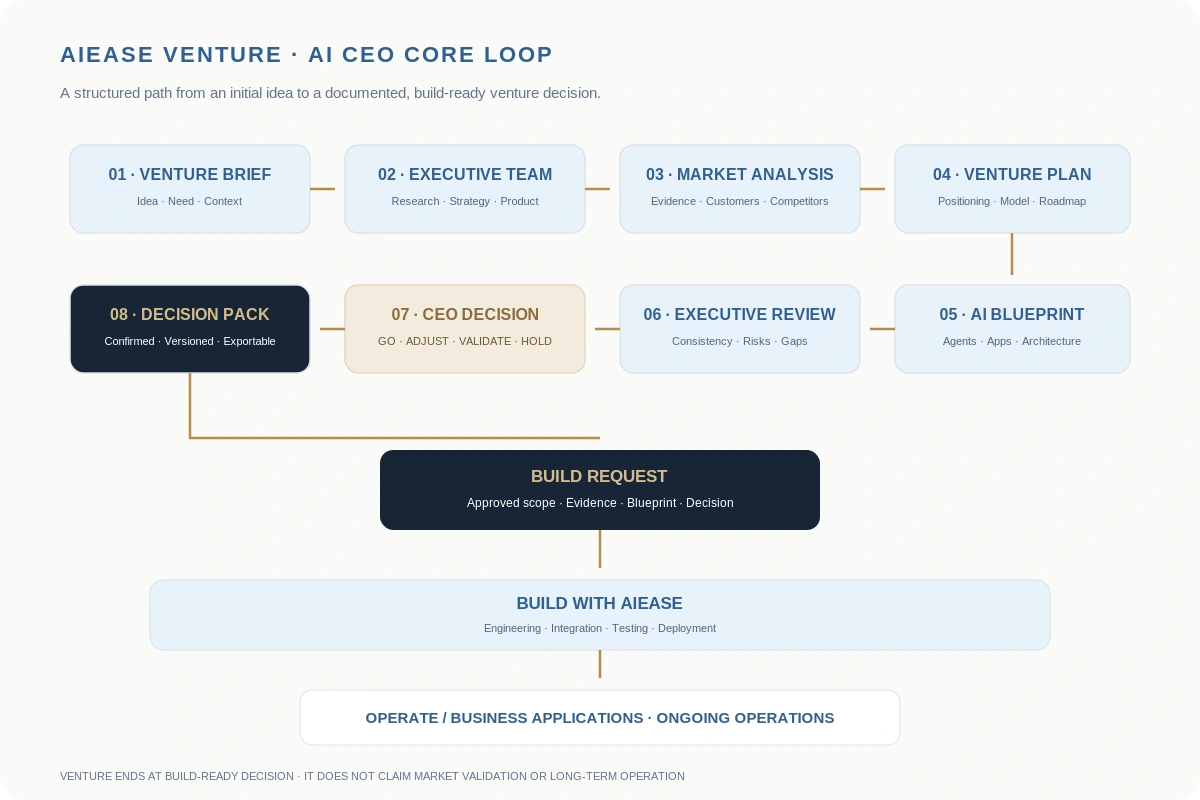
Its core path is: Business Idea or Business Need → Venture Brief → Market Research → Venture Plan → AI System Blueprint → CEO Decision → Venture Decision Pack → Build Request. This helps founders, enterprise leaders and innovation teams assess opportunities, structure the business, plan the product and AI system, and prepare inputs for the next stage of development.
AIEASE VENTURE · AI CEO Core LoopAIEASE VENTURE uses an AI CEO and Executive Team to produce research, venture planning, a system blueprint and a CEO decision. It outputs a Venture Decision Pack and Build Request; engineering and ongoing operations are handled by subsequent stages.AIEASE INSIGHTS · DigiKK
VENTURE produces a market analysis, venture plan, AI system blueprint and CEO decision. The CEO decision uses four outcomes—GO, ADJUST, VALIDATE and HOLD—to indicate whether the current plan is ready for the next stage, needs adjustment, requires further validation or should be paused. Only a confirmed GO can enter the Ready-to-Build state.
This boundary is important. GO means the project plan has met the decision conditions for entering Build. It does not mean development is complete, the system is deployed, customers have been acquired, revenue has been generated or product-market fit has been achieved. VENTURE ends with a build-ready project decision; Build with AIEASE, business applications and MANAGE / OPERATE take over afterward.
AIEASE Component
Role
Value to a Venture
AIEASE Component
Role
Value to a Venture
DI
Market research, data acquisition, evidence and cross-source analysis
Grounds opportunity decisions in traceable research and facts
BASE
Models, agent runtime, knowledge, memory, skills, tools and workflows
Provides reusable AI technology and execution capabilities
VENTURE
AI CEO and Executive Team, venture planning, system blueprint and CEO decision
Turns an idea into a build-ready project with decision evidence
Build with AIEASE / FDE
Dedicated development, integration, testing, deployment and engineering delivery
Turns an approved plan into a real product and system
MANAGE / OPERATE
Long-term goals, tasks, agent collaboration, approvals, outcomes and optimization
Moves the project into ongoing operations and business growth
VOICIE / EASEBIZ and other business applications
IP commercialization, enterprise apps, brand sites, marketing and customer service
Hosts the actual business and assets of different venture types
For founders, VENTURE provides a structured path from idea to decision and build readiness. For enterprises, it supports evaluation of new businesses and AI transformation opportunities. For investors, it can assist project research, proposal comparison and pre-investment assessment. For industrial parks and partners, it can help organize industrial resources, enterprise needs and technical teams into assessable projects.
Conclusion. In the AI Era, the Real Challenge Is Turning Opportunity into a Business That Can Endure
AI is lowering the barriers to research, design, development, content production and operational automation. But it has not removed the fundamentals of building a business: understand customers, solve real problems, establish sustainable economics, earn market trust and keep delivering value.
More AI products, agents, digital services, intelligent brands and industrial ventures will emerge. The ones worth long-term investment will not simply be those that can be generated quickly. They will be assets that customers continue to use and pay for, that can be delivered repeatedly and that accumulate data, brand, intellectual property, domain knowledge and organizational capability.
Founders should validate the problem before building the product. Enterprises should define business value before choosing technology. Investors should examine evidence and unit economics before committing capital. Industry partners should identify real use cases before organizing resources and teams.
AI makes it easier to build a company. Building a business worth operating for the long term still requires judgment, accountability, execution and the ability to create value continuously.
Focused on the intersection of artificial intelligence and business innovation, enterprise intelligence, AI venture building and global business growth.
AI TechnologyBusiness StrategyAI VentureGlobal Growth