The first wave of workplace AI was largely assistant-led. People asked questions, drafted documents, summarized information and received suggestions. That model is useful, but it leaves the human responsible for moving every task to the next step.
AI agents change the relationship. With a defined goal, instructions, access to approved tools and clear boundaries, an agent can carry a task through multiple steps. When work becomes broader or more specialized, multiple agents can collaborate—provided the system has a clear way to coordinate them.
01. From AI Assistant to AI Agent: What Actually Changes?
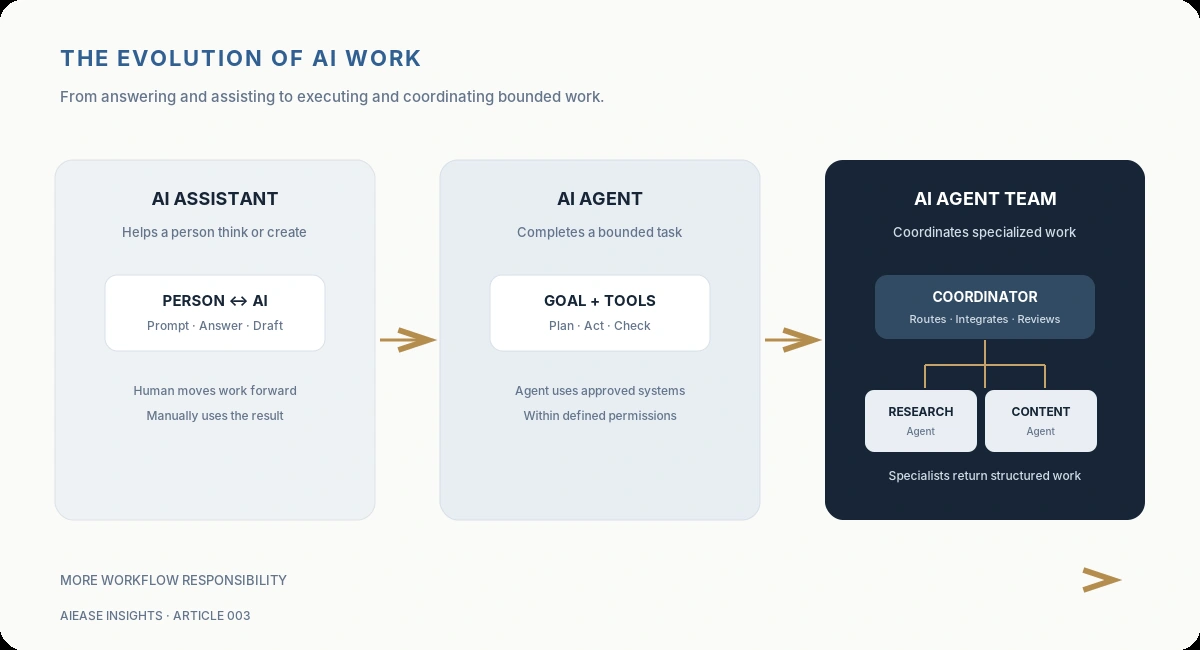
An AI assistant primarily helps a person think or produce an output: it answers, explains, drafts, summarizes or recommends. The person usually decides what happens next and manually carries the result into another system or workflow.
An AI agent is designed to pursue a defined task or outcome. It can interpret instructions, choose from approved tools, retrieve information, take permitted actions, check results and continue until a completion condition or escalation point is reached. The important distinction is not whether the interface looks like a chat window. It is whether the system can control and advance a bounded workflow.
From Assistant to Agent to Agent TeamThe progression is about increasing workflow responsibility and coordination—not simply adding more chatbots.AIEASE INSIGHTS · DigiKK
A practical agent is usually built from three foundations: a model that reasons about the task, tools that let it retrieve information or act on systems, and instructions that define its role and boundaries. Memory, state, orchestration, evaluation and guardrails become important as the workflow grows.
02. Why a Single Assistant Cannot Always Run the Whole Business
A single general-purpose assistant can handle many tasks. It is often the right starting point. But as the work becomes more complex, one agent may have to manage too many instructions, overlapping tools, different business policies and unrelated context.
Consider a global marketing campaign. The work may involve market research, audience analysis, brand compliance, creative development, localization, publishing and performance review. Each discipline uses different sources, standards and tools. A single agent can attempt the whole job, but its instructions and tool surface may become difficult to maintain and evaluate.
OpenAI's agent-building guidance recommends maximizing a single agent's capabilities first, then introducing multiple agents when complex logic, tool overload or separation of responsibilities makes the single-agent design harder to manage. More agents add coordination overhead, more prompts and more places where failures can occur.
Agent adoption is growing—but enterprise scaling is still uneven
40%Respondents at organizations with more than $1B in annual revenue said they were scaling AI agents2026 · McKinsey, State of AI 2026
These figures come from different studies and measurement methods. The 15× figure refers to active agents in Microsoft's ecosystem, not the whole enterprise AI market. Survey responses indicate reported scaling, not independently audited deployment quality.
03. What Makes an Agent Team?
An agent team is more than several agents sharing a conversation. It is a designed system in which each agent has a defined responsibility, a clear input and output contract, the right context and tools, and an explicit relationship to the overall workflow.
A coordinator or workflow owner — Maintains the objective, decides what work should be delegated, tracks dependencies and integrates results.
Specialist agents — Handle bounded tasks such as research, analysis, drafting, coding, customer support or compliance review.
Shared context and trusted knowledge — Provides the relevant business facts, project state, approved sources and decisions without exposing unnecessary data.
Tools and system connections — Allow agents to retrieve information and perform permitted actions in business applications.
Handoffs and output contracts — Define when work moves between agents, what information is passed and what a complete deliverable looks like.
Evaluation and human oversight — Check quality, cost, permissions, traceability and escalation before consequential actions.
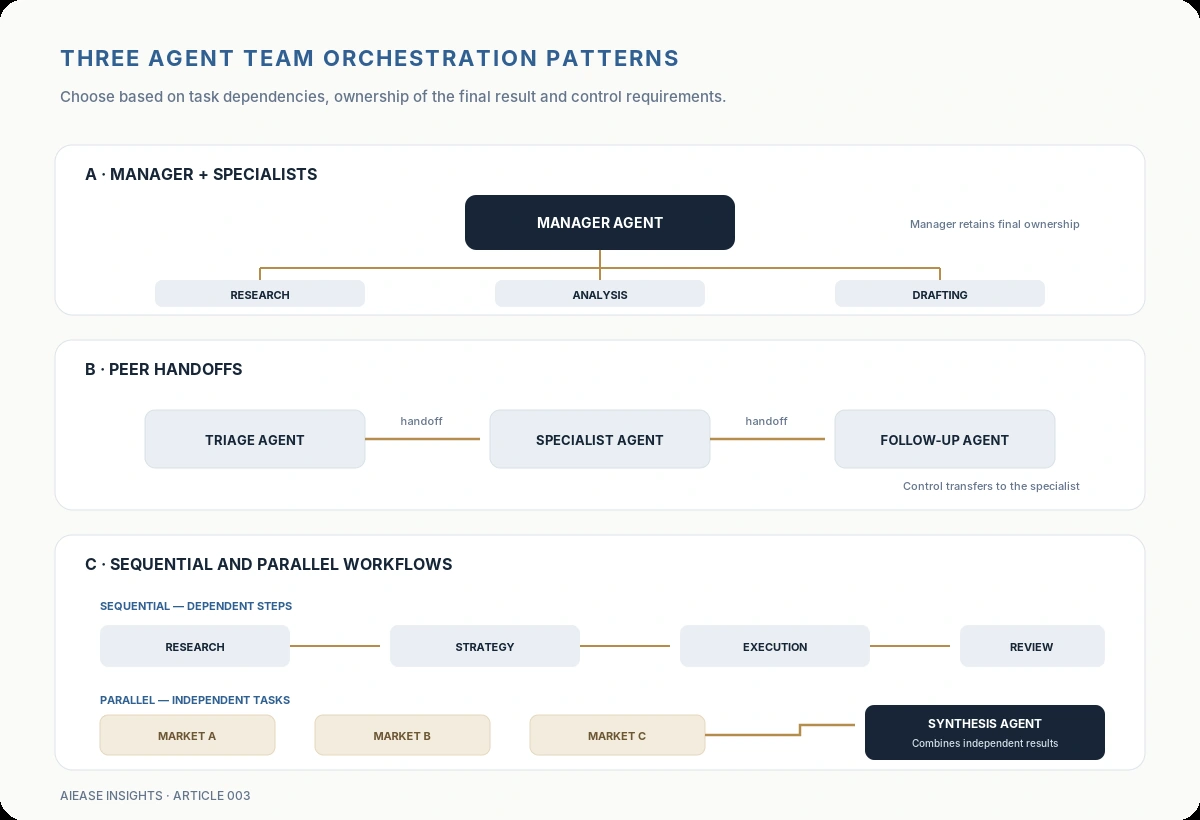
Three Agent Team Orchestration PatternsChoose the orchestration pattern based on who should own the final result, whether tasks are independent and where control must remain.AIEASE INSIGHTS · DigiKK
04. Three Ways to Coordinate Multiple Agents
Pattern A — Manager and Specialists
A manager agent owns the overall task and calls specialist agents as bounded capabilities. Specialists return structured results; the manager checks and combines them into one response or deliverable. This is useful when the user should have one consistent point of contact and one agent must retain responsibility for the final answer.
Pattern B — Handoffs Between Specialists
A routing or triage agent can transfer control to a specialist when a task enters that specialist's domain. The specialist takes over the next stage, and may hand the task back when its part is complete. This is useful when a specialist needs to own the conversation or execution branch rather than merely provide an internal analysis.
Pattern C — Sequential and Parallel Workflows
Some work is naturally sequential: research must be completed before a strategy is drafted, and a draft must be approved before publication. Other work can happen in parallel: several agents can independently review different markets, documents or product lines, after which a coordinator synthesizes the findings. Parallel work can reduce elapsed time, but it requires clear task boundaries and a reliable synthesis step.
05. Where Agent Teams Can Create Business Value
Agent teams are most useful when work spans distinct areas of expertise, multiple systems or several review stages. The following are practical business patterns—not a claim that every function should be fully autonomous.
Business area
Example agent roles
Human responsibility
Market intelligence
Research agent · Data analyst · Strategy synthesizer
Validate evidence, set priorities and approve strategic decisions
Approve payments, accounting treatment and consequential actions
For example, a campaign workflow might begin with a research agent gathering approved market evidence. A strategy agent turns the evidence into a campaign brief. A content agent creates drafts using the brand knowledge base. A review agent checks factual claims and brand rules. A localization agent adapts approved content for each market. A publishing workflow then waits for a human approval before distribution. Performance data feeds the next planning cycle.
06. The Operating Contract: How to Make Agents Reliable
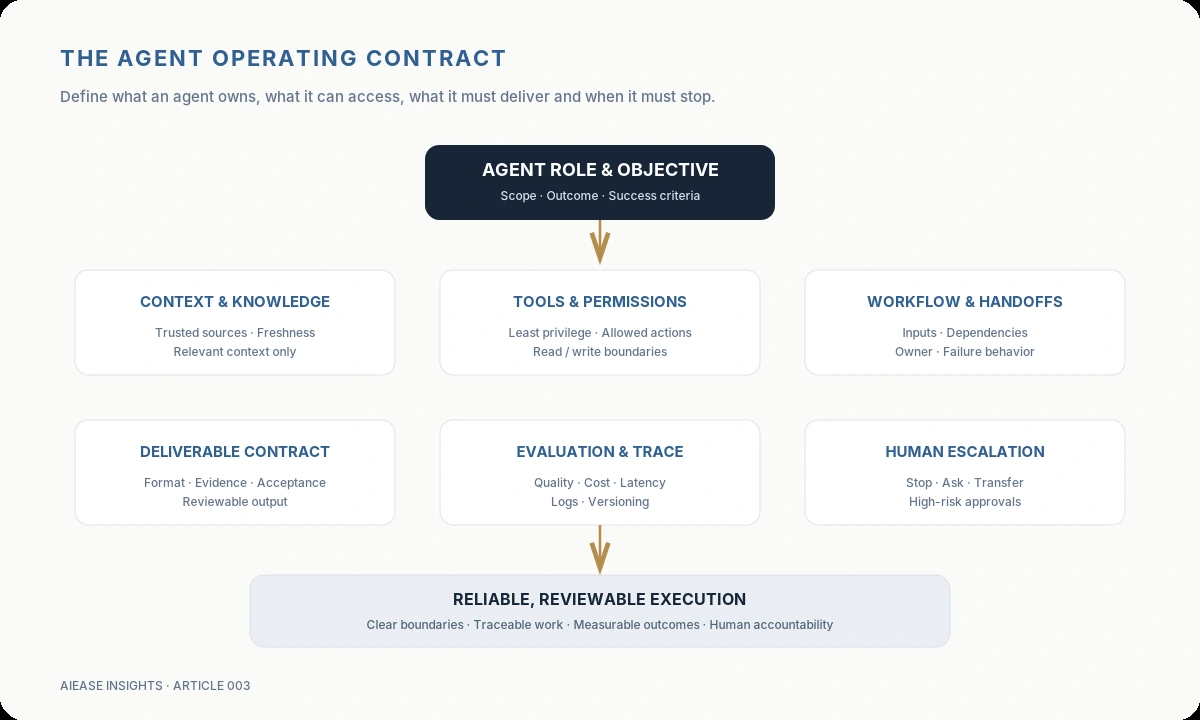
A job title such as Research Agent or Sales Agent is not enough. Every agent needs an operating contract that makes its responsibilities and limits explicit.
The Agent Operating ContractReliable agents need more than prompts: they need defined scope, trusted context, controlled tools, reviewable outputs and escalation rules.AIEASE INSIGHTS · DigiKK
Role and objective — What outcome is the agent responsible for, and what is explicitly outside its scope?
Context and knowledge — Which sources are trusted, current and relevant to the task?
Tools and permissions — Which systems can it read, write or trigger, and under what conditions?
Output contract — What format, evidence, fields or acceptance criteria must the deliverable contain?
Failure and escalation — When should the agent stop, retry, ask for clarification or transfer to a person?
Evaluation and observability — How are quality, latency, cost, tool calls, errors and handoffs measured and reviewed?
07. Governance: More Agents Require More Control, Not Less
An agent team can multiply both productivity and mistakes. A weak assumption passed between several agents may become a polished but incorrect final recommendation. A poorly scoped tool can create unauthorized changes. A missing audit trail can make it difficult to understand why an action occurred.
Governance should be built into the system: unique agent identities, least-privilege access, scoped credentials, separation of duties, traceable runs, versioned instructions, evaluations, rate and cost limits, and human approval for sensitive or irreversible actions.
High-impact actions—such as payments, contractual commitments, access changes, deletion of important records or external publication—should have explicit authorization and human review appropriate to their risk. Human oversight is not a temporary weakness in automation. It is part of a reliable operating model.
The goal is not maximum autonomy. The goal is dependable delegation: the right work, to the right agent, with the right context, permissions and review.
DigiKK · AIEASE AI CEO
08. A Practical Roadmap: Start Small, Then Build the Team
Choose one valuable workflow — Select a task with clear business value, enough repeatability and a measurable baseline.
Build a capable single agent first — Give it clear instructions, the minimum required tools and a bounded scope. Test it on real examples.
Identify the actual bottleneck — Determine whether failures come from unclear instructions, poor tools, missing context, policy conflicts or genuinely distinct specialist work.
Split only where separation helps — Introduce a specialist when it improves expertise, policy isolation, tool clarity, independent evaluation or traceability.
Define orchestration and handoffs — Choose a manager, handoff, sequential or parallel pattern. Specify inputs, outputs, ownership and failure behavior.
Add governance and evaluation — Measure quality, cost, latency, completion, escalation and business outcomes. Require approval for consequential actions.
Expand through learning — Capture successful workflows, failure cases and reviewed knowledge. Scale only after reliability is demonstrated.
09. The AIEASE Perspective: From Individual Agents to Business Teams
At AIEASE, we see agent teams as a way to organize AI capability around real business work. The foundation is not simply a collection of role-playing agents. It is a shared capability layer, trusted data, reusable skills and tools, workflow orchestration and operating governance.
BASE — AI Capability Layer — Provides agents, models, RAG, workflows, skills, tools, runtime and governance capabilities.
DI — Data Intelligence — Provides data acquisition, research, evidence, metrics and cross-source intelligence for agent work.
AIEASE VENTURE — Uses AI CEO and Executive Team capabilities to research opportunities, structure business plans and coordinate venture-building work.
EASEBIZ & Business Applications — Connects AI assistants and agents to business communication, CRM, customer service and collaboration workflows.
AI Content Marketing Cloud — Coordinates brand research, campaign planning, content production, review, publishing and performance feedback.
VOICIE — Intelligent IP Economy — Applies specialized agents to IP creation, asset operations, content production and commercialization.
Focused on the intersection of artificial intelligence and business innovation, enterprise intelligence, AI venture building and global business growth.
AI TechnologyBusiness StrategyAI VentureGlobal Growth