Traditionally, businesses managed brands through positioning documents, brand guidelines, visual identity systems, product information and marketing materials. These assets remain essential, but they are often scattered across documents, drives, design tools, teams and agencies. Brand leaders may know how the brand should be expressed, while the people and partners creating content may struggle to find the right version or understand which information is approved.
Generative AI makes content production faster, but it also creates new challenges for brand management. AI can quickly produce advertising copy, product descriptions, images, videos and customer conversations. Yet if it does not understand brand positioning, product facts, visual rules and market boundaries, producing more content can also produce more inconsistency.
The goal of intelligent branding is not to let AI invent a brand on the company's behalf. It is to make the company's existing brand knowledge, product facts, creative assets and governance rules structured capabilities that AI can understand, retrieve, use and apply accurately.
AI adoption is accelerating, but execution remains uneven
96%CMOs said AI is driving end-to-end transformation of marketing2026 · BCG
42%Still use GenAI mainly as an assistant for discrete tasksBCG
83%Creators still apply brand assets or rules manually, even with templates2026 · Visme
55%Marketers trust AI recommendations but still require human review2026 · Nielsen
These findings come from different organizations, samples and methodologies and should not be compared as if they were one survey. BCG's 96% and 42% figures come from the same survey of 300 global CMOs; Visme surveyed 607 mid-market brand owners and content creators; Nielsen's figure comes from its annual marketing survey.
01. Brand Management Is Moving from Visual Guidelines to Intelligent Governance
A brand has never been just a logo, a color palette or a typeface. It is the promise a company makes to customers, expressed through product value, service experience, organizational culture and market perception. Visual identity is only one part of brand expression. Long-term trust depends on whether the company consistently delivers on its promise across touchpoints.
Historically, brand guidelines primarily governed how people designed and communicated. Today, brands must also govern how AI interprets information, selects assets, generates content, answers customers and executes marketing tasks. The participants shaping brand expression now extend beyond employees, designers and agencies to include generative models, service agents, sales agents, recommendation systems and emerging shopping agents.
Gartner's 2026 research on AI-enabled brand governance notes that many initiatives focus on consistency across content assets, while the full brand experience also includes sales and service interactions. Brand governance therefore needs to extend beyond files and campaigns to the complete customer experience.
02. What Is an Intelligent Brand Asset System?
An intelligent brand asset system is a unified way to manage and use brand identity, product facts, creative assets, knowledge structures, usage rights and AI workflows. It enables different roles, business systems and AI agents to use the right brand information and assets within clearly defined permissions and version boundaries.
It is not simply uploading a brand manual into a knowledge base, nor is it just a digital asset management (DAM) repository. A brand manual tells people the rules; a DAM stores and distributes files. An intelligent brand asset system also understands relationships between assets, their intended use, current versions, rights and the AI tasks that may rely on them.
Traditional Brand Management
Intelligent Brand Asset System
What Changes
Brand manuals and scattered documents
Structured, searchable and versioned brand knowledge
People and AI can retrieve trusted guidance
Shared drives and asset folders
Assets with metadata, relationships, rights and usage scope
The right asset is used in the right context
Manual brand consistency checks
Rules applied before, during and after generation
Less rework and fewer brand deviations
Separate production for every channel
Multi-channel content driven by shared brand context
Scale expression without losing consistency
Traffic checks after publishing
Feedback from content, channels, customers and business outcomes
A continuous brand operating loop
The purpose is not to turn every creative idea into a rigid template. It is to distinguish the brand elements that must remain stable from the expressions that can adapt to markets, campaigns and audiences.
03. Layer One: Brand DNA—Teaching AI What the Brand Stands For
Brand DNA is the foundation of the system. It should be more than a short company description. It needs to structure the positioning, value promise, differentiation, audience relationship and expression boundaries the company intends to preserve over time.
Positioning and Value Proposition — Who the brand serves, what problem it solves, what distinctive value it offers and why customers should choose it.
Mission and Values — The principles, attitudes and decision criteria the business intends to uphold over time.
Audience and Relationship — Core customer groups, needs, perceptions, use cases and the relationship the brand wants to build.
Personality and Voice — Whether the brand is expert, approachable, pioneering, dependable or playful—and how that changes by context.
Differentiation and Competitive Boundaries — What makes the brand distinct and which core perceptions must not be diluted.
Expression and Promise Boundaries — What must not be said, which promises must not be made and which claims require evidence.
Brand DNA should also distinguish invariants from configurable elements. Positioning, core values, product facts and essential visual identity are usually stable. Campaign themes, channel tone, market language, content formats and creative styles can adapt within defined rules.
04. Layer Two: Product Truth—Making AI Accurate, Not Just Persuasive
Brand expression ultimately has to be grounded in products and services. If AI does not understand actual features, specifications, prices, intended users, limitations, after-sales policies and supporting evidence, it may generate marketing content that sounds convincing but is inaccurate.
Brand knowledge should therefore manage brand promises separately from product facts. A brand may communicate value persuasively, but it must not invent product capabilities or alter prices, specifications, certifications, eligibility or service commitments.
Product Master Data — Names, models, versions, specifications, features, materials, compatibility and product status.
Commercial Information — Prices, plans, inventory, sales territories, delivery terms and promotion validity.
Proof and Evidence — Test reports, certifications, case studies, customer reviews, research and approved public evidence.
Usage and Limitations — Intended users, conditions, risk notices, prohibited use cases and after-sales policies.
Version and Effective Date — Record the source, owner, review status, update time and applicable scope for every fact.
05. Layer Three: Visual and Creative Assets—Preserving Recognition Across Media
AI image and video generation lowers the barrier to creative production, but it also increases the risk of visual drift. Models may alter product details, logo proportions, character identity, brand colors and visual style. Different teams using different reference images and prompts can make one brand look like several unrelated brands.
Asset Category
Assets to Manage
Critical Metadata
Brand Identity
Logos, marks, color palettes, typefaces and icons
Version, format, minimum size and prohibited use
Visual System
Photography, composition, lighting, materials, illustration and graphic language
Style rules, reference examples and intended use
Product Media
Product photos, packaging, detail shots, lifestyle images and 3D models
Product model, capture version and factual detail
People and IP
Brand ambassadors, digital humans, characters, models and voices
Identity consistency, license scope, image and voice rights
Content Templates
Advertising, social, video, email, landing pages and sales materials
Dimensions, channel, language and editable zones
Audio and Video
Music, sound effects, voiceover, clips and animation
Copyright, territory, term, platform and purpose
An asset library should go beyond folders. It should record the relevant product, market, language, channel, rights holder, license term, commercial use, derivative-use permission and whether AI training or generation reference is permitted. This is especially important for real-person likenesses, digital humans, music and third-party materials.
06. Layer Four: Brand Knowledge Architecture—Helping AI Retrieve the Right Context
Putting files into a knowledge base does not guarantee that AI will use them correctly. AI needs to know what each item describes, which product and market it applies to, whether it is still valid, who approved it and how it relates to other assets.
An intelligent brand asset system therefore needs both structured data and unstructured content. Structured fields support precise filtering and permission checks; documents, images, videos and descriptions support semantic retrieval and contextual understanding. Both are connected through shared identifiers for brands, products, campaigns and assets.
Stable Identifiers — Give brands, sub-brands, products, collections, markets, campaigns, people and assets stable IDs.
Core Metadata — Language, territory, channel, audience, version, validity, status, rights and reviewer.
Asset Relationships — Connect brands to products, products to media, campaigns to templates, people to licenses and content to evidence.
Source and Provenance — Preserve original files, fact sources, revision history, approvals and generation records.
Retrieval with Permissions — Retrieved information must be relevant and also valid for the task's market, version, permissions and license scope.
07. Layer Five: Brand Agents—Bringing Brand Knowledge into Real Workflows
Once brand knowledge and assets are structured, AI can take on specialized work within defined boundaries. A brand agent should be more than a chatbot that answers questions about the brand. It should collaborate around specific brand-operating tasks.
Brand Strategy Agent — Use market, audience and positioning context to support brand strategy, campaign direction and communication priorities.
Brand Knowledge Agent — Retrieve guidelines, product facts, licensed assets and approved content to provide trusted context to other agents.
Creative Agent — Develop concepts, copy, visual directions and production briefs from campaign goals, Brand DNA and references.
Content Production Agent — Create copy, images, short-video scripts, advertising assets, localized versions and channel adaptations.
Brand Review Agent — Check voice, product facts, visual rules, rights and prohibited claims; flag issues and suggest revisions.
Localization Agent — Adapt content for the target market's language, culture, regulations and channels rather than translating mechanically.
Publishing and Analytics Agent — Distribute content after authorization and approval, then consolidate channel performance, leads and conversion data for review.
These agents do not all need to run independently, and they should not automatically have permission to publish, change prices, modify product facts or make external commitments. They can be invoked by a shared marketing workflow, perform bounded responsibilities and hand work to a brand owner at critical approval points.
08. Brand Content Operations: From One-Off Creation to Continuous Production
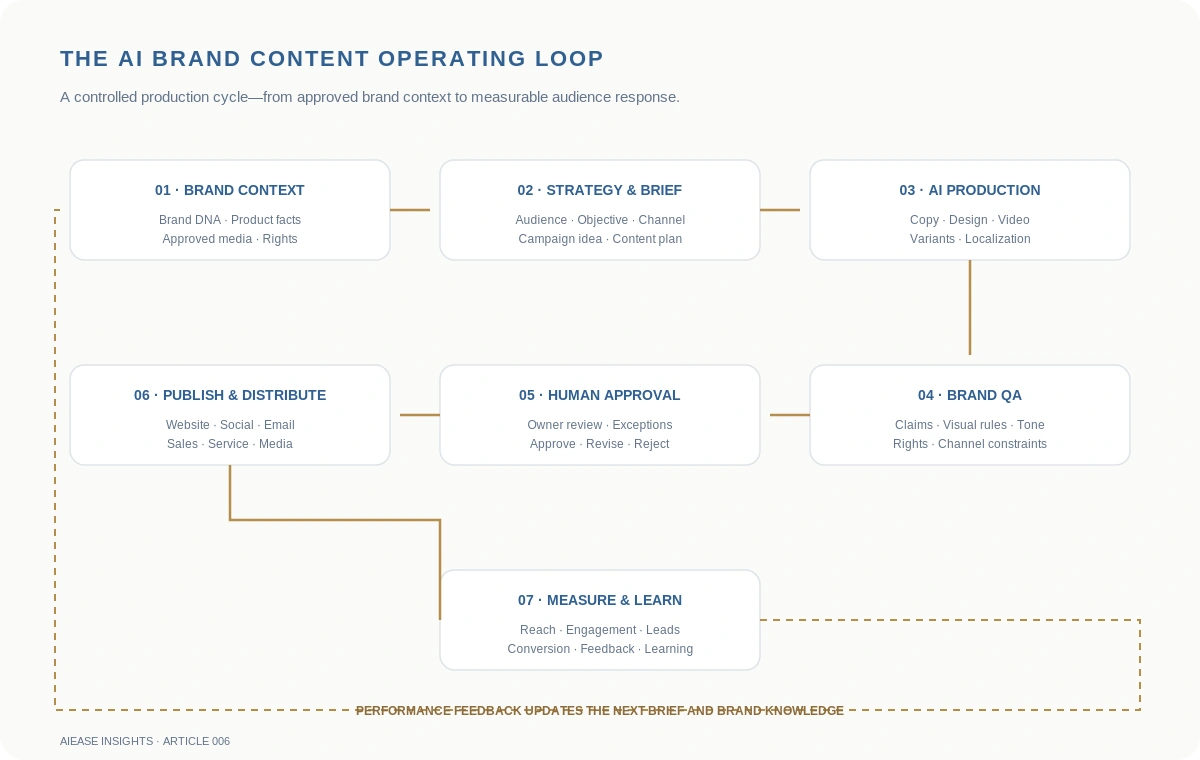
Scalable brand content production is not about asking AI to generate large volumes of images and copy in one go. It is about creating a repeatable process from brand context to content delivery and performance feedback. Every task should define the audience, product facts, approved assets, content format, channel specifications, review requirements and intended outcome.
The AI Brand Content Operating LoopStart with brand knowledge, product facts and approved assets; move through strategy, production, brand review, human approval, publishing and performance learning.AIEASE INSIGHTS · DigiKK
This process allows a brand to produce content in different lengths, formats and market versions around one campaign theme while preserving its core promise, product facts and visual identity. Content is no longer an isolated file; it becomes a long-term asset connected to the brand, product, campaign, channel and performance data.
09. Brand Consistency Cannot Depend Only on Manual Checks Before Publishing
If brand rules are checked only after content is complete, many problems have already occurred. AI may have used outdated product information, a designer may have selected the wrong logo, a generated image may have changed the product, copy may include unsupported performance claims, or an asset may be outside its license term.
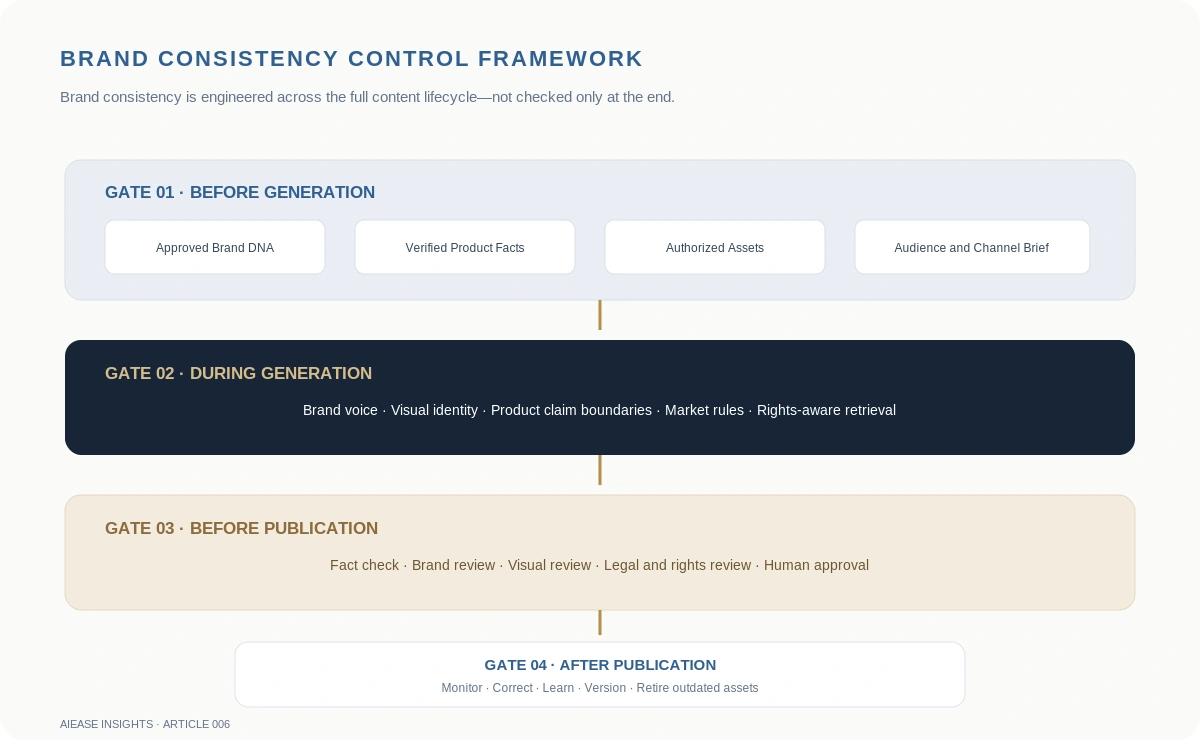
Brand consistency should be governed throughout the lifecycle, with at least four control gates.
Brand Consistency Control FrameworkBefore generation, confirm Brand DNA, product facts, licensed assets and the brief. During generation, apply voice, visual and market rules. Before publication, review facts, rights, legal constraints and human approval. After publication, monitor, correct and update versions.AIEASE INSIGHTS · DigiKK
Before Generation: Control Inputs — Provide only current brand knowledge and licensed assets relevant to the product, market, channel and task.
During Generation: Control the Process — Apply voice, visual references, product facts, prohibited claims and channel rules to the generation process.
Before Publication: Control Outputs — Check factual accuracy, brand expression, visual consistency, rights, regulations and platform requirements; obtain owner approval.
After Publication: Control Change — Monitor feedback, incorrect content, expired assets and channel performance; withdraw, revise or update versions when needed.
Google Search Central also emphasizes accuracy, quality and relevance for AI-generated content, with manual fact-checking before publication. Producing large volumes of pages without added user value may violate its scaled-content-abuse policies. The more powerful AI production becomes, the more important review, provenance and accountability become.
10. Global Brand Operations: Preserve the Core, Adapt to Each Market
Global branding is not simply translating one Chinese campaign into ten languages, nor is it replacing the text on one poster. Consumer perceptions, cultural context, purchasing habits, regulations, channel specifications and payment methods can differ substantially across markets.
An intelligent brand asset system must manage both a globally consistent brand core and approved local expressions. Positioning, core promises and essential visual identity should remain consistent, while language, examples, prices, product bundles, promotions and channel content adapt to each market.
Global Brand Core — Keep positioning, core values, visual identity, product promises and non-negotiable expression boundaries consistent.
Market Profiles — Maintain language, culture, regulations, channels, currency, customer preferences and local owners for each market.
Localized Product Truth — Manage product versions, prices, inventory, certifications, service and sales policies by market.
Local Creative Adaptation — Adapt content to local audiences, culture and media habits rather than translating word for word.
Regional Approval — Have local owners review content involving culture, regulations, products and commercial commitments.
A brand can express itself differently across markets without creating contradictory product facts or promises. The key to multilingual brand management is to localize within clearly defined rules and factual boundaries.
11. Brand Asset Governance: Rights, Versions, Ownership and Traceability
Brand assets are not merely creative resources. They may include trademarks, copyrights, image rights, voice rights, music licenses, product photography and third-party materials. AI makes reuse and adaptation easier, but it does not automatically expand the original license.
Rights Metadata — Record rights holder, license type, territory, term, medium, commercial use, derivative rights and AI-use scope.
Version Ownership — Define who can create, edit, review, publish, retire and restore each class of brand asset.
Approval History — Preserve reviewers, dates, comments, revisions and final approval records.
AI Provenance — Record the knowledge version, reference assets, model, prompt and human edits used by a generation task.
Retirement and Revocation — Prevent future tasks from retrieving expired, withdrawn or obsolete assets.
This is why a brand asset system needs clear owners and permissions. AI can help detect issues, inspect assets and make recommendations, but trademark use, major marketing claims, compliance statements and external publication still require accountable, authorized people.
12. Measuring Intelligent Branding: From Asset Health to Business Outcomes
Intelligent branding should not be measured only by how many assets were generated or how much design time was saved. Enterprises need to know whether brand assets are complete and trustworthy, whether AI retrieves the right information, whether content remains consistent and whether the work improves brand perception and business outcomes.
A 2026 study by Fudan University's research team, based on a global sample of 200 brands, introduced an AI Brand Health Index and a C-B-A framework: Tier C assesses digital asset health, Tier B examines whether content mechanisms align with how AI processes information, and Tier A measures how the brand appears across AI endpoints. The study emphasizes that the quality of foundational assets constrains higher-level performance.
Measurement Layer
Example Metrics
Management Question
Asset Health
Brand profile completeness, factual accuracy, current-version rate, rights coverage
Are brand assets complete, trustworthy and usable?
Knowledge Health
Retrieval hit rate, source coverage, outdated-content ratio, update latency
Does AI retrieve the right and current brand knowledge?
Do teams and channels express the brand correctly?
Content Operations
Production cycle time, cost per asset, reuse rate, localization turnaround
Is brand content delivered faster and more reliably?
Brand and Business Impact
Brand awareness, AI-search representation, qualified leads, conversion, retention and ROI
Are brand assets creating customer and business value?
Brand representation in AI search and generated answers can also be monitored, but a single model response should not be treated as a stable ranking. Different models, user contexts, regions and times may produce different results. Enterprises should sample consistently, record sources, analyze changes and combine these observations with website, customer and business data.
13. AIEASE: From Brand Assets to AI-Powered Brand Operations
Within AIEASE, intelligent brand assets are not an isolated file-management module. They are a shared business foundation that the content marketing platform and enterprise agents can use. Brand knowledge, product facts, visual assets, licensed media and brand rules are organized into a unified context, then BASE agents and workflows support planning, production, review, publishing and performance feedback.
Brand Foundation — Maintain Brand DNA, product knowledge, evidence sources, brand rules, versions and market configurations.
Creative Asset Library — Manage logos, visual systems, product media, character IP, audio and video, templates and licenses.
BASE Agent Layer — Provide agents for brand retrieval, marketing strategy, content creation, brand review, localization and publishing collaboration.
AI Content Marketing Cloud — Connect brand knowledge, marketing tasks, image and video production, human review, channel delivery and performance analysis.
BIZSTORE and Brand Sites — Extend brand content and product truth to independent websites, product pages, customer service and global commerce touchpoints.
BIZGEO and DI — Combine data research, search and AI visibility analysis to understand how brand information is discovered, understood and cited.
MANAGE — Track operating metrics, content tasks, costs, customer feedback and business outcomes over time.
Conclusion. The Future Brand Advantage Is an Intelligent Asset That Keeps Working
In the AI era, a brand no longer exists only in its brand manual, advertising and website. It also exists in AI conversations, product recommendations, digital employees, customer service, content production and agent-assisted shopping journeys.
Businesses need to connect brand identity, product facts, creative assets, knowledge structures, usage rights and workflows so that both people and AI can understand and express the brand in the right context.
An intelligent brand is not one that simply generates more content. It is one whose every expression is more accurate, consistent and valuable—and whose capabilities continue to evolve through real customer feedback and business outcomes.
The value of brand assets is not measured by how many files a company owns, but by whether the right knowledge and creative capabilities work in every customer interaction.
Focused on the intersection of artificial intelligence and business innovation, enterprise intelligence, AI venture building and global business growth.
AI TechnologyBusiness StrategyAI VentureGlobal Growth